




























APOD
Astronomy Picture of the Day
Discover the cosmos! Each day a different image or photograph of our fascinating universe is featured, along with a brief explanation written by a professional astronomer.
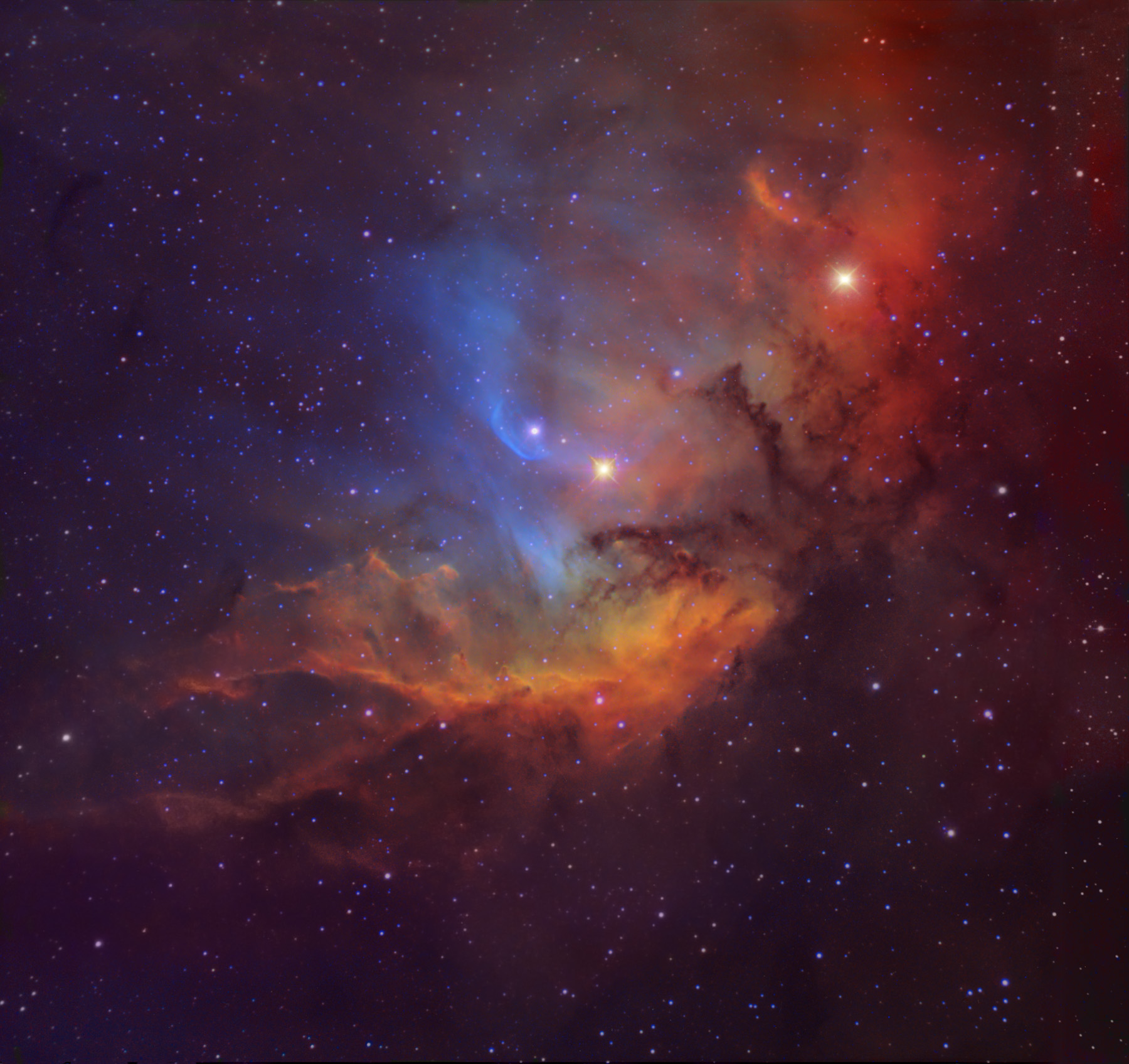
The Tulip in the Swan
Explanation: Framing a bright emission region this telescopic view looks out along the plane of our Milky Way Galaxy toward the nebula rich constellation Cygnus the Swan . Popularly called the Tulip Nebula the glowing cloud of interstellar gas and dust is also found in the 1959 catalog by astronomer Stewart Sharpless as Sh2-101 . About 8,000 light-years distant the nebula is understandably not the only cosmic cloud to evoke the imagery of flowers . The complex and beautiful nebula is shown here in a composite image that maps emission from ionized sulfur, hydrogen, and oxygen atoms into red, green, and blue colors. Ultraviolet radiation from young, energetic O star HDE 227018 ionizes the atoms and powers the emission from the Tulip Nebula. HDE 227018 is the bright star very near the blue arc at image center.
| Date | July 26, 2012 |
|---|---|
| Credit | Image Credit & Copyright: Michael Joner, David Laney ( West Mountain Observatory , BYU); Processing - Robert Gendler |
| Authors & editors: | Robert Nemiroff (MTU) & Jerry Bonnell (UMCP) |
| A service of: |
ASD at NASA / GSFC, NASA Science Activation & Michigan Tech. U. |