



























APOD
Astronomy Picture of the Day
Discover the cosmos! Each day a different image or photograph of our fascinating universe is featured, along with a brief explanation written by a professional astronomer.
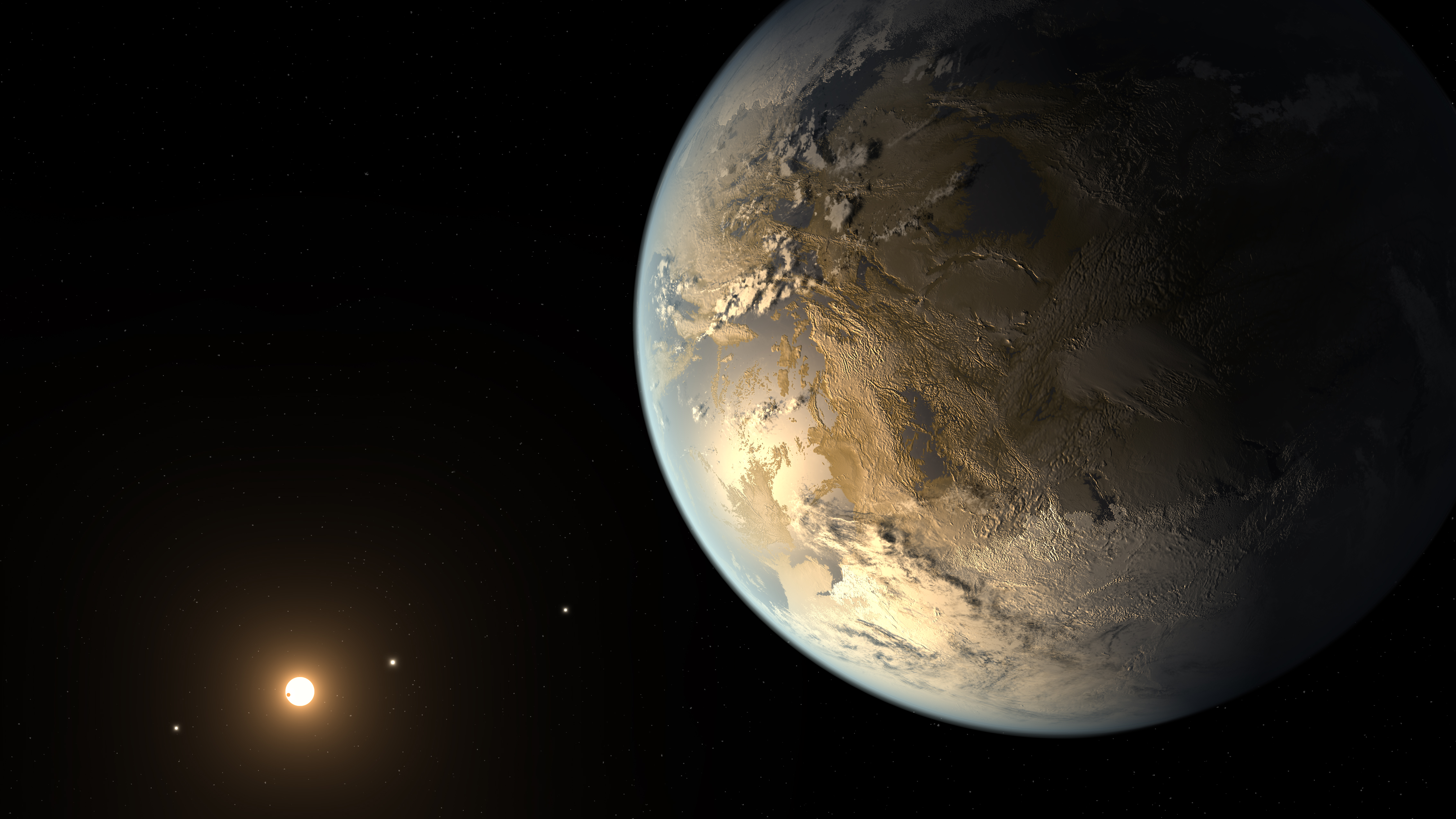
Earth-size Kepler-186f
Explanation: Planet Kepler-186f is the first known Earth- size planet to lie within the habitable zone of a star beyond the Sun. Discovered using data from the prolific planet-hunting Kepler spacecraft , the distant world orbits its parent star, a cool, dim, M dwarf star about half the size and mass of the Sun, some 500 light-years away in the constellation Cygnus. M dwarfs are common , making up about 70 percent of the stars in our Milky Way galaxy. To be within the habitable zone , where surface temperatures allowing liquid water are possible, Kepler-186f orbits close , within 53 million kilometers (about the Mercury-Sun distance) of the M dwarf star, once every 130 days. Four other planets are known in the distant system. All four are only a little larger than Earth and in much closer orbits, also illustrated in the tantalizing artist's vision. While the size and orbit of Kepler-186f are known, its mass and composition are not, and can't be determined by Kepler's transit technique . Still, models suggest that it could be rocky and have an atmosphere, making it potentially the most Earth-like exoplanet discovered so far ...
| Date | April 19, 2014 |
|---|---|
| Credit | Illustration Credit: NASA Ames / SETI Institute / JPL-Caltech , Discovery: Elisa V. Quintana, et al. |
| Authors & editors: | Robert Nemiroff (MTU) & Jerry Bonnell (UMCP) |
| A service of: |
ASD at NASA / GSFC, NASA Science Activation & Michigan Tech. U. |