





















APOD
Astronomy Picture of the Day
Discover the cosmos! Each day a different image or photograph of our fascinating universe is featured, along with a brief explanation written by a professional astronomer.
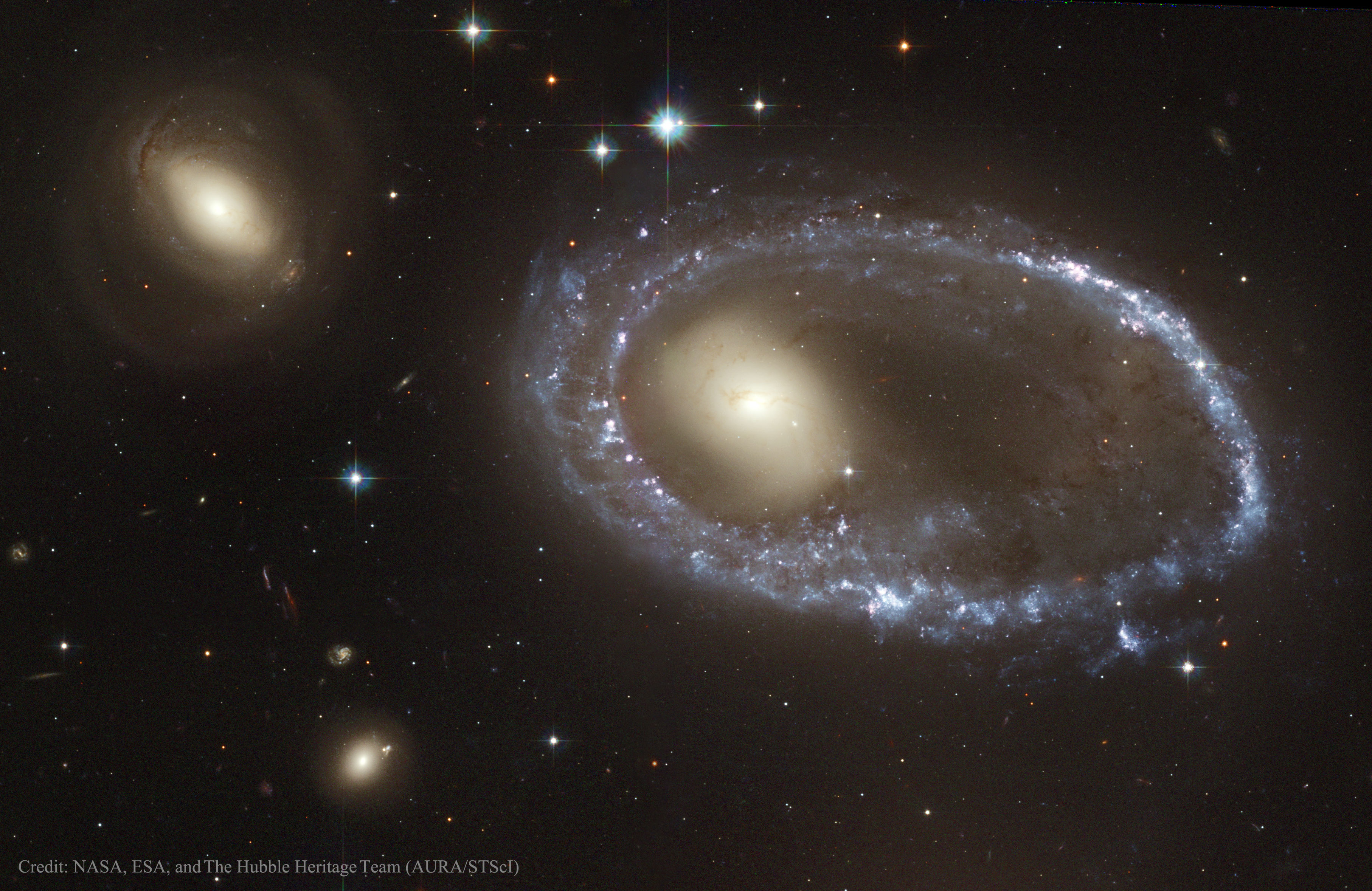
Ring Galaxy AM 0644-741 from Hubble
Explanation: How could a galaxy become shaped like a ring? The rim of the blue galaxy pictured on the right is an immense ring-like structure 150,000 light years in diameter composed of newly formed, extremely bright, massive stars. That galaxy, AM 0644-741 , is known as a ring galaxy and was caused by an immense galaxy collision. When galaxies collide , they pass through each other -- their individual stars rarely come into contact. The ring -like shape is the result of the gravitational disruption caused by an entire small intruder galaxy passing through a large one. When this happens, interstellar gas and dust become condensed, causing a wave of star formation to move out from the impact point like a ripple across the surface of a pond. The intruder galaxy is just outside of the frame taken by the Hubble Space Telescope . This featured image was taken to commemorate the anniversary of Hubble's launch in 1990. Ring galaxy AM 0644-741 lies about 300 million light years away.
| Date | April 19, 2015 |
|---|---|
| Credit | Image Credit: Hubble Heritage Team ( AURA / STScI ), J. Higdon ( Cornell ) ESA , NASA |
| Authors & editors: | Robert Nemiroff (MTU) & Jerry Bonnell (UMCP) |
| A service of: |
ASD at NASA / GSFC, NASA Science Activation & Michigan Tech. U. |