



























APOD
Astronomy Picture of the Day
Discover the cosmos! Each day a different image or photograph of our fascinating universe is featured, along with a brief explanation written by a professional astronomer.
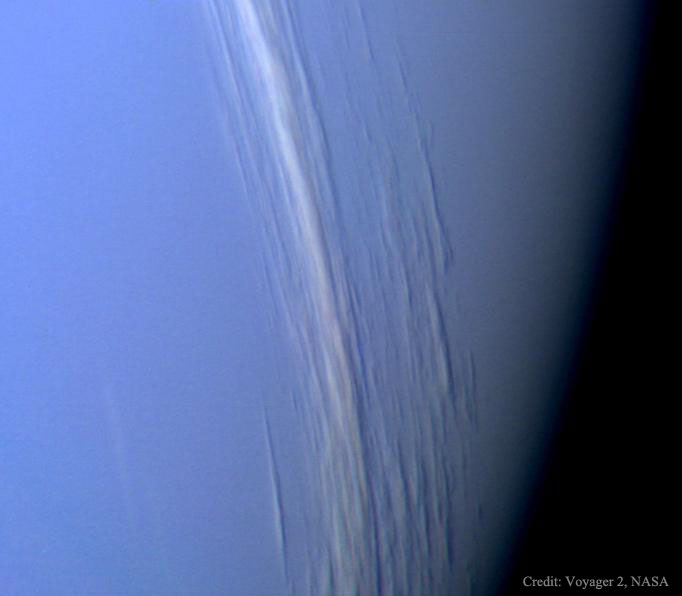
Two Hours Before Neptune
Explanation: Two hours before closest approach to Neptune in 1989, the Voyager 2 robot spacecraft snapped this picture . Clearly visible for the first time were long light-colored cirrus -type clouds floating high in Neptune's atmosphere . Shadows of these clouds can even be seen on lower cloud decks. Most of Neptune's atmosphere is made of hydrogen and helium , which is invisible. Neptune 's blue color therefore comes from smaller amounts of atmospheric methane , which preferentially absorbs red light. Neptune has the fastest winds in the Solar System , with gusts reaching 2000 kilometers per hour. Speculation holds that diamonds may be created in the dense hot conditions that exist under the cloud tops of Uranus and Neptune . Twenty-six years later, NASA 's New Horizons is poised to be the first spacecraft to zoom past Pluto this July.
Almost Hyperspace: Random APOD Generator
| Date | February 15, 2015 |
|---|---|
| Credit | Image Credit: Voyager 2, NASA |
| Authors & editors: | Robert Nemiroff (MTU) & Jerry Bonnell (UMCP) |
| A service of: |
ASD at NASA / GSFC, NASA Science Activation & Michigan Tech. U. |