


























APOD
Astronomy Picture of the Day
Discover the cosmos! Each day a different image or photograph of our fascinating universe is featured, along with a brief explanation written by a professional astronomer.
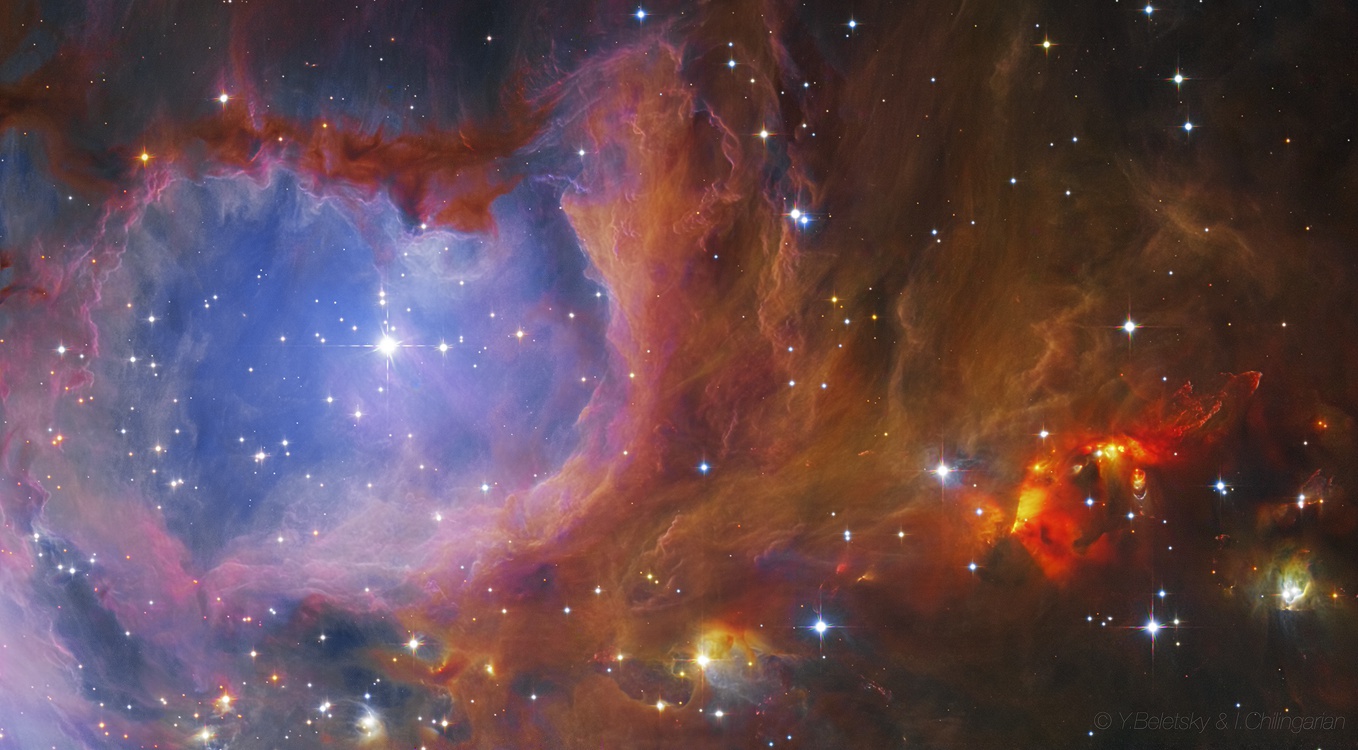
Messier 43
Explanation: Often imaged but rarely mentioned, Messier 43 is a large star forming region in its own right. It's just part of the star forming complex of gas and dust that includes the larger, more famous neighboring Messier 42, the Great Orion Nebula. In fact , the Great Orion Nebula itself lies off the lower edge of this scene. The close-up of Messier 43 was made while testing the capabilities of a near-infrared instrument with one of the twin 6.5 meter Magellan telescopes at Las Campanas Observatory in the Chilean Andes. The composite image shifts the otherwise invisible infrared wavelengths to blue, green, and red colors. Peering into caverns of interstellar dust hidden from visible light, the near-infrared view can also be used to study cool, brown dwarf stars in the complex region. Along with its celebrity neighbor , Messier 43 lies about 1,500 light-years away, at the edge of Orion's giant molecular cloud. At that distance, this field of view spans about 5 light-years.
| Date | July 10, 2015 |
|---|---|
| Credit | Image Credit & Copyright: Yuri Beletsky ( Carnegie Las Campanas Obs. ), Igor Chilingarian ( Harvard-Smithsonian CfA ) |
| Authors & editors: | Robert Nemiroff (MTU) & Jerry Bonnell (UMCP) |
| A service of: |
ASD at NASA / GSFC, NASA Science Activation & Michigan Tech. U. |