


























APOD
Astronomy Picture of the Day
Discover the cosmos! Each day a different image or photograph of our fascinating universe is featured, along with a brief explanation written by a professional astronomer.
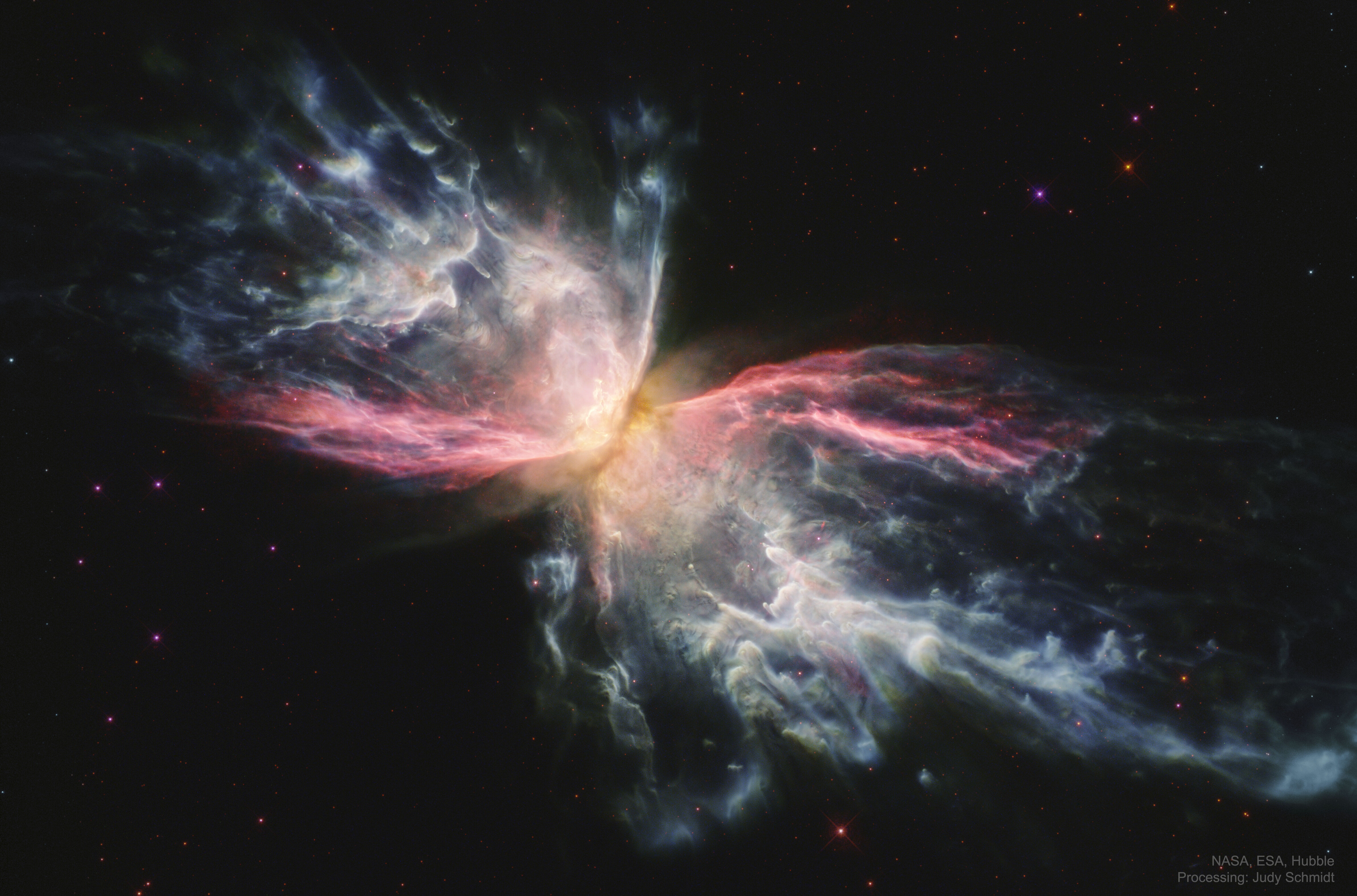
Iron in the Butterfly Nebula
Explanation: Can stars, like caterpillars, transform themselves into butterflies? No, but in the case of the Butterfly Nebula -- it sure looks like it. Though its wingspan covers over 3 light-year s and its estimated surface temperature exceeds 200,000 degrees, C , the dying central star of NGC 6302, the featured planetary nebula , has become exceptionally hot, shining brightly in visible and ultraviolet light but hidden from direct view by a dense torus of dust. This sharp close-up was recorded by the Hubble Space Telescope and is reprocessed here to show off the remarkable details of the complex planetary nebula , highlighting in particular light emitted by iron , shown in red. NGC 6302 lies about 4,000 light-years away in the arachnologically correct constellation of the Scorpion ( Scorpius ). Planetary nebula s evolve from outer atmospheres of stars like our Sun , but usually fade in about 20,000 years.
Great Debates in Astronomy: 2020: How will humanity first discover extraterrestrial life ?
| Date | July 21, 2020 |
|---|---|
| Credit | Image Credit: NASA , ESA , Hubble ; Processing & License: Judy Schmidt |
| Authors & editors: | Robert Nemiroff (MTU) & Jerry Bonnell (UMCP) |
| A service of: |
ASD at NASA / GSFC, NASA Science Activation & Michigan Tech. U. |