


























APOD
Astronomy Picture of the Day
Discover the cosmos! Each day a different image or photograph of our fascinating universe is featured, along with a brief explanation written by a professional astronomer.
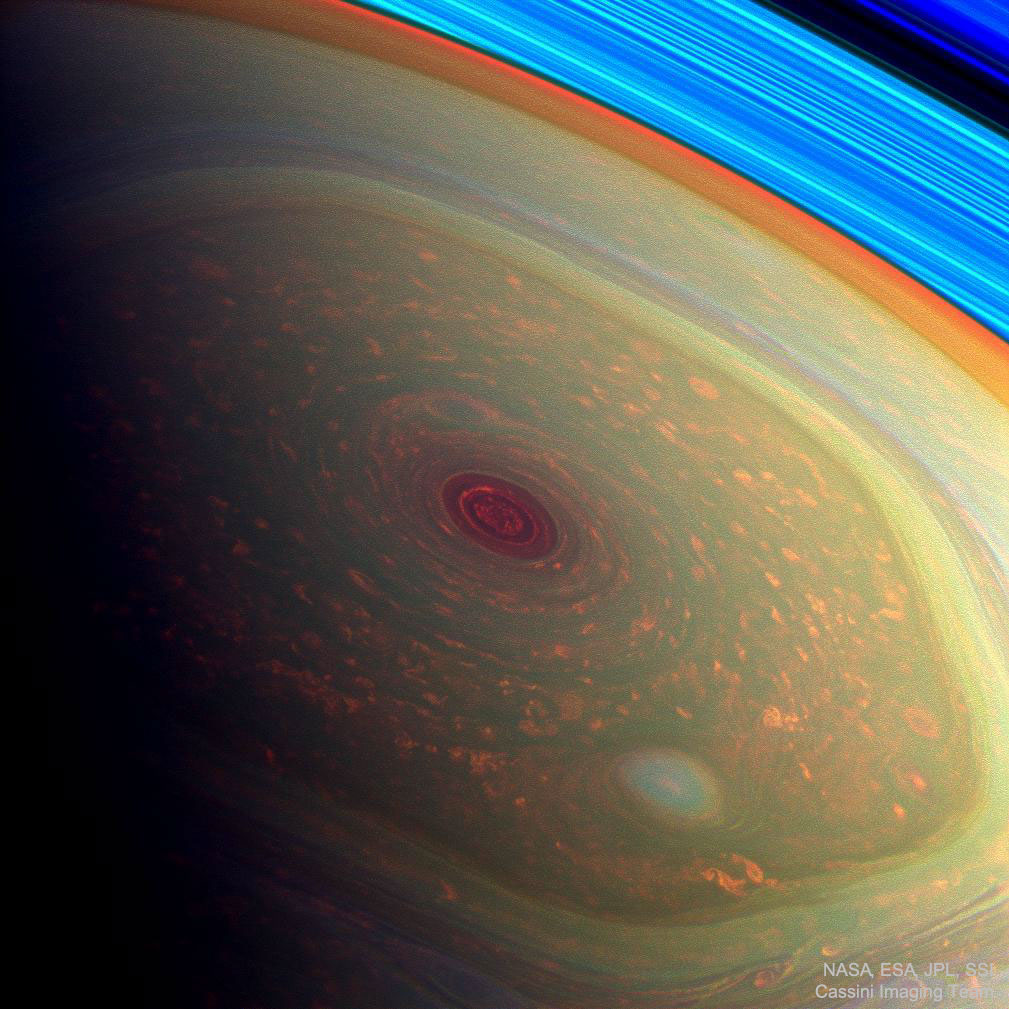
Saturn's Northern Hexagon
Explanation: Why would clouds form a hexagon on Saturn? Nobody is sure. Originally discovered during the Voyager flybys of Saturn in the 1980s, nobody has ever seen anything like it anywhere else in the Solar System . Acquiring its first sunlit views of far northern Saturn in late 2012 , the Cassini spacecraft's wide-angle camera recorded this stunning, false-color image of the ringed planet's north pole. The composite of near-infrared image data results in red hues for low clouds and green for high ones, giving the Saturnian cloudscape a vivid appearance. This and similar images show the stability of the hexagon even 20+ years after Voyager. Movies of Saturn's North Pole show the cloud structure maintaining its hexagonal structure while rotating. Unlike individual clouds appearing like a hexagon on Earth , the Saturn cloud pattern appears to have six well defined sides of nearly equal length. Four Earth s could fit inside the hexagon . Beyond the cloud tops at the upper right, arcs of the planet's eye-catching rings appear bright blue.
| Date | July 5, 2020 |
|---|---|
| Credit | Image Credit: NASA , ESA , JPL , SSI , Cassini Imaging Team |
| Authors & editors: | Robert Nemiroff (MTU) & Jerry Bonnell (UMCP) |
| A service of: |
ASD at NASA / GSFC, NASA Science Activation & Michigan Tech. U. |