


























APOD
Astronomy Picture of the Day
Discover the cosmos! Each day a different image or photograph of our fascinating universe is featured, along with a brief explanation written by a professional astronomer.
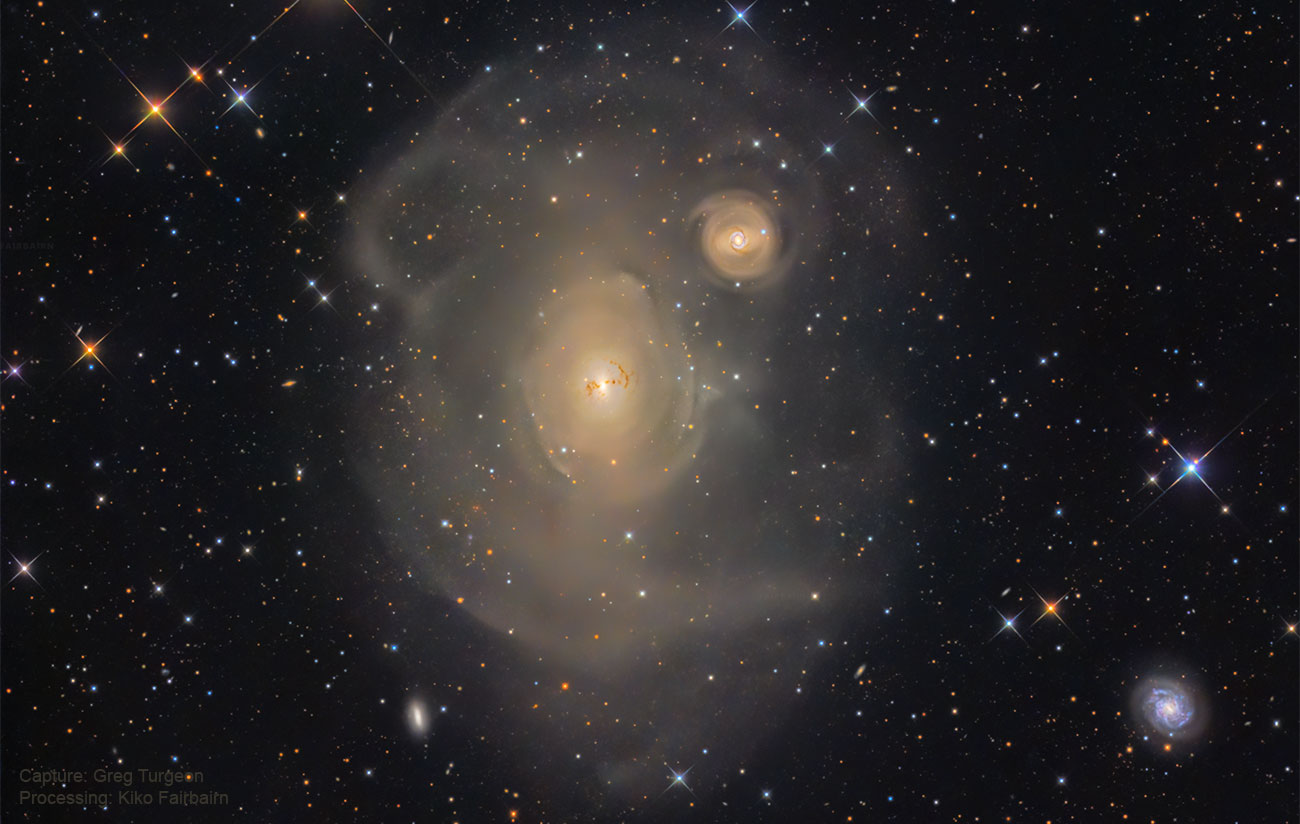
NGC 1316: After Galaxies Collide
Explanation: Astronomers turn detectives when trying to figure out the cause of startling sights like NGC 1316 . Investigations indicate that NGC 1316 is an enormous elliptical galaxy that started, about 100 million years ago, to devour a smaller spiral galaxy neighbor, NGC 1317 , just on the upper right. Supporting evidence includes the dark dust lanes characteristic of a spiral galaxy, and faint swirls and shells of stars and gas visible in this wide and deep image. One thing that >remains unexplained is the unusually small globular star clusters , seen as faint dots on the image. Most elliptical galaxies have more and brighter globular clusters than NGC 1316 . Yet the observed globulars are too old to have been created by the recent spiral collision . One hypothesis is that these globulars survive from an even earlier galaxy that was subsumed into NGC 1316 . Another surprising attribute of NGC 1316 , also known as Fornax A, is its giant lobes of gas that glow brightly in radio waves .
| Date | May 17, 2022 |
|---|---|
| Credit | Image Credit & Copyright: Capture: Greg Turgeon ; Processing: Kiko Fairbairn |
| Authors & editors: | Robert Nemiroff (MTU) & Jerry Bonnell (UMCP) |
| A service of: |
ASD at NASA / GSFC, NASA Science Activation & Michigan Tech. U. |