























Galaxy Triplet NGC 5679 (Arp 274)
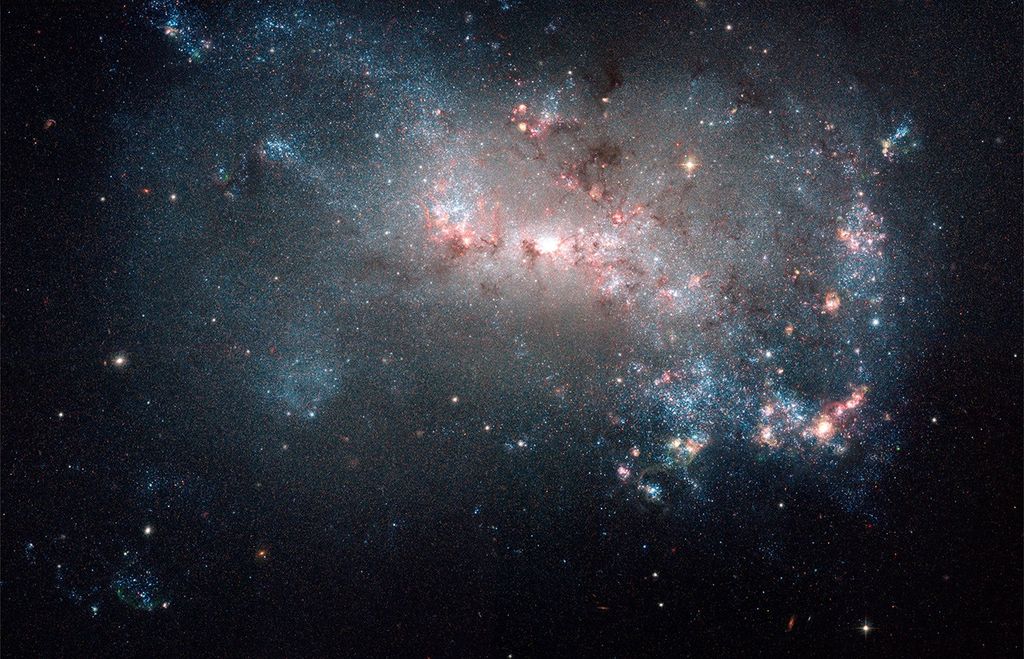
NGC 5679 is a galaxy trio found in the constellation Virgo. Yellowish older stars can be seen in the central bulge of each galaxy. A bright central cluster of stars pinpoint each nucleus. Younger blue stars trace the spiral arms, along with pinkish nebulas that are illuminated by new star formation. Interstellar dust is silhouetted against the starry population. A pair of foreground stars inside our own Milky Way are at far right. The center, slightly barred spiral is flanked by two smaller “starburst” galaxies, ones with high star-formation rates as evidenced by the many bright blue star clusters within them. It had been generally thought by scientists that tidal interaction among the three galaxies produced the compressed regions where the star formation burst forth. In this view, however, no clear distortion in the galaxies’ shapes due to gravitational interaction is evident. In fact, spectroscopic measurements of the three objects indicate that all three lie at different distances and simply appear as a cluster due to their location along the same line of sight. The system is also known as Arp 274, a designation from the noted U.S. astronomer Halton Arp’s Atlas of Peculiar Galaxies, a catalog of 338 unusual objects compiled in the years from 1962 through 1967. Many of these are multiple-galaxy systems.
Image Credit: NASA, ESA, M. Livio, and the Hubble Heritage Team (STScI/AURA)
- X
https://science.nasa.gov/image-detail/653834main_arp274-orig_full/
Image CreditNASA, ESA, M. Livio, and the Hubble Heritage Team (STScI/AURA)
Size2238x1295px