




















Pluto’s Moons in Orbit
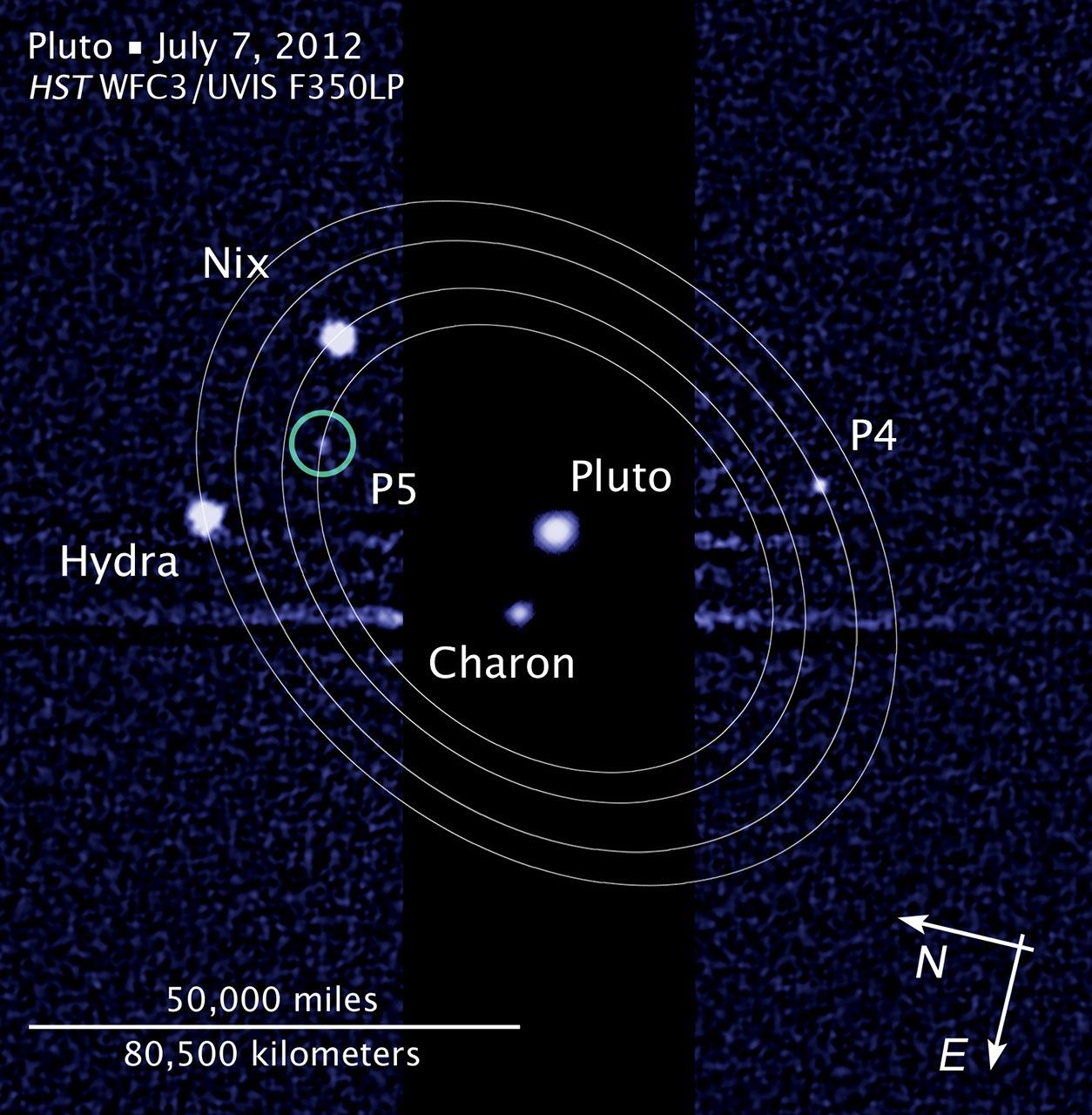
Astronomers using the Hubble Space Telescope had previously discovered two small moons — Nix and Hydra — orbiting Pluto alongside its larger moon Charon. They would add two more in 2011 and 2012, bringing the icy dwarf planet's total number of moons to five. Astronomers using Hubble to research the Pluto system in advance of 2015's New Horizons flyby found two objects, P4 in 2011 and P5 in 2012. The two moons would later be renamed Kerberos and Styx, respectively. This image is annotated to show the orbits of Pluto's more recently discovered moons. P5 is circled. The dwarf planet’s entire moon system is believed to have formed by a collision between Pluto and another planet-sized body early in the history of the solar system. The smashup flung material that coalesced into the family of moons observed around Pluto.
Image Credit: NASA, ESA, and M. Showalter (SETI Institute)
- X
https://science.nasa.gov/image-detail/amf-14dcaeb9-7661-478a-8157-9e95fab9df64/
Image CreditNASA, ESA, and M. Showalter (SETI Institute)
Size1546x1578px