


















NGC 248
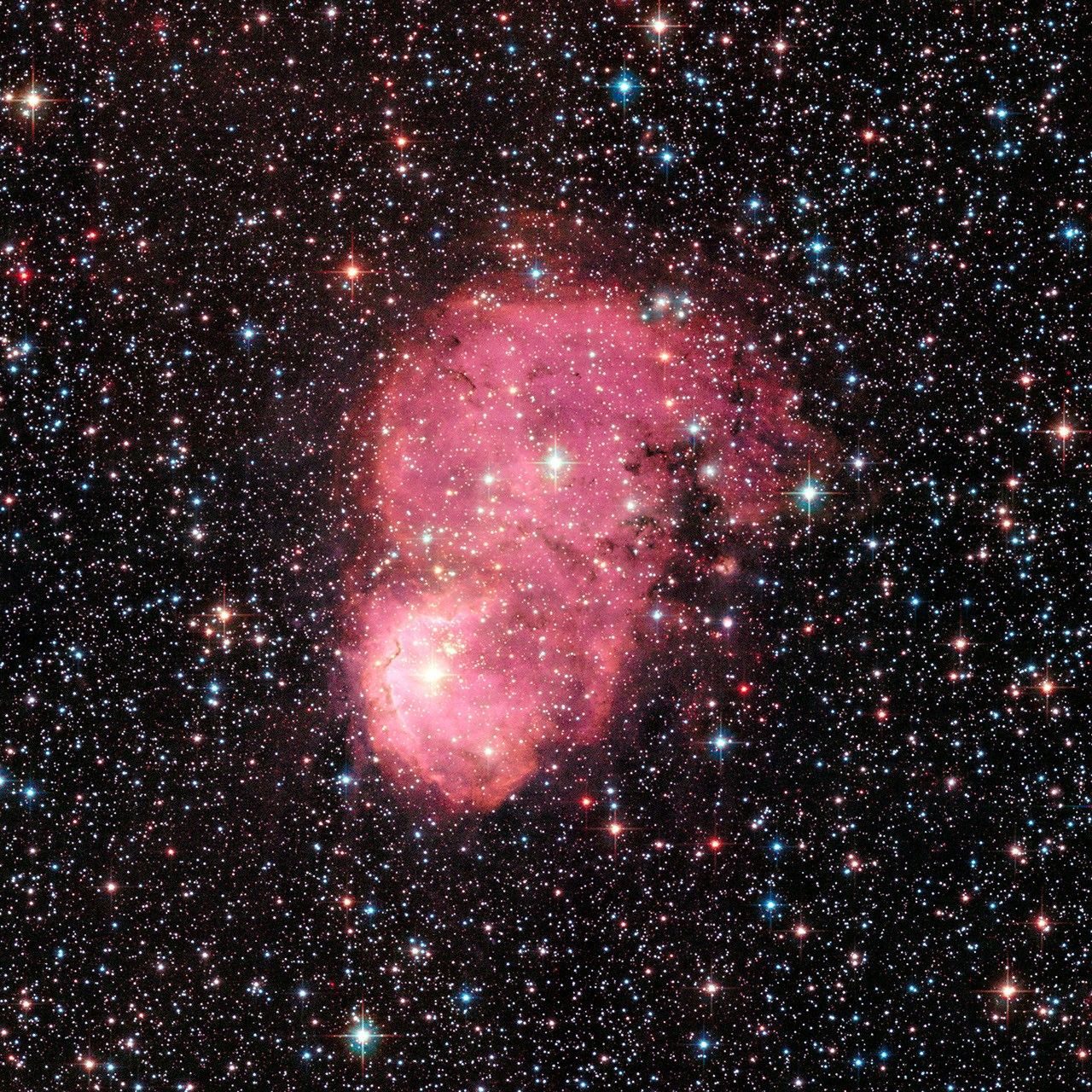
In this image, NASA's Hubble Space Telescope captured two nebulae, situated so they appear as one. They reside in the Small Magellanic Cloud, a dwarf galaxy that is a satellite of our Milky Way Galaxy. Intense radiation from the brilliant central stars is heating hydrogen in each of the nebulae, causing them to glow red. The nebulae, together, are called NGC 248. They were discovered in 1834 by the astronomer Sir John Herschel. NGC 248 is about 60 light-years long and 20 light-years wide. It is among a number of glowing hydrogen nebulae in the dwarf satellite galaxy, which is located approximately 200,000 light-years away in the southern constellation Tucana. The Small Magellanic Cloud has between a fifth and a tenth of the amount of heavy elements that the Milky Way does. Because it is so close, astronomers can study its dust in great detail, and learn about what dust was like earlier in the history of the universe. Most of the star formation happened earlier in the universe, at a time where there was a much lower percentage of heavy elements than there is now.
Image Credit: NASA, ESA, STScI, K. Sandstrom (University of California, San Diego), and the SMIDGE team
- X
https://science.nasa.gov/image-detail/amf-18b890e2-1afa-417b-9526-dc36deb811b0/
Image CreditNASA, ESA, STScI, K. Sandstrom (University of California, San Diego), and the SMIDGE team
Size2048x2048px