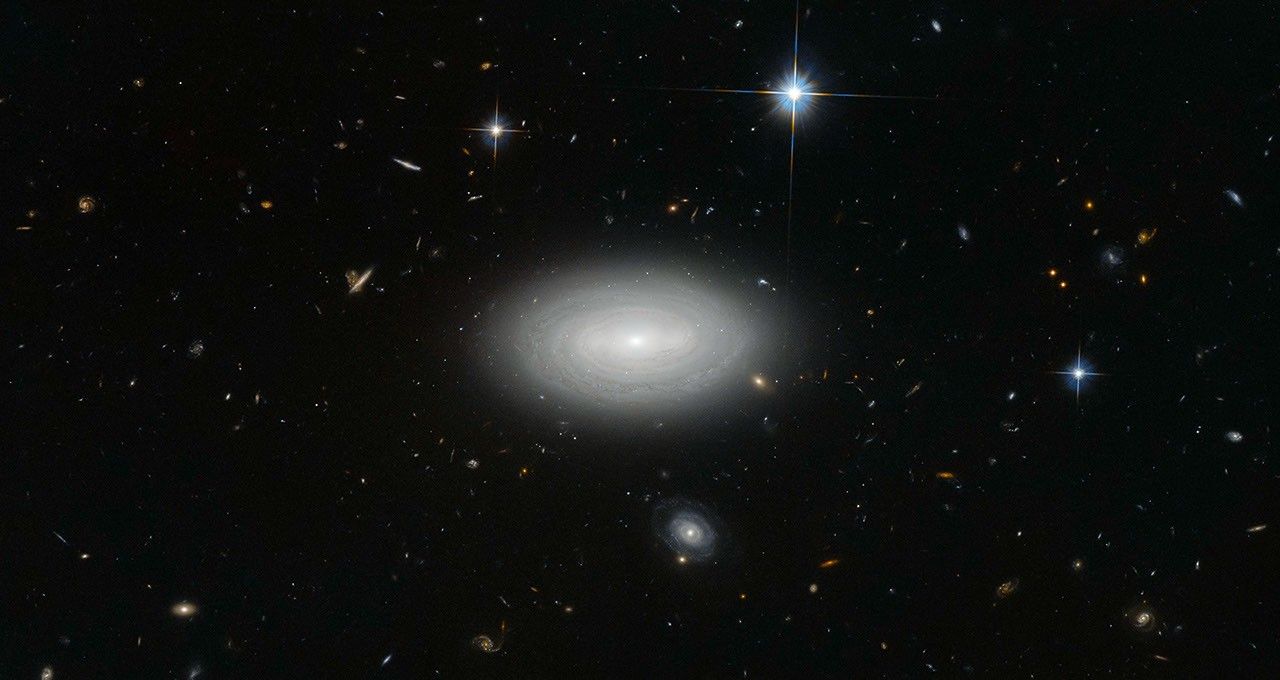
















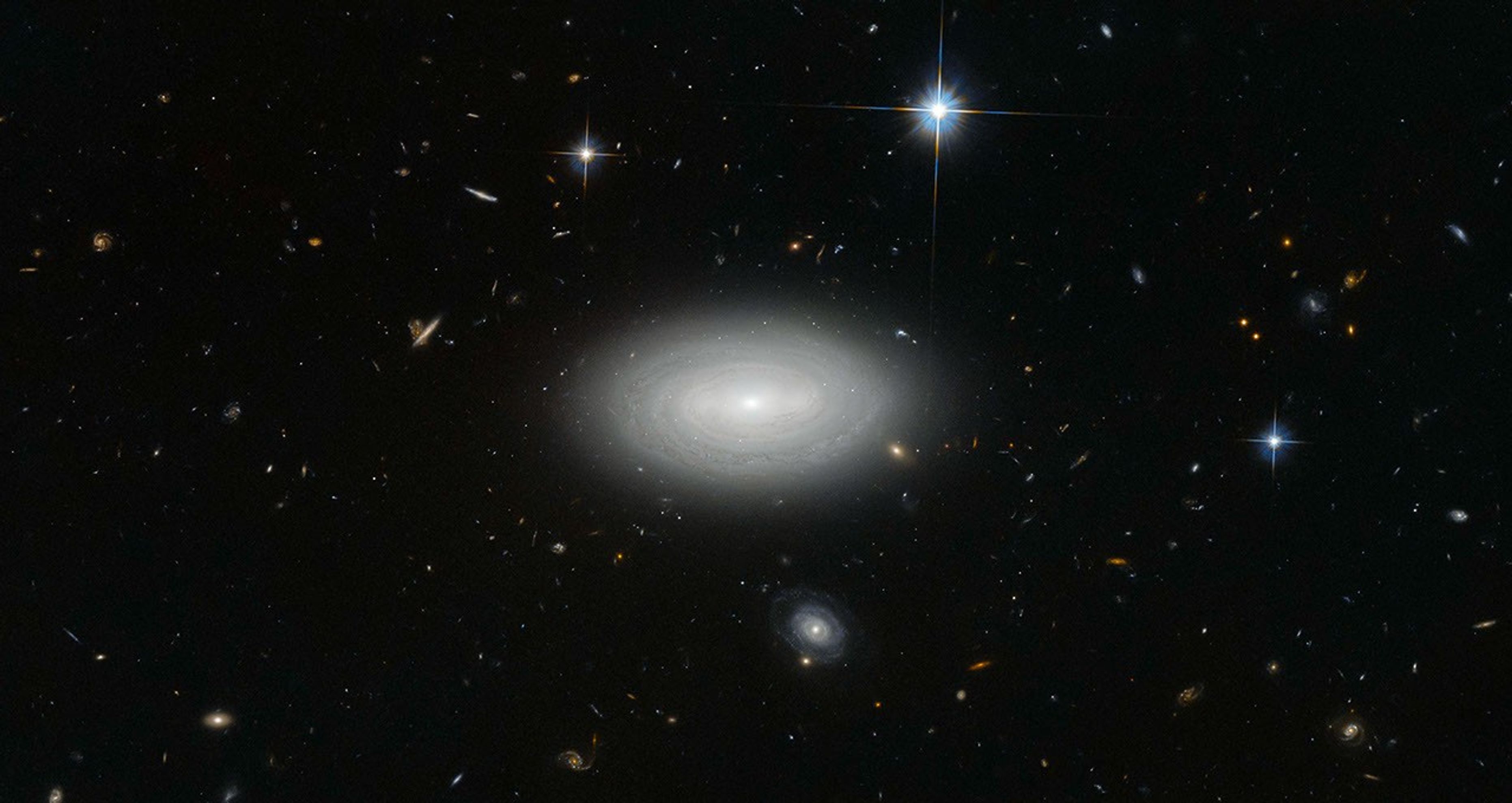
The “Void Galaxy” MCG+01-02-015
The vast majority of galaxies are drawn together by the influence of gravity into immense sinuous filaments — thread-like formations that make up the large-scale structure of the universe. Between these filaments stretch immense voids; the universe’s wastelands, where, outside of the extremely rare presence of a galaxy, there is very little matter — about one atom per cubic meter. n one such outer space void located in the constellation Pisces, galaxy MCG+01-02-015 is found. In this view, the galaxy’s isolated position is difficult to appreciate due to the large number of background galaxies captured by the camera’s sensitive detectors. In fact, only three stars appear in this image, easily identified by the cross-shaped diffraction spikes superimposed on them by the four struts that hold Hubble’s secondary mirror centered in the telescope’s optical tube. Everything else seen in the background are distant galaxies. About 20 such “void galaxies” have been cataloged by astronomers, though there are undoubtedly more.
Image Credit: ESA/Hubble & NASA and N. Gorin (STScI); Acknowledgment: Judy Schmidt
- X
https://science.nasa.gov/image-detail/amf-20cee66d-b2f3-4051-abfb-b854ef6f4abd/
Image CreditESA/Hubble & NASA and N. Gorin (STScI); Acknowledgment: Judy Schmidt
Size3726x1982px