
























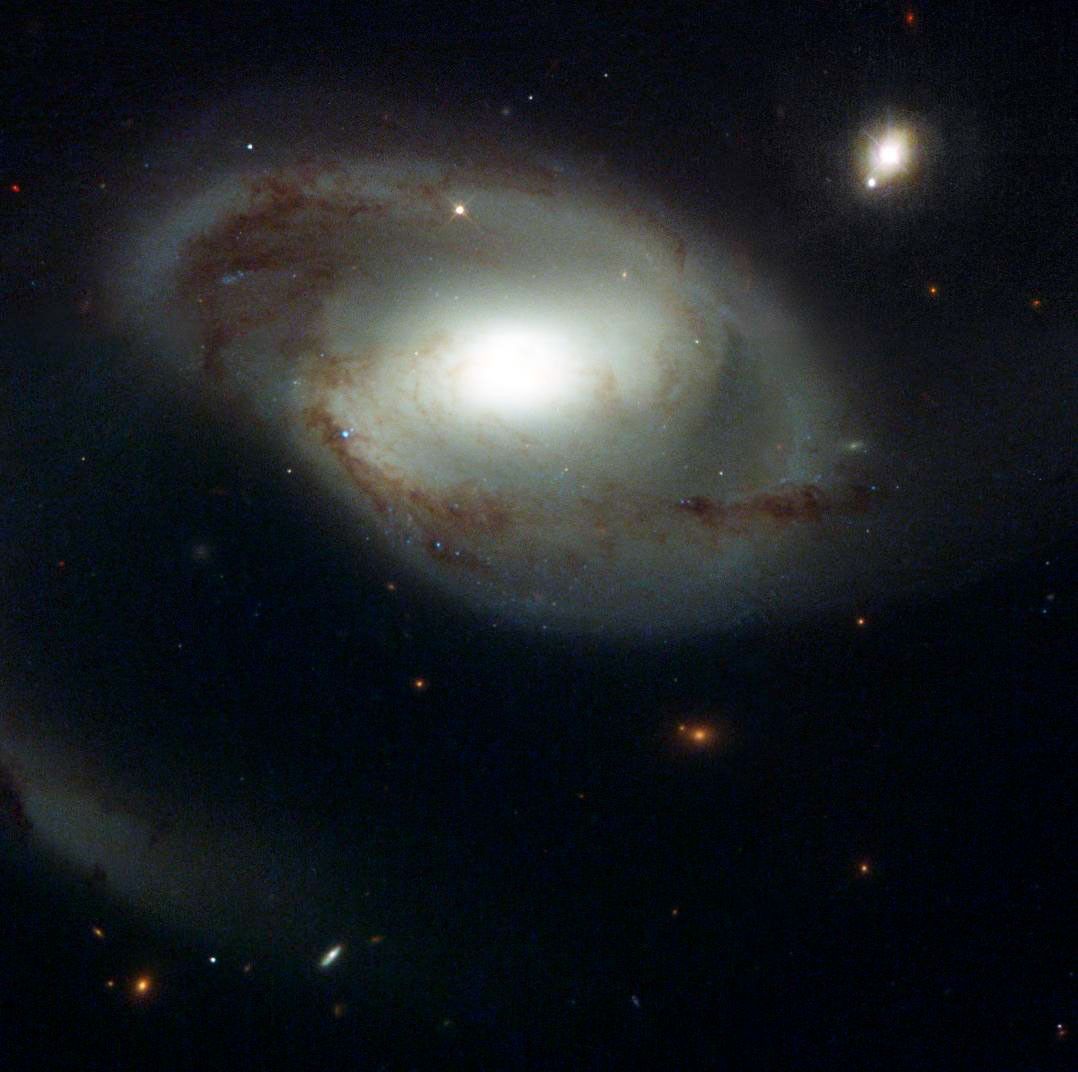
Spiral Galaxy NGC 4319 and Quasar Markarian 205
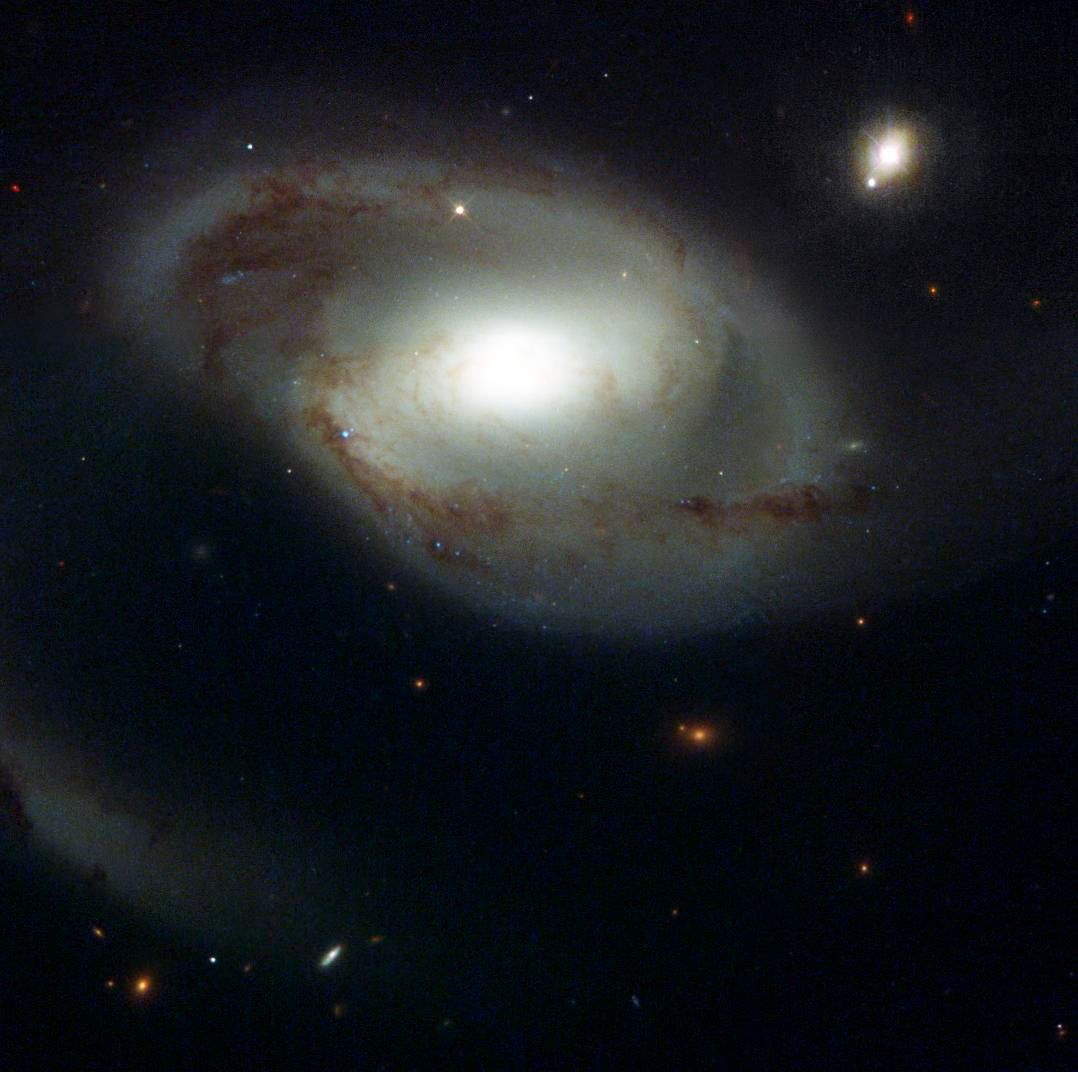
In this image, the spiral galaxy NGC 4319 (center) and a quasar called Markarian 205 (upper right), appear to be neighbors. In reality, the two objects are separated by time and space. NGC 4319 is 80 million light-years from Earth. Markarian 205 (Mrk 205) is more than 14 times farther away, residing 1 billion light-years from Earth. Astronomers used two methods to determine the distances to these objects. First, they measured how their light has been stretched in space due to the universe's expansion. Then they measured how much the ultraviolet light from Mrk 205 dimmed as it passed through the interstellar gas of NGC 4319. Mrk 205 is a relatively nearby quasar. Quasars, once known only as mysterious point-like objects, are now known to be distant galaxies that have extremely bright cores. These powerhouses of light are probably fueled by massive black holes. With powerful telescopes like Hubble, it is often possible to see the quasar's surrounding halo of faint starlight, as is clearly visible around Mrk 205. Mrk 205 has a companion, a compact galaxy just below it. The objects appear to be interacting. The compact galaxy may be responsible for the structure in Mrk 205's halo.
Image Credit: NASA and the Hubble Heritage Team (STScI/AURA); Acknowledgment: R. Knacke (Penn State Erie)
- X
https://science.nasa.gov/image-detail/amf-2497798a-0100-4aeb-9bed-9ff4cde56a16/
Image CreditNASA and the Hubble Heritage Team (STScI/AURA); Acknowledgment: R. Knacke (Penn State Erie)
Size1078x1072px