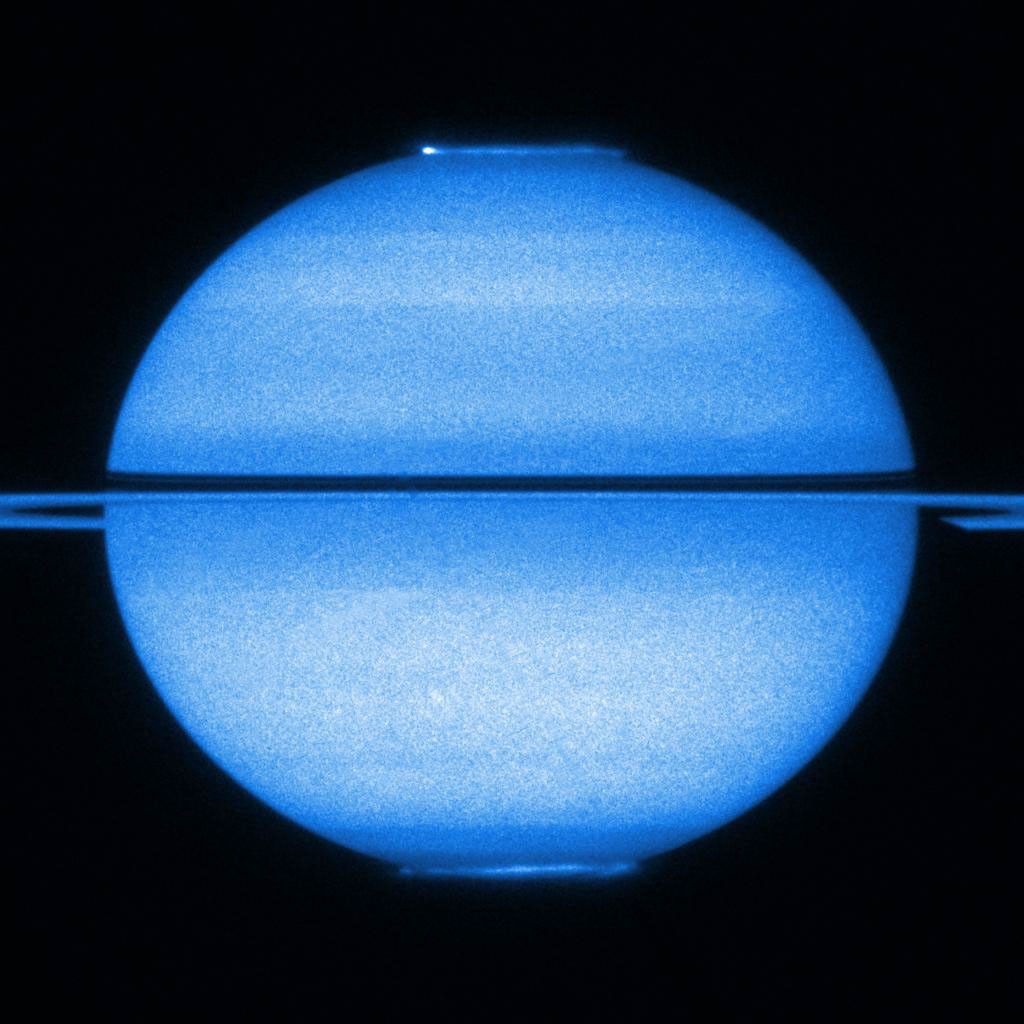
















Saturn’s Double Light Show
In January and March 2009, astronomers took advantage of a rare opportunity to record Saturn when its rings were edge-on, resulting in a unique image featuring the nearly symmetrical light show at both of the giant planet's poles. It takes Saturn almost thirty years to orbit the Sun, with the opportunity to image both of its poles occurring only twice during that time. The light shows, called auroras, are produced when electrically charged particles race along the planet's magnetic field and into the upper atmosphere where they excite atmospheric gases, causing them to glow. Saturn's auroras resemble the same phenomena that take place at the Earth's poles.
Image Credit: NASA, ESA, and Jonathan Nichols (University of Leicester)
- X
https://science.nasa.gov/image-detail/amf-25f9cb30-ffd4-4cc9-95d3-7548e7047443/
Image CreditNASA, ESA, and Jonathan Nichols (University of Leicester)
Size1024x1024px