















Saturn in Natural Colors
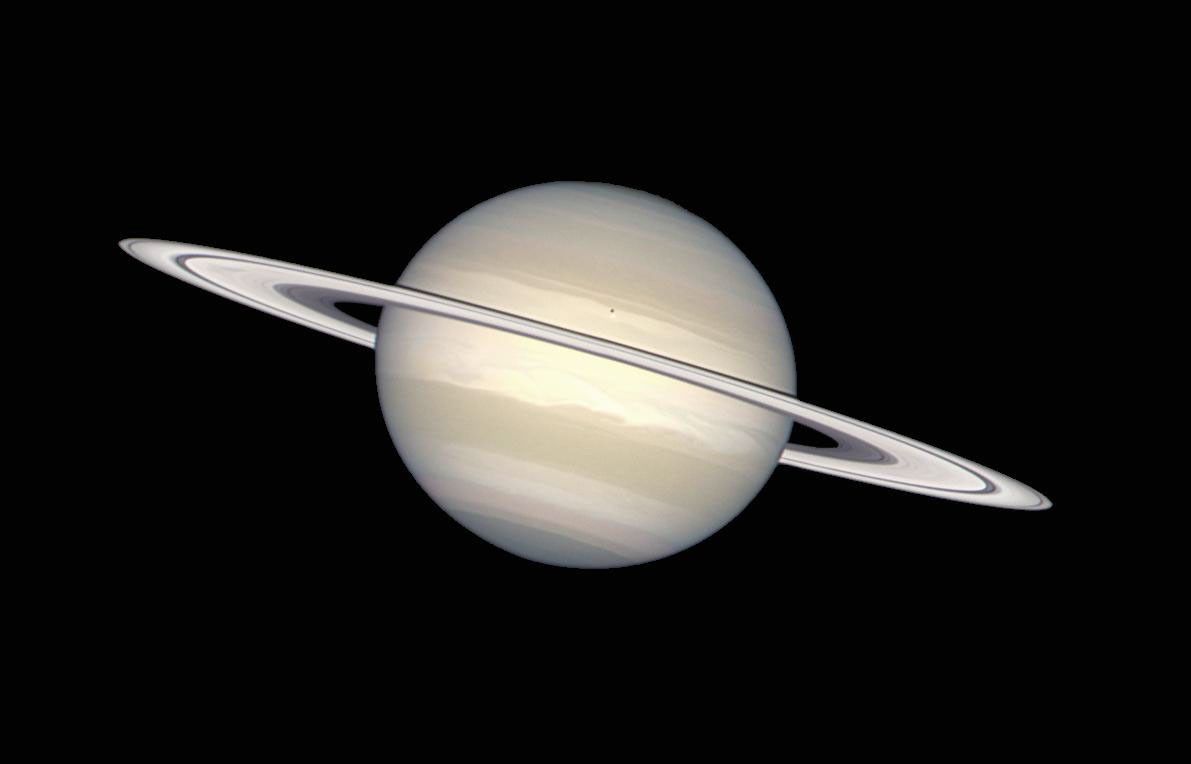
The Hubble Space Telescope has provided images of Saturn in many colors, including black-and-white, orange, and blue, green, and red. But in this picture, captured by Hubble on September 30, 1996, image-processing specialists worked to provide a crisp, extremely accurate view of Saturn, which highlights the planet's pastel colors. Bands of subtle color — yellows, browns, grays — distinguish differences in the clouds over Saturn, the second largest planet in the solar system. Saturn's high-altitude clouds are made of colorless ammonia ice. Above these clouds is a layer of haze or smog, produced when ultraviolet light from the Sun shines on methane gas. The smog contributes to the planet's subtle color variations. One of Saturn's moons, Enceladus, is seen casting a shadow on the giant planet as it passes just above the ring system. The flattened disk swirling around Saturn is the planet's famous ring system, consisting mostly of chunks of water ice. Although it appears as if the disk is composed of only a few rings, it actually consists of tens of thousands of thin "ringlets." This picture also shows the two classic divisions in the ring system. The narrow Encke Gap is nearest to the disk's outer edge, while the Cassini Division is the wide gap near the center.
Image Credit: NASA, ESA, and the Hubble Heritage Team (STScI/AURA); Acknowledgment: R. G. French (Wellesley College)
- X
https://science.nasa.gov/image-detail/amf-391d8f0a-ee9d-4d40-aa7c-c47a234f7a97/
Image CreditNASA, ESA, and the Hubble Heritage Team (STScI/AURA); Acknowledgment: R. G. French (Wellesley College)
Size1191x764px