























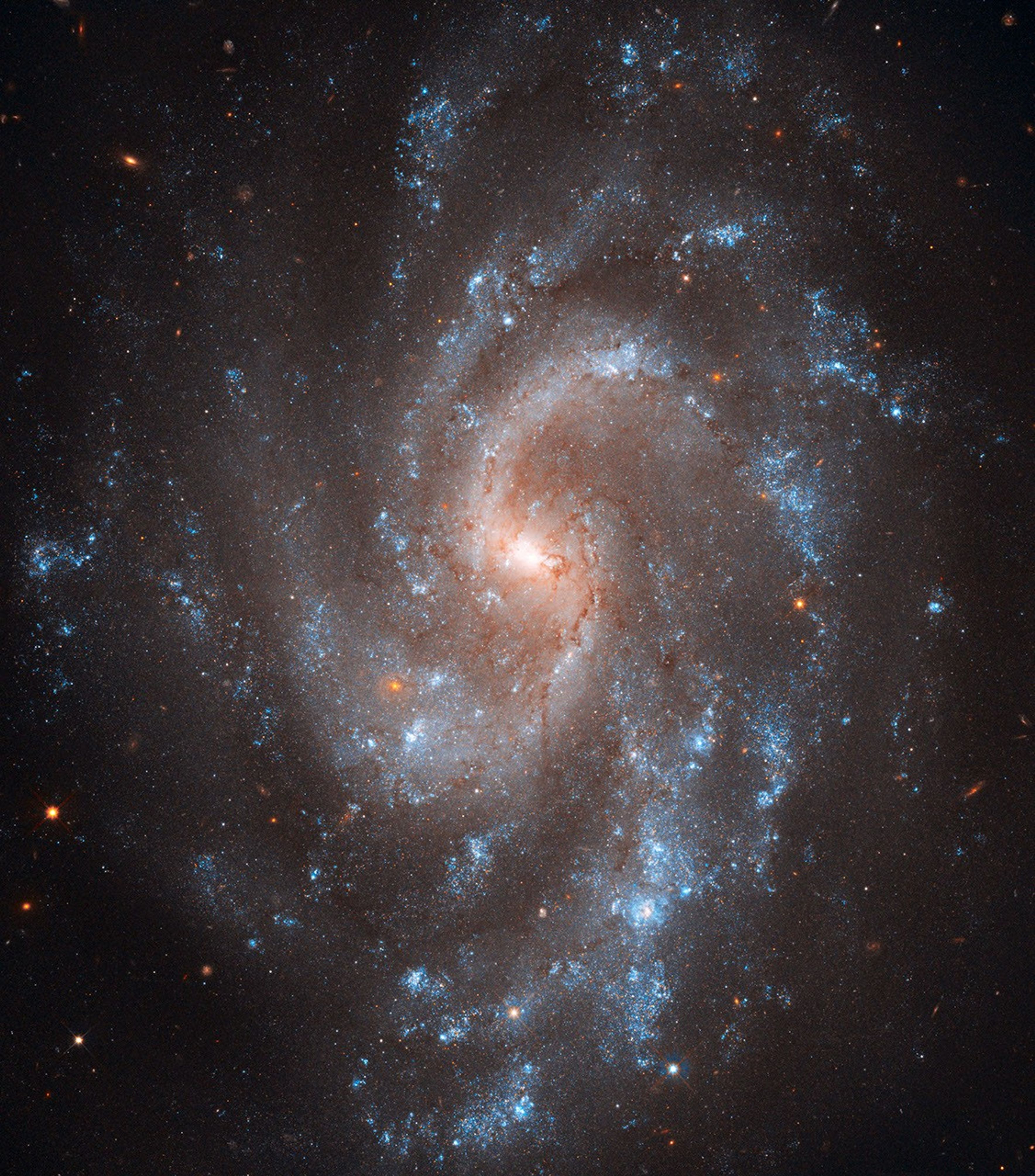
Spiral Galaxy NGC 5584
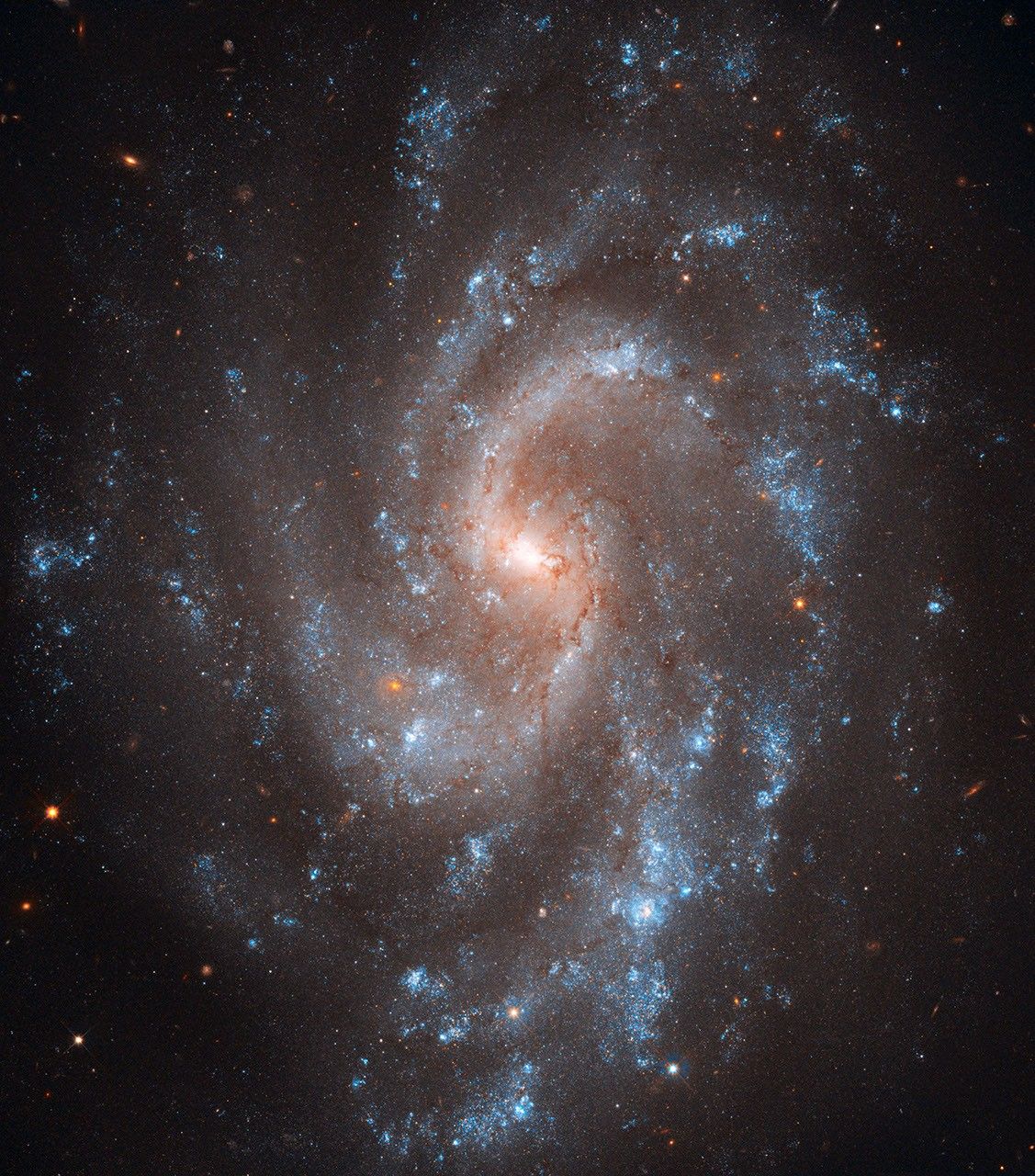
The brilliant, blue glow of young stars traces the graceful spiral arms of galaxy NGC 5584. Thin, dark dust lanes appear to be flowing from the yellowish core, where older stars reside. The reddish dots sprinkled throughout the image are largely background galaxies. Among the galaxy's myriad stars are pulsating stars called Cepheid variables and one recent Type Ia supernova, a special class of exploding stars. Cepheid variables pulsate at a rate matched closely by their intrinsic brightness, making them ideal for measuring distances to relatively nearby galaxies. Type Ia supernovas likewise flare with an intrinsic brightness that is known, though much greater, permitting their use to help gauge larger distances. Astronomers search for Type Ia supernovas in nearby galaxies containing Cepheid variables so they can identify the true brightness of both types of stars. They then use that information when viewing Type Ia supernovas in far-flung galaxies to estimate their distance from Earth.
Image Credit: NASA, ESA, A. Riess (STScI/JHU), L. Macri (Texas A&M University), and the Hubble Heritage Team (STScI/AURA)
- X
https://science.nasa.gov/image-detail/amf-5a893f17-9e29-4afc-8197-7247f0a6b489/
Image CreditNASA, ESA, A. Riess (STScI/JHU), L. Macri (Texas A&M University), and the Hubble Heritage Team (STScI/AURA)
Size3539x4016px