
















Mars on Verge of Closest Approach: August 26, 2003
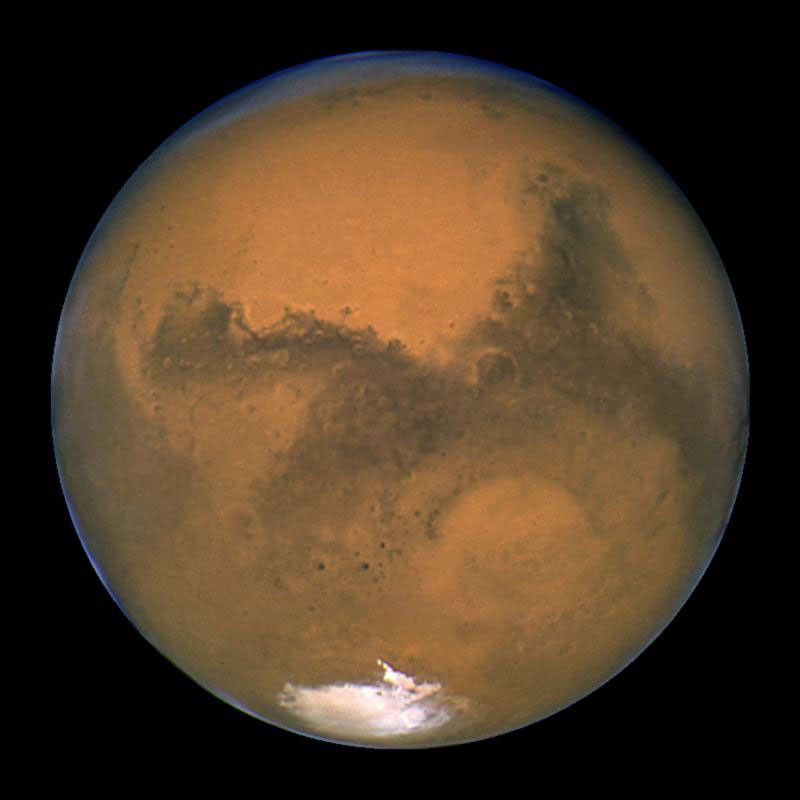
The Hubble Space Telescope took this close-up of the planet Mars when it was just 34,648,840 miles (55,760,220 km) away. This color image was assembled from a series of exposures taken between 6:20 p.m. and 7:12 p.m. EDT August 26, 2003. The picture was taken just 11 hours before the planet made its closest approach to Earth in 60,000 years. Many small, dark, circular impact craters can be seen, attesting to the Hubble telescope's ability to reveal fine detail on the planet's surface. One of the most striking is the 270-mile- (450-km-) diameter Huygens crater, seen near the center of the image. The two dominant dark swatches seen on this part of the planet are classical regions labeled by early Mars observers. The "shark-fin" shape to the right is Syrtis Major. The horizontal lane to the left is Sinus Meridani. The picture shows that it is a relatively warm summer in the southern hemisphere on Mars, as evident in the lack of water-ice clouds at mid-latitude and the receding southern polar cap. Ice on the rugged topography gives a somewhat ragged, scalloped look. Up north, at the top of the disk where it is Martian winter, a frigid polar hood of clouds covers the northern polar cap and surrounding region.
Image Credit: NASA, ESA, STScI, J. Bell (Cornell U.), and M. Wolff (SSI)
- X
https://science.nasa.gov/image-detail/amf-60385e6f-38b0-41f9-a2fb-6317a031a6f8/
Image CreditNASA, ESA, STScI, J. Bell (Cornell U.), and M. Wolff (SSI)
Size800x800px