




















Ganymede Disappears Behind Jupiter
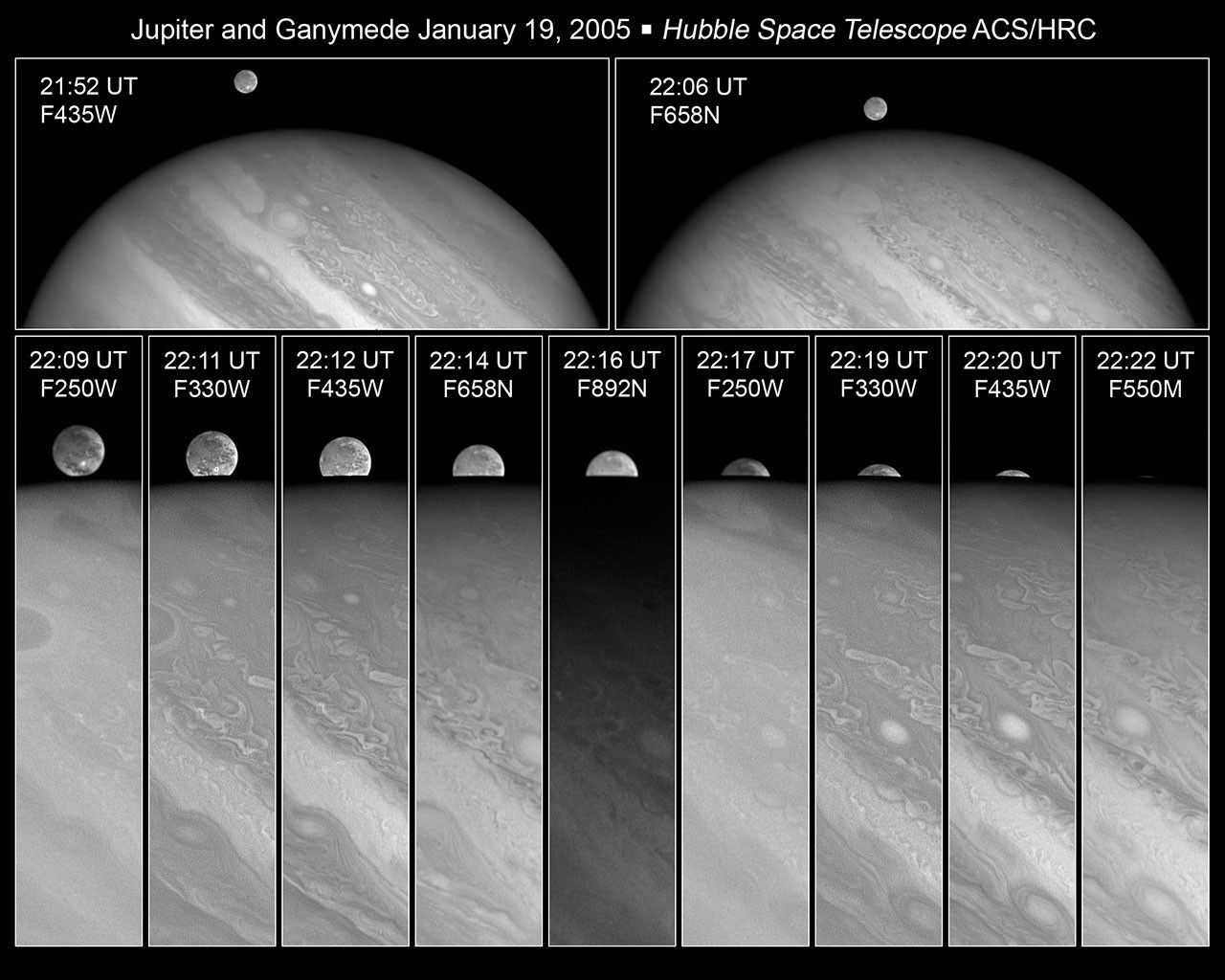
This series of images taken with the Hubble Space Telescope shows Jupiter's largest moon, Ganymede, disappearing behind the planet. Ganymede completes an orbit around Jupiter every seven days. Because Ganymede's orbit is tilted nearly edge-on to Earth, it routinely can be seen playing a game of "peek-a- boo," passing in front of and disappearing behind its giant host, only to reemerge later. Composed of rock and ice, Ganymede is the largest moon in our solar system. It is even larger than the planet Mercury. The top images show Ganymede next to Jupiter. The close-up images at bottom follow Ganymede as it ducks behind Jupiter a few minutes later.
Image Credit: NASA, ESA, and E. Karkoschka (University of Arizona)
- X
https://science.nasa.gov/image-detail/amf-6b3cce5d-fe06-4e4d-aedc-da87a61861b6/
Image CreditNASA, ESA, and E. Karkoschka (University of Arizona)
Size2205x1764px