


















Jupiter’s Stormy Weather
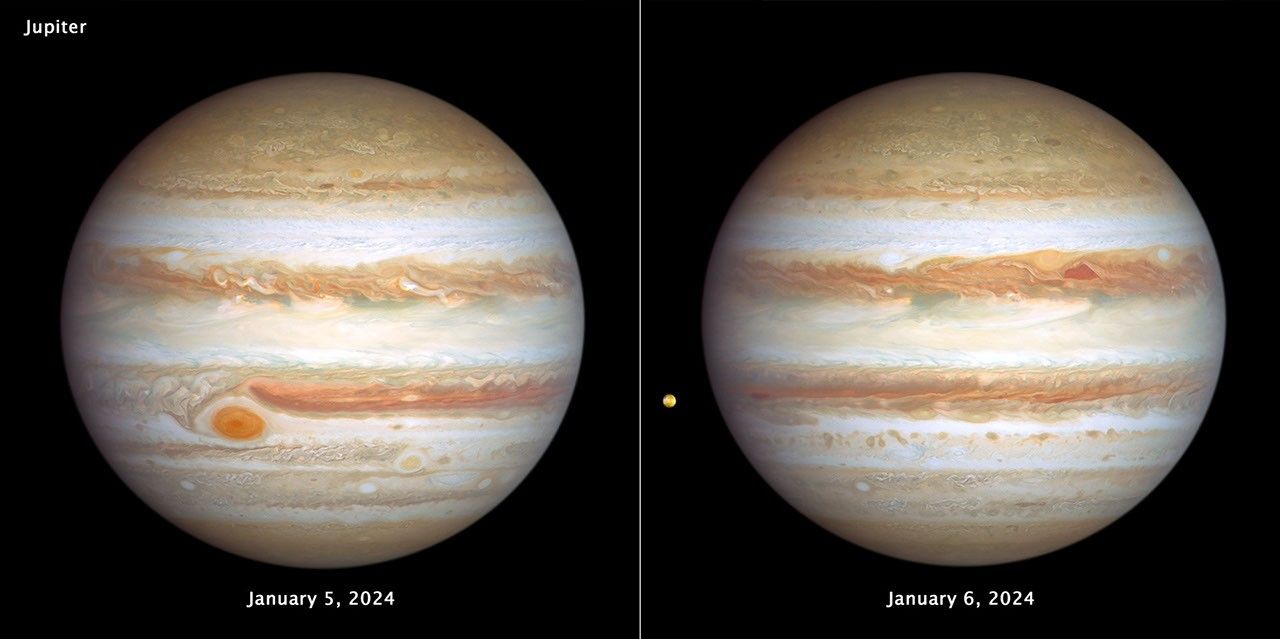
The giant planet Jupiter, in all its banded glory, is revisited in these latest images, taken on January 5-6, 2024, capturing both sides of the planet. Hubble monitors Jupiter and the other outer solar system planets every year under the Outer Planet Atmospheres Legacy program (OPAL). This is because these large worlds are shrouded in clouds and hazes stirred up by violent winds, causing a kaleidoscope of ever-changing weather patterns. [left image] – Big enough to swallow Earth, the classic Great Red Spot stands out prominently in Jupiter's atmosphere. To its lower right, at a more southerly latitude, is a feature sometimes dubbed Red Spot Jr. This anticyclone was the result of storms merging in 1998 and 2000, and it first appeared red in 2006 before returning to a pale beige in subsequent years. This year it is somewhat redder again. The source of the red coloration is unknown but may involve a range of chemical compounds: sulfur, phosphorus, or organic material. Staying in their lanes, but moving in opposite directions, Red Spot Jr. passes the Great Red Spot about every two years. Another small red anticyclone appears in the far north. [right image] – Storm activity also appears in the opposite hemisphere. A pair of storms, a deep red cyclone and a reddish anticyclone, appear next to each other at right of center. They look so red that at first glance, it looks like Jupiter skinned a knee. These storms are rotating in opposite directions, indicating an alternating pattern of high- and low-pressure systems. For the cyclone, there's an upwelling on the edges with clouds descending in the middle, causing a clearing in the atmospheric haze. Toward the left edge of the image is the innermost Galilean moon, Io – the most volcanically active body in the Solar System, despite its small size (only slightly larger than Earth's moon). Hubble resolves volcanic outflow deposits on the surface. Hubble's sensitivity to blue and violet wavelengths clearly reveals interesting surface features. In 1979 NASA's Voyager 1 spacecraft discovered Io's pizza-like appearance and volcanism, to the surprise of planetary scientists because it is such a small moon. Hubble picked up where Voyager left off by keeping an eye on restless Io year by year.
Image Credit: NASA, ESA, STScI, Amy Simon (NASA-GSFC)
- X
https://science.nasa.gov/image-detail/amf-6dc819f9-cced-44d9-84ae-1c09088ae7ef/
Image CreditNASA, ESA, STScI, Amy Simon (NASA-GSFC)
Size2000x999px