




















Dynamic Atmosphere of Uranus
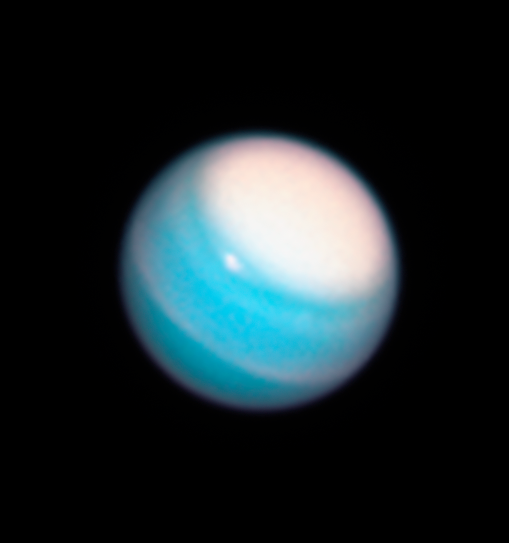
The two major planets beyond Saturn have only been visited once by a spacecraft, albeit briefly. NASA's Voyager 2 spacecraft swung by Uranus in 1986. Our robotic deep-space tourist snapped the only close-up, detailed images of these monstrous worlds. Unlike Neptune's dynamic atmosphere, Uranus appeared featureless. But these views were only brief snapshots. They couldn't capture how the planets' atmospheres change over time, any more than a single snapshot of Earth could tell meteorologists about weather behavior. And, they go through protracted seasonal changes in their multi-decades-long orbits. Ever since the Voyager encounter, the Hubble Space Telescope has provided an opportunity to monitor these worlds like a diligent weatherman. Since Hubble's launch in 1990, astronomers have used it to amass an album of outer planet images. Yearly monitoring of these giant worlds is now allowing astronomers to study long-term seasonal changes, as well as capture transitory weather patterns. This snapshot of Uranus shows that the ice giant is not a planetary wallflower. A vast bright polar cap across the north pole dominates the image. The cap, which may form due to seasonal changes in atmospheric flow, has become much more prominent than in previous observations dating back to the Voyager 2 flyby, when the planet, in the throes of winter, looked bland.
Image Credit: NASA, ESA, A. Simon (NASA Goddard Space Flight Center), and M.H. Wong and A. Hsu (University of California, Berkeley)
- X
https://science.nasa.gov/image-detail/amf-74f1318f-3e1a-4f0a-a09a-487df40058ce/
Image CreditNASA, ESA, A. Simon (NASA Goddard Space Flight Center), and M.H. Wong and A. Hsu (University of California, Berkeley)
Size509x543px