

















Ghostly Galaxy Missing Dark Matter
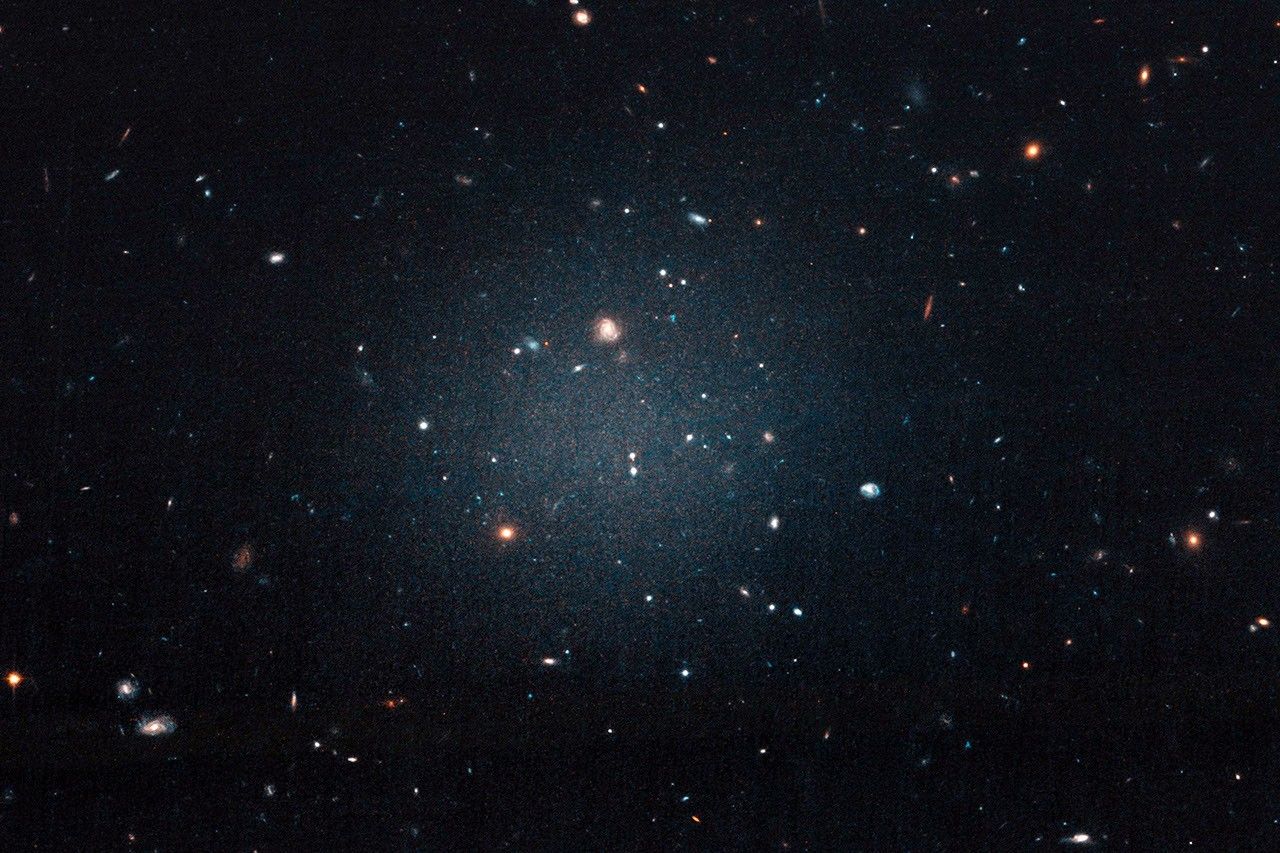
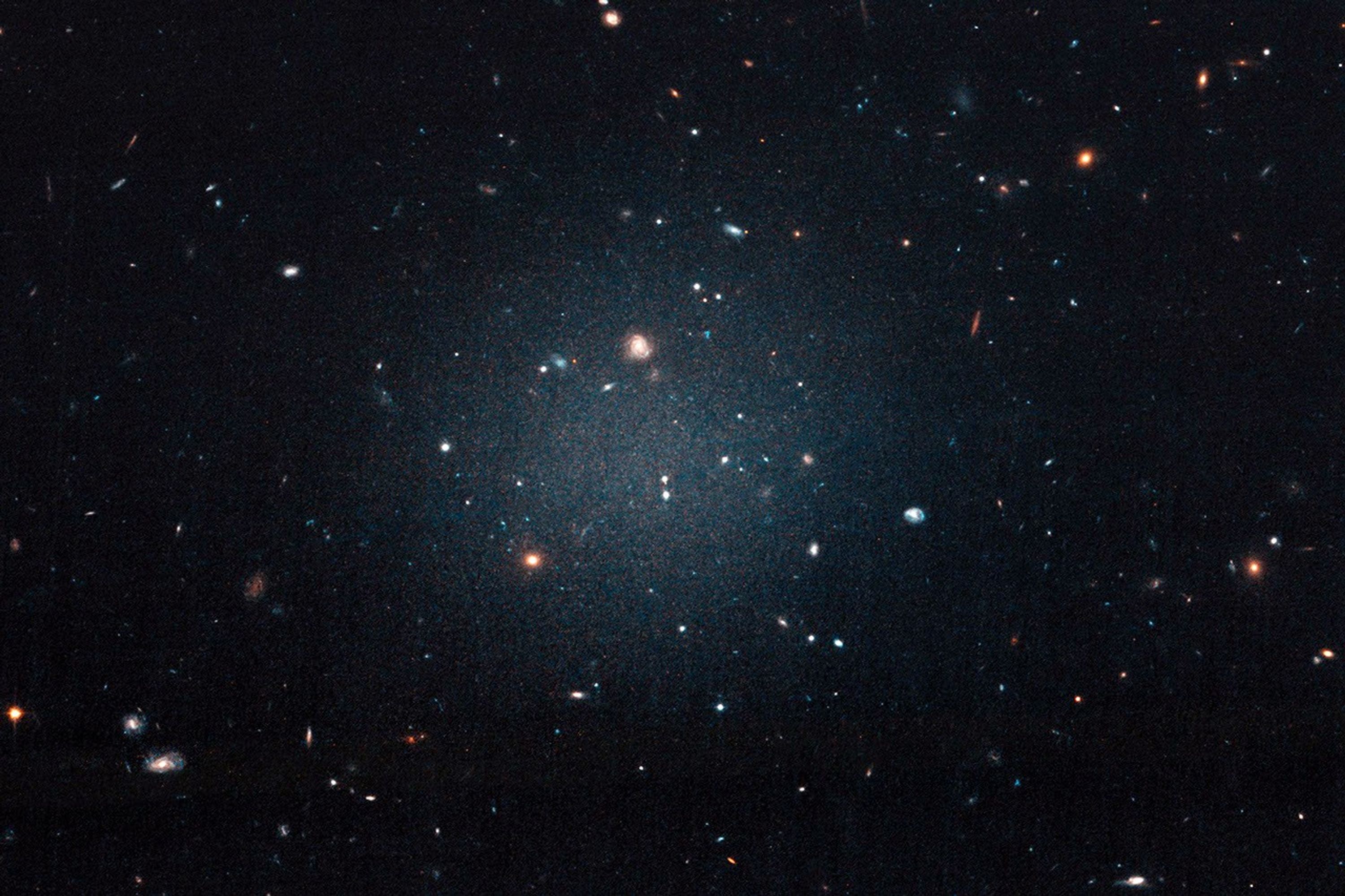
This large, fuzzy-looking galaxy is so diffuse that astronomers call it a “see-through” galaxy because they can clearly see distant galaxies behind it. The ghostly object, cataloged as NGC 1052-DF2, doesn’t have a noticeable central region, or even spiral arms and a disk, typical features of a spiral galaxy. But it doesn’t look like an elliptical galaxy, either. Even its globular clusters are oddballs: they are twice as large as typical stellar groupings seen in other galaxies. All of these oddities pale in comparison to the strangest aspect of this galaxy: NGC 1052-DF2 is missing most, if not all, of its dark matter. An invisible substance that makes up the bulk of our universe, dark matter is the glue that holds the visible matter in galaxies — stars and gas — together. The galaxy contains at most 1/400th the amount of dark matter that astronomers had expected. Since dark matter is thought to play an important role in coalescing matter to form galaxies and galaxy clusters, NGC 1052-DF2’s origin at this point is a complete mystery. The galactic oddball is as large as our Milky Way, but was only recently discovered because it contains only 1/200th the number of stars as our galaxy. Given the object’s large size and faint appearance, astronomers classify NGC 1052-DF2 as an ultra-diffuse galaxy. Based on the colors of its globular clusters, NGC 1052-DF2 is about 10 billion years old. It resides approximately 65 million light-years away in the constellation Cetus, the Whale.
Image Credit: NASA, ESA, and P. van Dokkum (Yale University)
- X
https://science.nasa.gov/image-detail/amf-7b16d151-ad4a-428e-be23-ffbfebbc44a8/
Image CreditNASA, ESA, and P. van Dokkum (Yale University)
Size3000x2000px