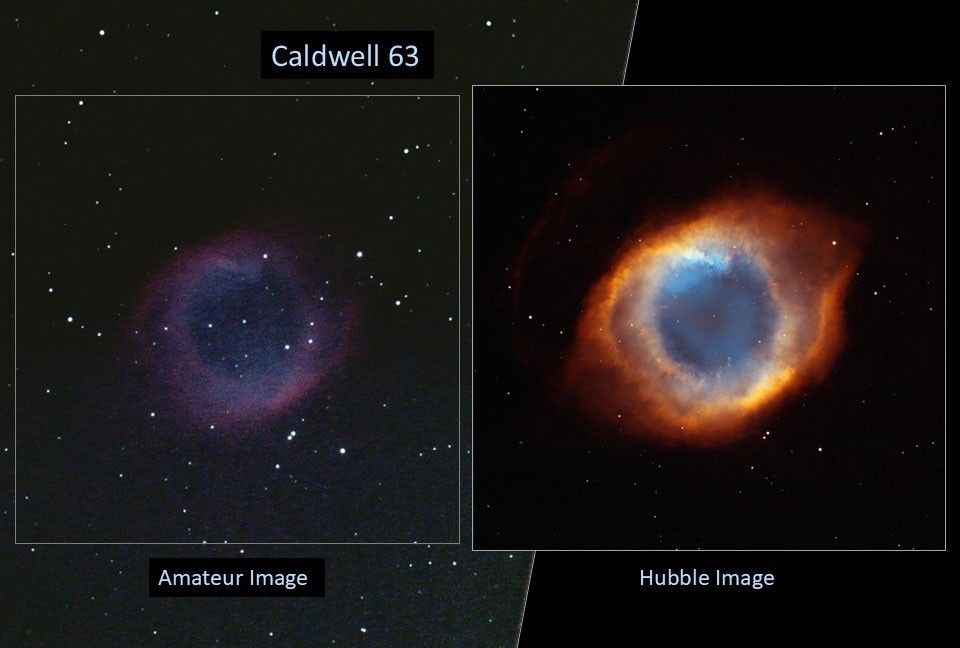


















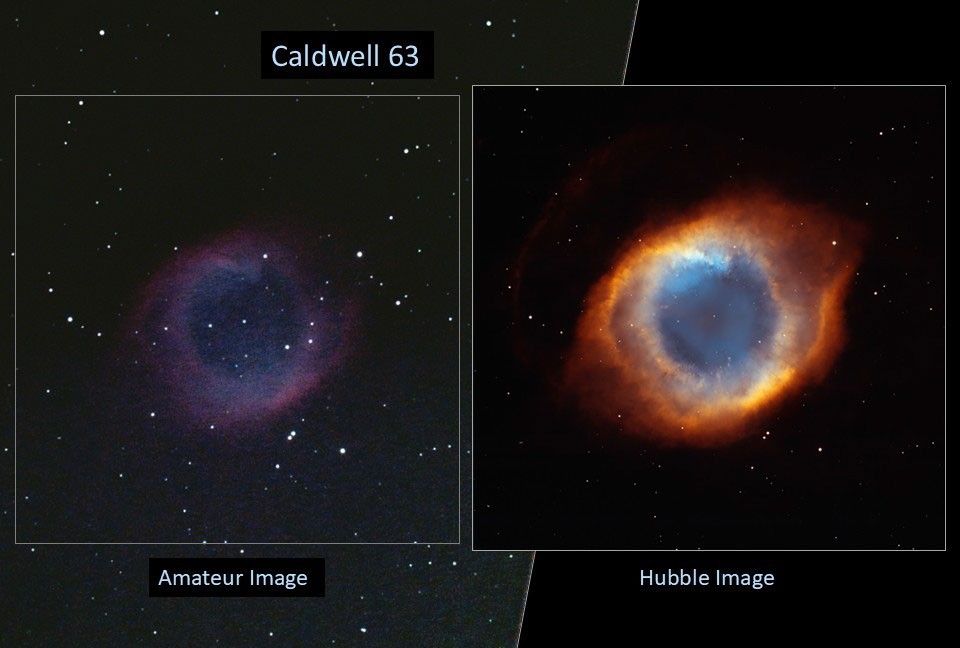
Caldwell 63: Amateur Image vs. Hubble Image
Caldwell 63 (C63) is a planetary nebula in the constellation Aquarius located some 650 light-years away. Commonly called the Helix Nebula, Caldwell 63’s bright ring stretches across nearly three light-years and dimmer, outer features extend even farther. Planetary nebulae like this one have no actual connection to planets but are called that because many of them have disk-like shapes that look like planets when viewed through small telescopes. They are produced as a medium-mass star dies and sloughs off its outer gaseous layers. These layers are expelled into space at astonishing speeds and glow from the energy given off by the dying star. The Caldwell 63 is one of the closest planetary nebulae to Earth. The left image was taken with an 8-inch Schmidt-Cassegrain telescope using a 0.63x focal reducer and a DSLR Camera. The right image was taken by NASA’s Hubble Space Telescope.
Image Credit: Photographed by and used with permission of K. Hartnett; Hubble Image: NASA, NOAO, ESA, the Hubble Helix Nebula Team, M. Meixner (STScI), and T.A. Rector (NRAO)
- X
https://science.nasa.gov/image-detail/amf-8cf8fce2-c134-40cf-af8c-0e6c9d3e3b63/
Image CreditPhotographed by and used with permission of K. Hartnett; Hubble Image: NASA, NOAO, ESA, the Hubble Helix Nebula Team, M. Meixner (STScI), and T.A. Rector (NRAO)
Size960x648px