

























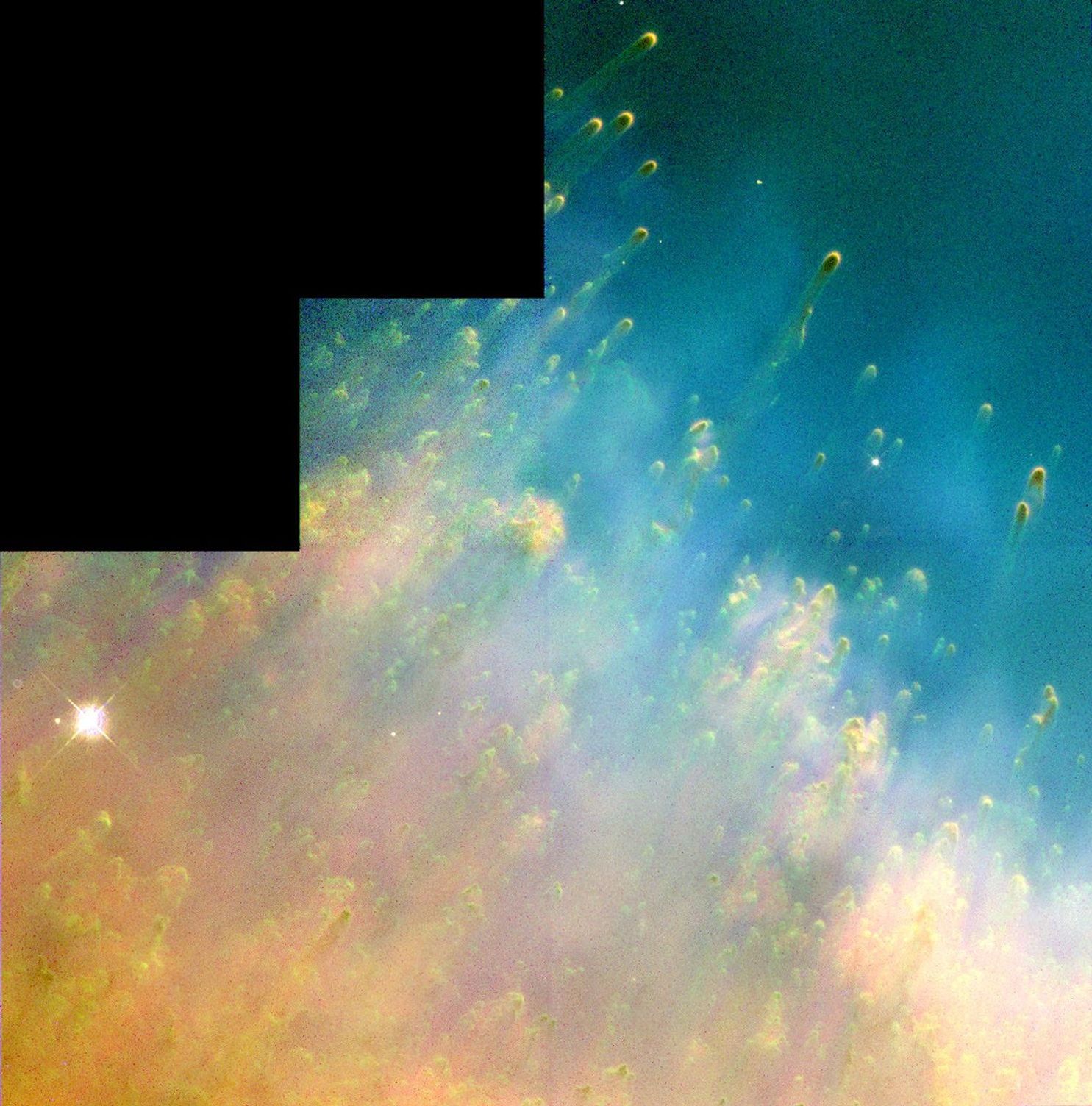
Helix Nebula
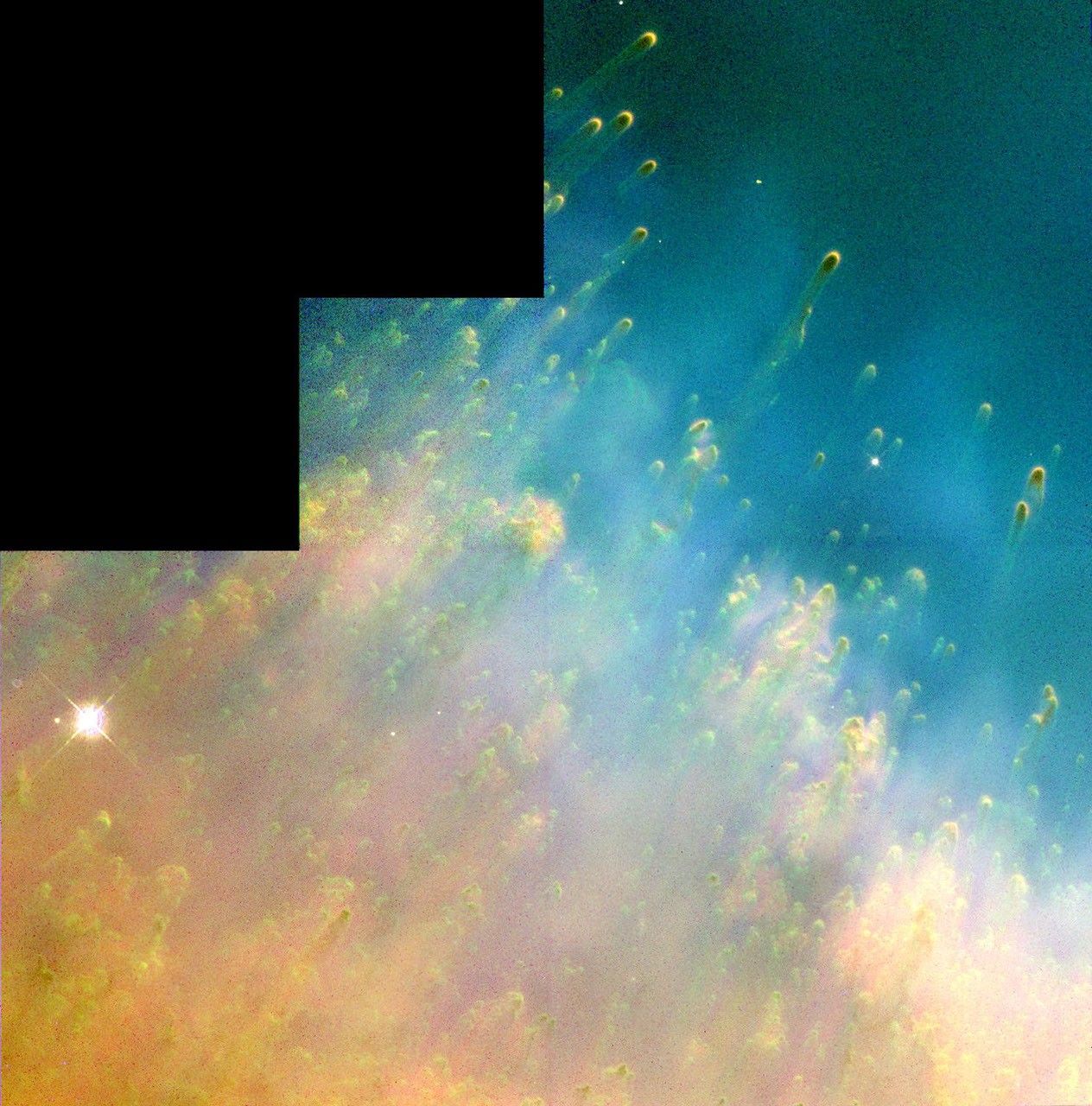
This colorful image from the Hubble Space Telescope shows the collision of two gases near a dying star. Astronomers have dubbed the tadpole-like objects in the upper right corner "cometary knots" because their glowing heads and gossamer tails resemble comets. Although astronomers have seen gaseous knots through ground-based telescopes, they have never seen so many in a single nebula. Hubble captured thousands of these knots from a doomed star in the Helix Nebula, the closest planetary nebula to Earth at 450 light-years away in the constellation Aquarius. Each gaseous head is at least twice the size of our solar system; each tail stretches 100 billion miles, about 1,000 times the Earth's distance to the Sun. The most visible gaseous fragments lie along the inner edge of the star's ring, trillions of miles from the star at its center. The comet-like tails form a radial pattern around the star like the spokes on a wagon wheel.
Image Credit: NASA, C. Robert O'Dell and Kerry P. Handron (Rice University)
- X
https://science.nasa.gov/image-detail/amf-91b75adb-0db0-4bdf-9911-6f51213c4631/
Image CreditNASA, C. Robert O'Dell and Kerry P. Handron (Rice University)
Size1486x1504px