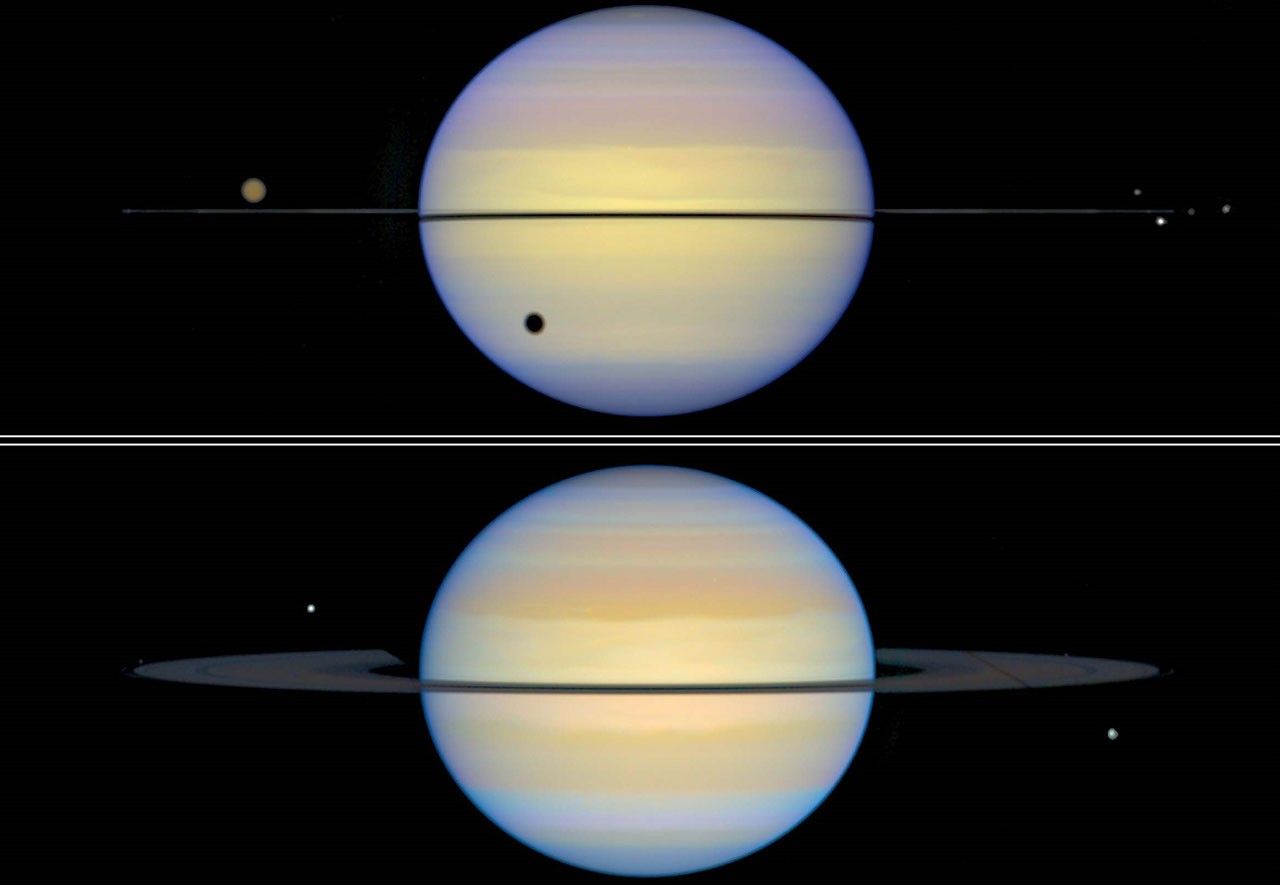






















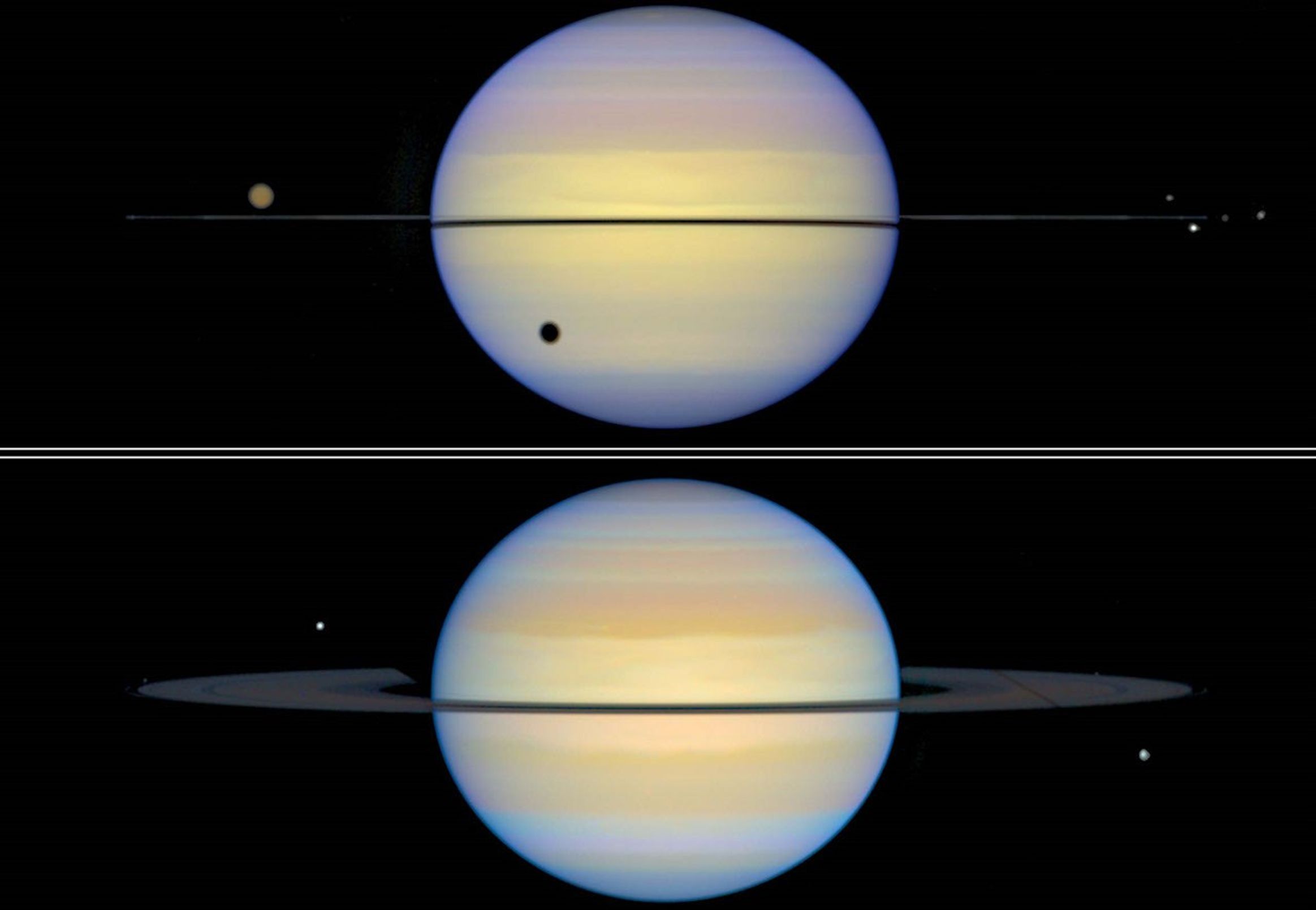
Saturn with Rings Edge-On
This Hubble Space Telescope snapshot shows Saturn with its rings edge-on and barely visible. Normally, astronomers see Saturn with its rings tilted. Earth was almost in the plane of Saturn's rings, thus the rings appear edge-on. In the top image, Saturn's largest moon, Titan, is casting a shadow on Saturn. Titan's atmosphere is a dark brown haze. The other moons appear white because of their bright, icy surfaces. Four moons — from left to right, Mimas, Tethys, Janus, and Enceladus — are clustered around the edge of Saturn's rings on the right. Two other tiny moons appear in front of the ring plane. Prometheus is on the right edge; Pandora, on the left. The rings also are casting a shadow on Saturn because the Sun was above the ring plane. The bottom photograph shows Saturn with its rings slightly tilted. The moon called Dione, on the lower right, is casting a long, thin shadow across the whole ring system due to the setting Sun on the ring plane. The moon on the upper left of Saturn is Tethys.
Image Credit: Erich Karkoschka (University of Arizona Lunar & Planetary Lab) and NASA
- X
https://science.nasa.gov/image-detail/amf-92292c76-7d91-4a6a-86ed-3d5ca9214b83/
Image CreditErich Karkoschka (University of Arizona Lunar & Planetary Lab) and NASA
Size2327x1610px