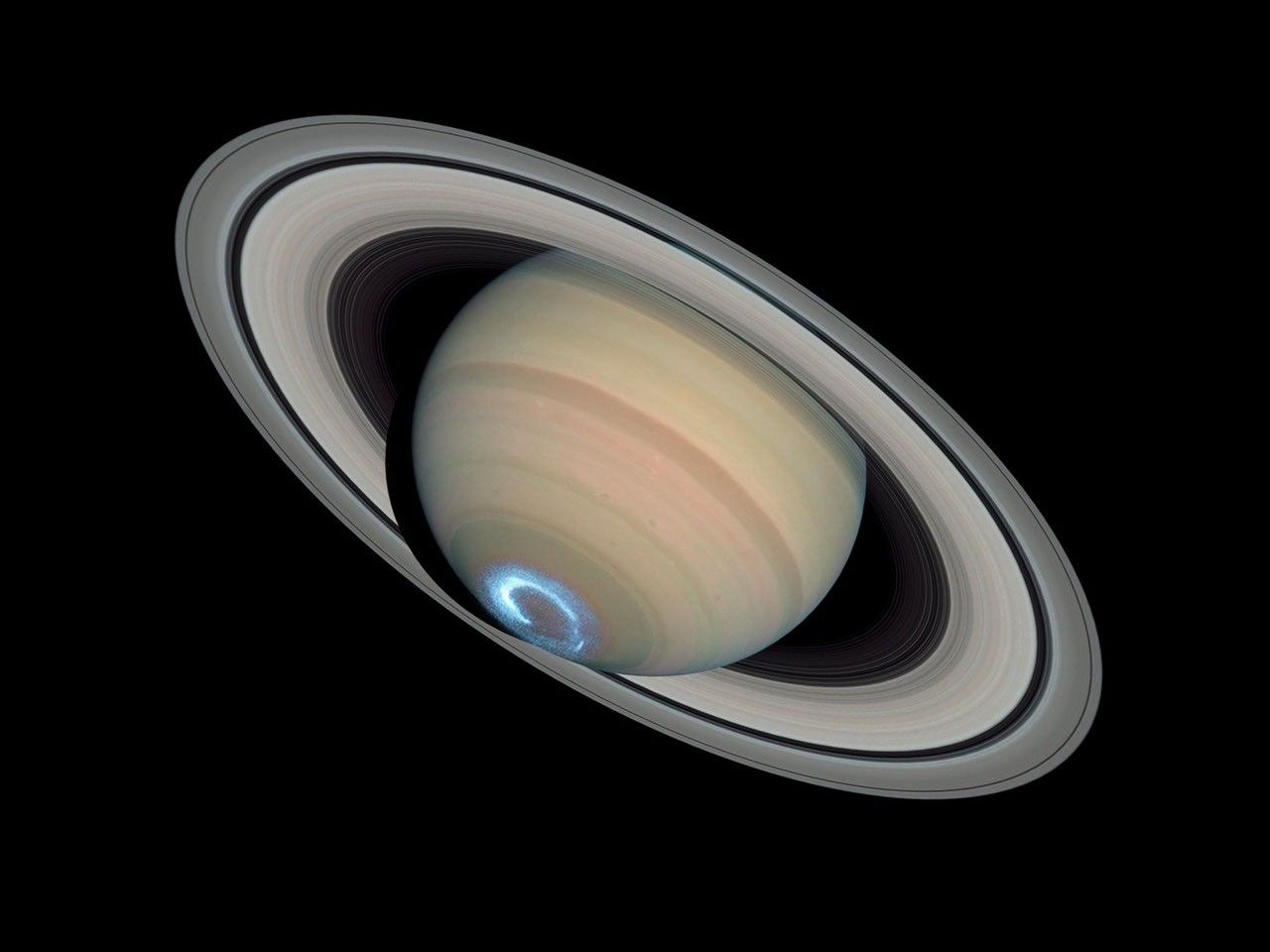



















Aurora on Saturn
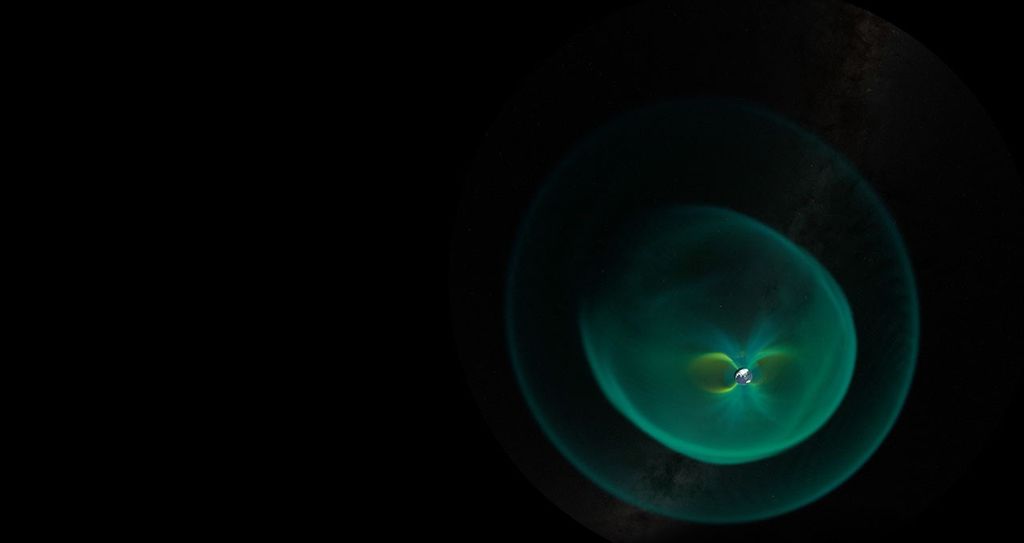
Seen from space, an aurora appears as a ring of light circling a planet's polar region, where magnetic poles typically reside. Auroral displays are initiated when charged particles in space collide with a planet's magnetic field and stream into the upper atmosphere. Collisions with gases in the planet's atmosphere produce flashes of glowing energy in the form of light and radio waves. Scientists had long believed Saturn's auroras possess properties akin to both Earth and Jupiter. Like Earth's, they were thought to be influenced by the solar wind. Like Jupiter's, they were assumed to be influenced by a ring of ions and charged particles encircling the planet. Though Saturn's auroras do share characteristics with the other planets, they are fundamentally unlike those on either Earth or Jupiter. When Saturn's auroras become brighter (and thus more powerful), the ring of energy encircling the pole shrinks in diameter. When Earth's auroras become brighter, the polar region for several minutes is filled with light. Then the ring of light dims and begins to expand. Jupiter's auroras, however, are only weakly influenced by the solar wind, becoming brighter about once a month, at the most, in response to solar wind changes. Saturn's auroral displays also become brighter on the sector of the planet where night turns to day as the storms increase in intensity, unlike either of the other two planets. At certain times, Saturn's auroral ring is more like a spiral, its ends not connected as the energy storm circle the pole.
Image Credit: NASA, ESA, J. Clarke (Boston University), and Z. Levay (STScI)
- X
https://science.nasa.gov/image-detail/amf-a2cc98c9-387a-4f08-9e57-227db26f58ad/
Image CreditNASA, ESA, J. Clarke (Boston University), and Z. Levay (STScI)
Size2261x1696px