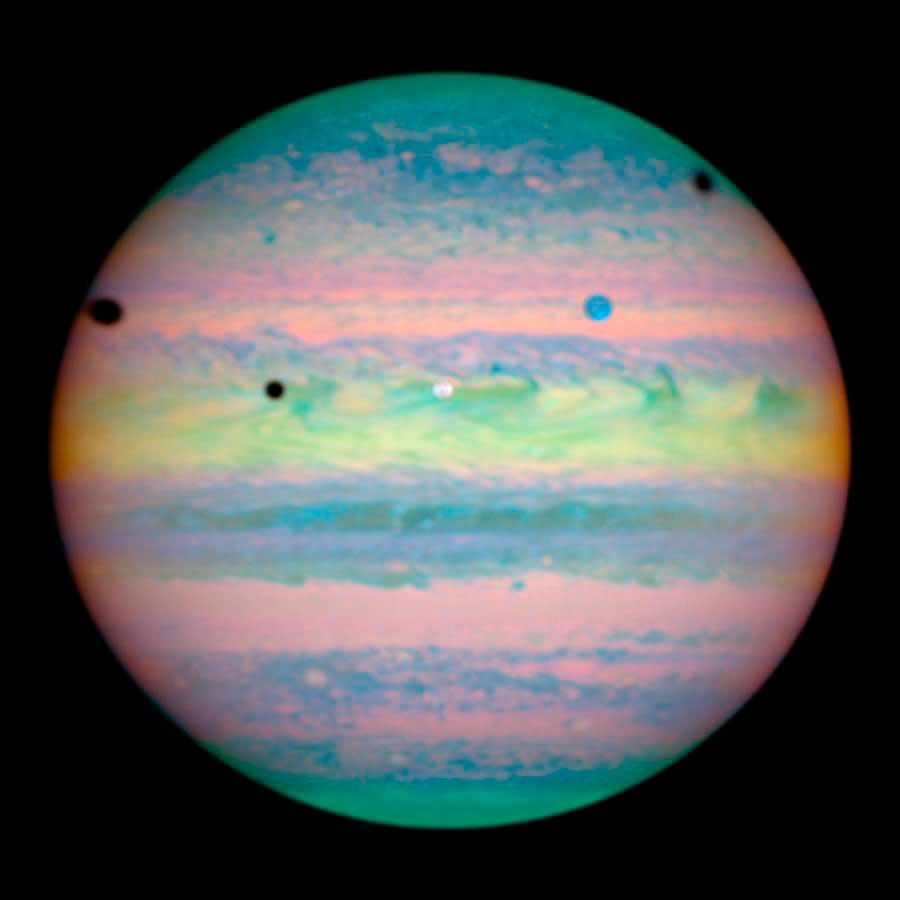

















Three Moons Cast Shadows on Jupiter
Jupiter appears in pastel colors in this photo because this observation was taken in near-infrared light. The photo shows sunlight reflected from Jupiter's clouds. In the near infrared, methane gas in Jupiter's atmosphere limits the penetration of sunlight, which causes clouds to appear in different colors depending on their altitude. Studying clouds in near-infrared light is very useful for scientists studying the layers of clouds that make up Jupiter's atmosphere. Yellow colors indicate high clouds, red colors lower clouds, and blue colors even lower clouds in Jupiter's atmosphere. The green color near the poles comes from a thin haze very high in the atmosphere. The black circles are cast by three of Jupiter's largest moons: Io, Ganymede, and Callisto. Io's shadow is located just above center and to the left, Ganymede's on the planet's left edge, and Callisto's near the right edge. The blue color of Ganymede (upper right) comes from the absorption of water ice on the moon's surface at longer wavelengths. The white color of Io (center) is from light reflected off bright sulfur compounds on that moon's surface. Callisto is out of the image and to the right. Seeing three shadows on Jupiter happens only about once or twice a decade. Why is this triple eclipse so unique? Io, Ganymede, and Callisto orbit Jupiter at different rates. Their shadows likewise cross Jupiter's face at different rates. For example, the outermost moon Callisto orbits the slowest of the three moons. Callisto's shadow moves across the planet once for every 20 shadow crossings of Io. Add the crossing rate of Ganymede's shadow and the possibility of a triple eclipse becomes even more rare. Viewing the triple shadows in this 2004 observation was even more special, because two of the moons were crossing Jupiter's face at the same time as the three shadows.
Image Credit: NASA, ESA, and E. Karkoschka (University of Arizona)
- X
https://science.nasa.gov/image-detail/amf-a5511be5-eadb-40f1-b5e4-ab0d5d0f4492/
Image CreditNASA, ESA, and E. Karkoschka (University of Arizona)
Size900x900px