
















Jupiter Auroras
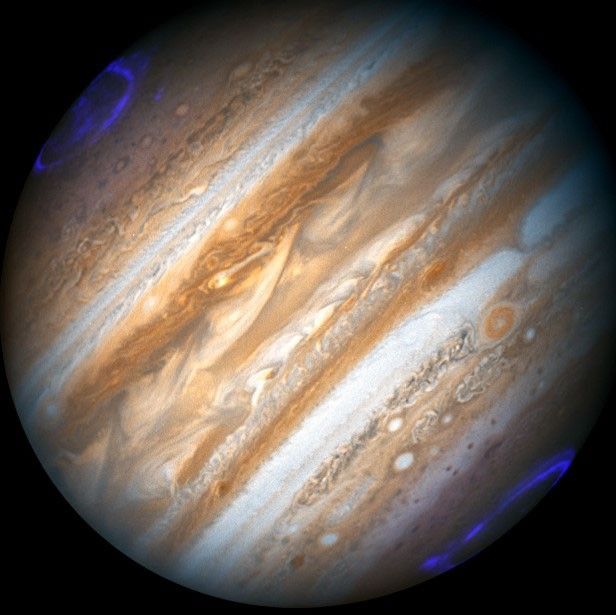
The Hubble Space Telescope captured this image of Jupiter's auroras in February 2007, in cooperation with NASA's New Horizons mission, which was approaching Jupiter at the time. Hubble’s ultraviolet capabilities, in particular, made it possible to study Jupiter’s auroras while the New Horizons spacecraft sampled the solar wind in situ. The glowing auroras near Jupiter’s north and south poles are produced when charged particles from the Sun become trapped in Jupiter's powerful magnetic field. They cause hydrogen to fluoresce high in Jupiter's atmosphere, near the planet's magnetic poles. In this dramatic image, Jupiter shows a novel array of cloud features including the recently formed Little Red Spot (on the right), a smaller version of Jupiter’s well-known and long-lived Great Red Spot (not shown here). Atmospheric features as small as 100 miles (160 km) across can be discerned.
Image Credit: NASA, ESA, and the Hubble Heritage Team (STScI/AURA); Acknowledgment: H. Weaver (JHU/APL) and A. Simon-Miller (NASA/GSFC)
- X
https://science.nasa.gov/image-detail/amf-c6cef067-ccc0-440b-8bb3-395c2be54a0d/
Image CreditNASA, ESA, and the Hubble Heritage Team (STScI/AURA); Acknowledgment: H. Weaver (JHU/APL) and A. Simon-Miller (NASA/GSFC)
Size616x615px