
























Disintegrating Asteroid P/2013 R3
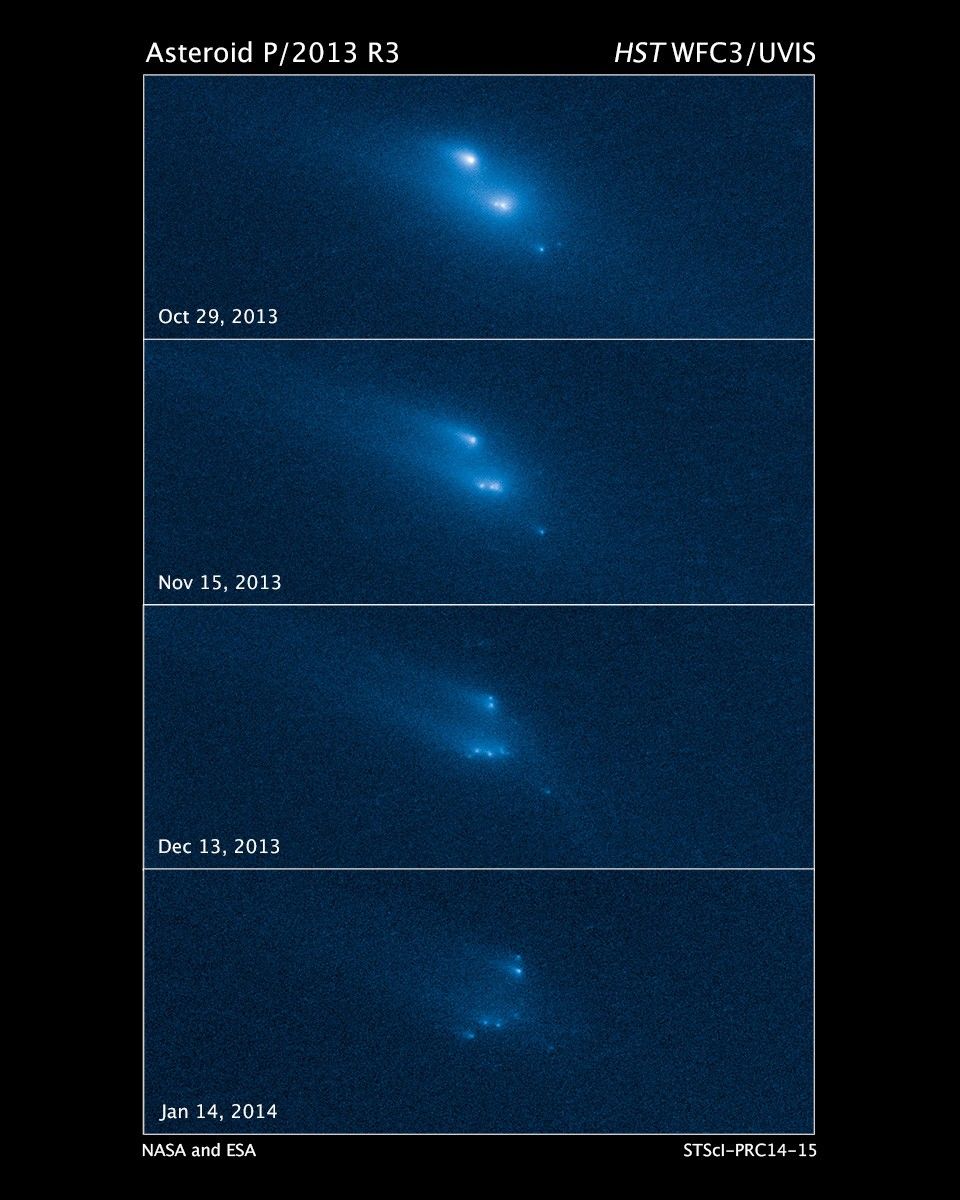
The Hubble Space Telescope photographed this breakup of an asteroid into as many as 10 smaller pieces. Though fragile comet nuclei had been seen falling apart as they neared the Sun, nothing like this breakup had ever been observed before in the asteroid belt. The series of images shows that the fragments are drifting away from each other at a leisurely one mile per hour. This makes it unlikely that the asteroid is disintegrating because of a collision with another asteroid. A plausible explanation is that the asteroid is crumbling due to a subtle effect of sunlight. This causes the rotation rate to slowly increase until centrifugal force pulls the asteroid apart. The asteroid's remnant debris, weighing in at 200,000 tons, will in the future provide a rich source of meteoroids. Most will eventually plunge into the Sun but a small fraction of the debris may one day hit Earth to blaze across the sky as meteors.
Image Credit: NASA, ESA, and D. Jewitt (University of California, Los Angeles)
- X
https://science.nasa.gov/image-detail/amf-e435c5ba-e894-4f5f-ba65-7f5b94f2b992/
Image CreditNASA, ESA, and D. Jewitt (University of California, Los Angeles)
Size960x1200px
