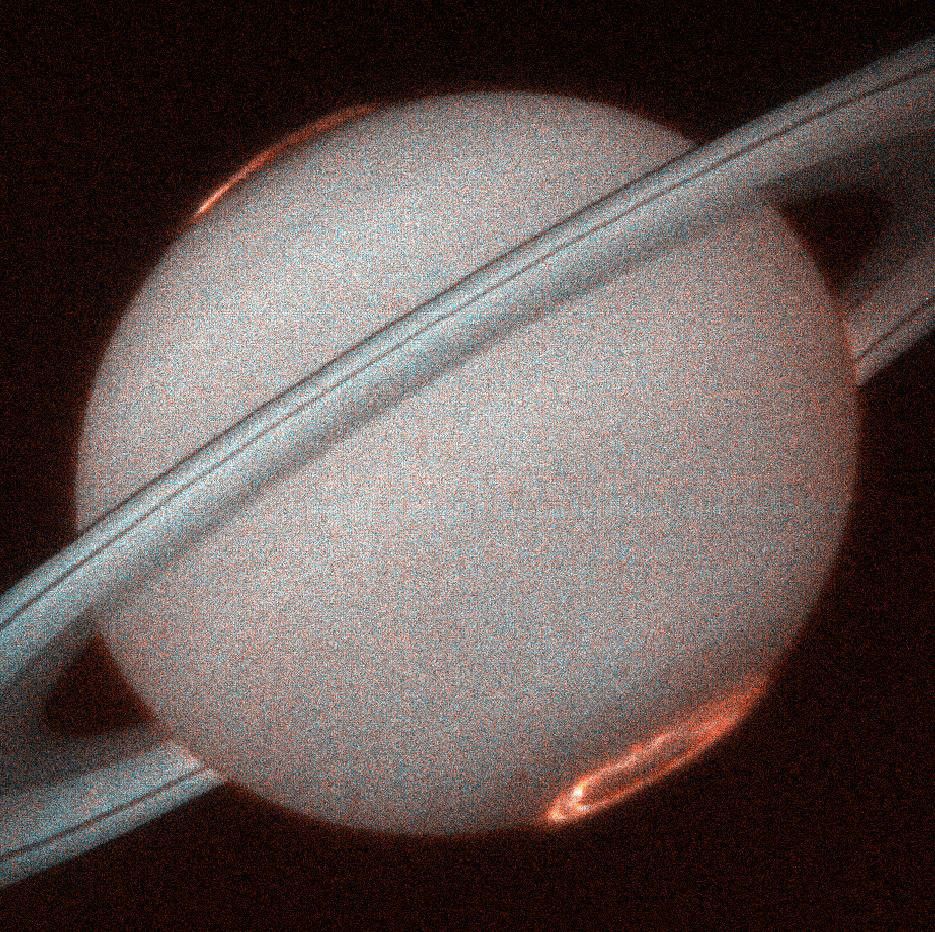





















Saturn’s Ultraviolet Aurora
This image of Saturn's ultraviolet auroras was taken in 1997 when Saturn was a distance of 810 million miles (1.3 billion kilometers) from Earth. Saturn's auroral displays are caused by an energetic wind from the Sun that sweeps over the planet, much like Earth's auroras, which are occasionally seen in the nighttime sky and similar to the phenomenon that causes fluorescent lamps to glow. But unlike auroras on Earth, Saturn's auroras are only seen in ultraviolet light, invisible from Earth's surface, hence the auroras can only be observed from space. Hubble's images of Saturn's auroras reveal ripples and overall patterns that evolve slowly, appearing generally fixed in our view and independent of planet rotation. At the same time, the auroras show local brightening that often follow the rotation of the planet and exhibit rapid variations on time scales of minutes. These variations and regularities indicate that the auroras are primarily shaped and powered by a continual tug-of-war between Saturn's magnetic field and the flow of charged particles from the Sun.
Image Credit: J.T. Trauger (Jet Propulsion Laboratory) and NASA
- X
https://science.nasa.gov/image-detail/amf-f4099871-2834-4831-868e-3729c3946a69/
Image CreditJ.T. Trauger (Jet Propulsion Laboratory) and NASA
Size935x932px