




















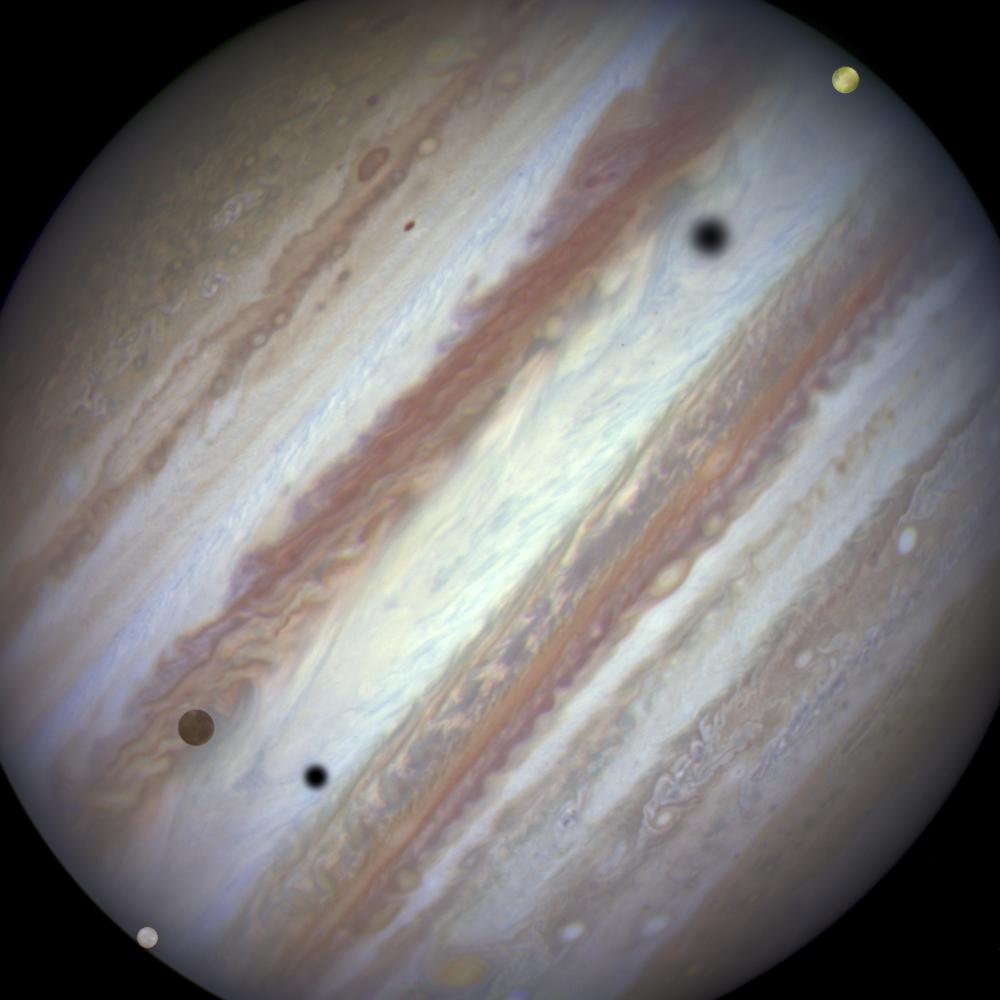
Jupiter Moon Transits
On January 24, 2015, the Hubble Space Telescope captured a rare look at three of Jupiter's largest moons, Europa, Callisto, and Io, zipping across the banded face of the gas-giant planet. Jupiter's four largest moons can commonly be seen transiting the face of the giant planet and casting shadows onto its cloud tops. However, seeing three moons transiting the face of Jupiter at the same time is rare, occurring only once or twice a decade. Europa has entered the frame at lower left. Slower-moving Callisto is above and to the right of Europa. Fastest-moving Io is approaching the eastern limb of the planet (on the right). Europa's shadow is toward the left side of the image and Callisto's shadow is to the right. Missing from the sequence is the moon Ganymede, which was too far from Jupiter in angular separation to be part of the conjunction.
Image Credit: NASA, ESA, and the Hubble Heritage Team (STScI/AURA)
- X
https://science.nasa.gov/image-detail/jupiter-moon-transits/
Image CreditNASA, ESA, and the Hubble Heritage Team (STScI/AURA)
Size1000x1000px