
























Six-tailed Asteroid P/2013 P5
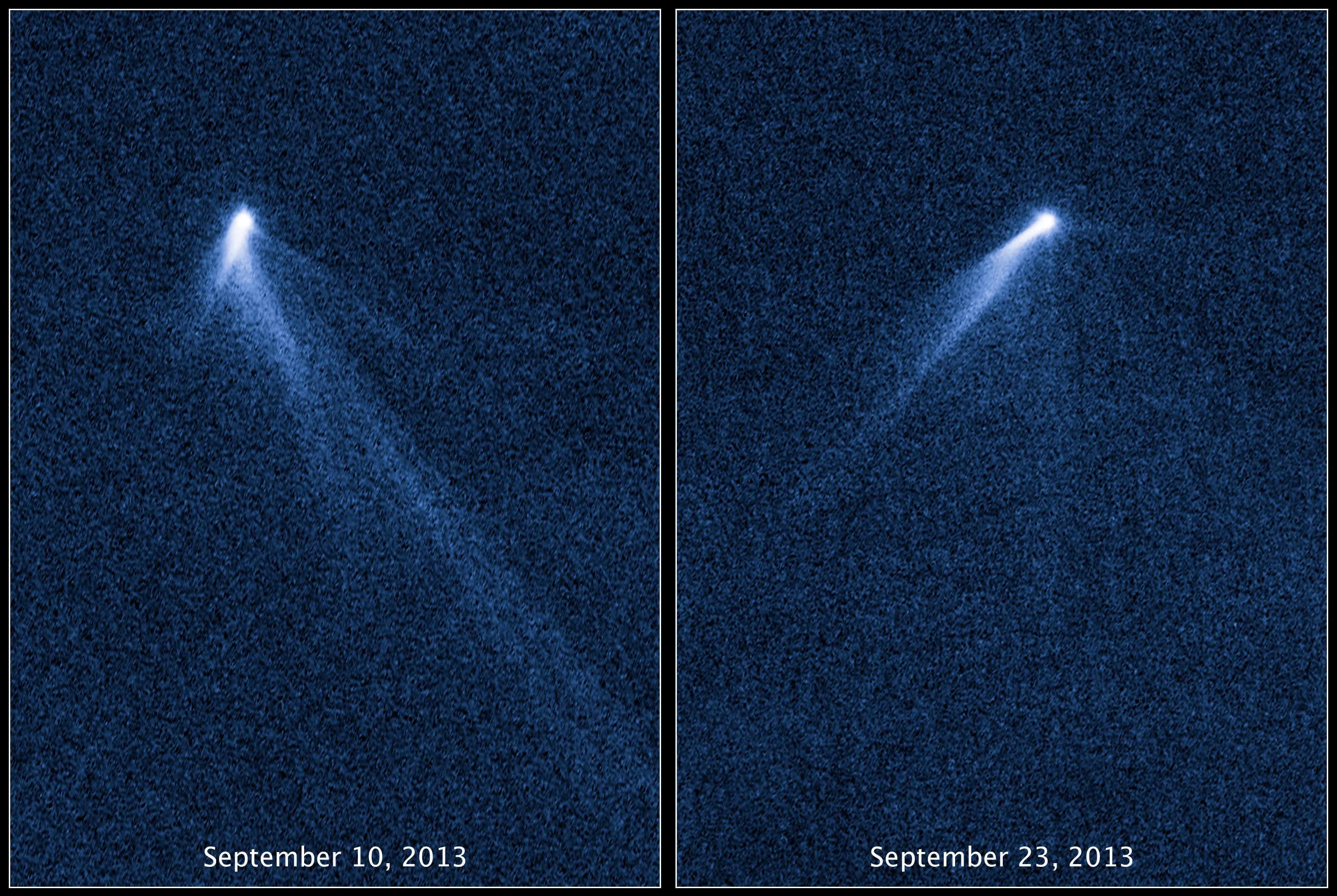
This pair of Hubble Space Telescope images reveals a never-before-seen set of six comet-like tails radiating from an asteroid designated P/2013 P5. The asteroid was discovered as an unusually fuzzy-looking object with the Panoramic Survey Telescope and Rapid Response System (Pan-STARRS) survey telescope in Hawaii. The multiple tails were discovered in Hubble images taken on September 10, 2013. When Hubble viewed the asteroid again on September 23, the asteroid's appearance had totally changed. It looked as if the entire structure had swung around. One interpretation is that the asteroid's rotation rate was increased to the point where dust was falling off the surface and escaping into space, where the pressure of sunlight swept out finger-like tails. According to this theory, the asteroid's spin was accelerated by the gentle push of sunlight. The object, estimated to be no more than 1,400 feet across, had ejected dust for at least five months, based on analysis of the tail structure.
Image Credit: NASA, ESA, D. Jewitt (University of California, Los Angeles), J. Agarwal (Max Planck Institute for Solar System Research), H. Weaver (Johns Hopkins University Applied Physics Laboratory), M. Mutchler (STScI), and S. Larson (University of Arizona)
- X
https://science.nasa.gov/image-detail/prc13-52a/
Image CreditNASA, ESA, D. Jewitt (University of California, Los Angeles), J. Agarwal (Max Planck Institute for Solar System Research), H. Weaver (Johns Hopkins University Applied Physics Laboratory), M. Mutchler (STScI), and S. Larson (University of Arizona)
Size2888x1936px