
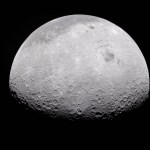











This is the final targeted flyby of Dione in Cassini's long mission. The radio science team will conduct a gravity experiment at closest approach. The data collected will contribute to our knowledge of the internal structure of Dione, the rigidity of its outer ice shell, and enable insightful comparisons with Saturn’s other icy moons. The camera and spectrometers will observe the fully lit anti-Saturn side of Dione during approach. These instruments will also get a quick peek at the North Pole, which hasn’t been observed closely, at a resolution of only a few meters. The Composite Infrared Spectrometer (CIRS) will map areas on Dione that have unusual thermal anomalies. These are regions that are especially good at trapping heat. The Cosmic Dust Analyzer will continue its search for dust particles emitted from Dione.
Dione Flyby at a Glance
Date
Aug. 17, 2015
Altitude
295 miles (474 km)
Speed
14,316 mph (6.4 km/sec)