





















Description
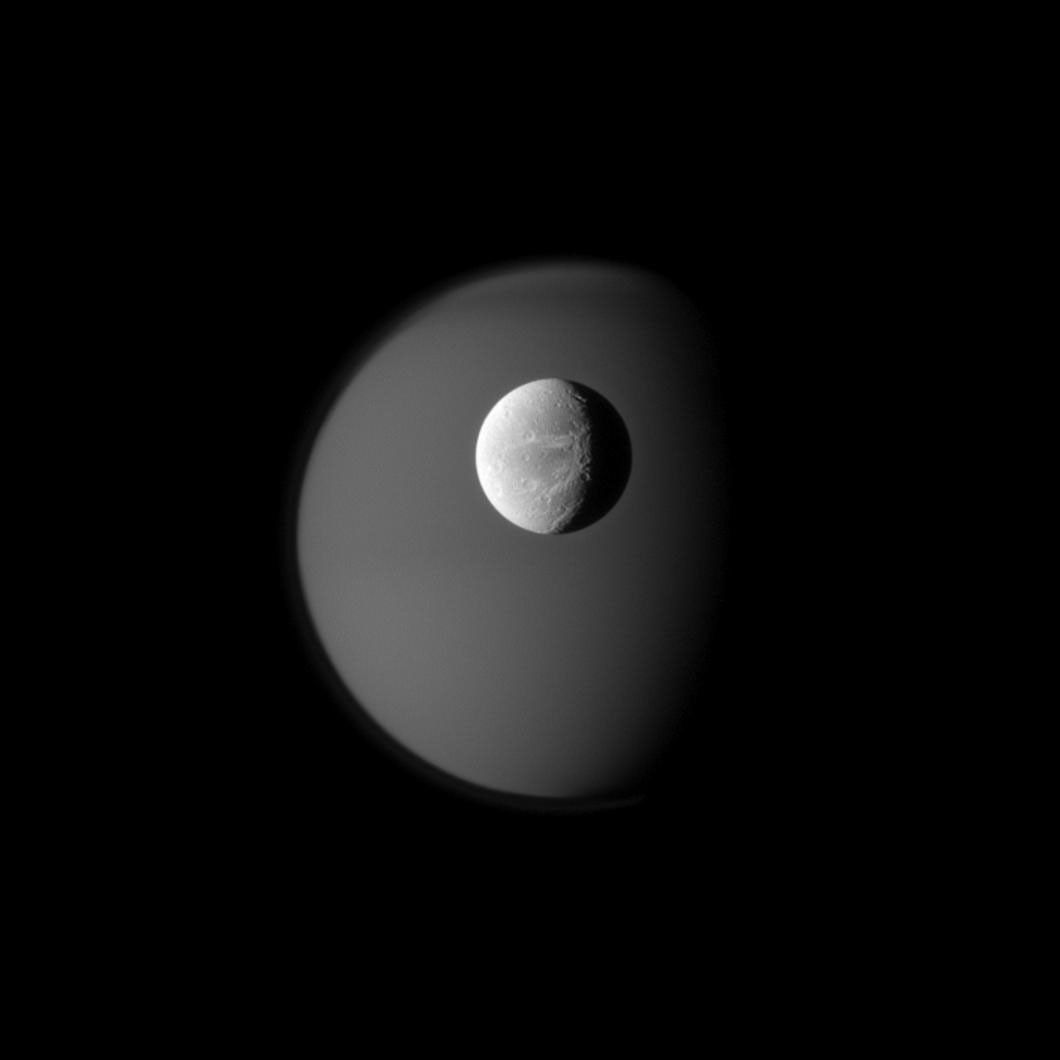
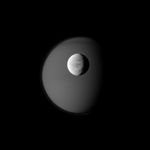
The surface of Saturn's moon Dione is rendered in crisp detail against a hazy, ghostly Titan.
A portion of the "wispy" terrain of Dione's trailing hemisphere can be seen on the right (see
). Also visible in this image are hints of atmospheric banding around Titan's north pole. To learn more about the northern bands, see
and
. This view looks toward the Saturn-facing hemisphere of Dione (1,123 kilometers, or 698 miles across) and Titan (5,150 kilometers, or 3,200 miles across).
The image was taken in visible blue light with the Cassini spacecraft narrow-angle camera on April 10, 2010. The view was acquired at a distance of approximately 1.8 million kilometers (1.1 million miles) from Dione and 2.7 million kilometers (1.7 million miles) from Titan. Scale in the original image was 11 kilometers (7 miles) per pixel on Dione and 16 kilometers (10 miles) on Titan. The image has been magnified by a factor of 1.5 and contrast-enhanced to aid visibility.
The Cassini-Huygens mission is a cooperative project of NASA, the European Space Agency and the Italian Space Agency. The Jet Propulsion Laboratory, a division of the California Institute of Technology in Pasadena, manages the mission for NASA's Science Mission Directorate, Washington, D.C. The Cassini orbiter and its two onboard cameras were designed, developed and assembled at JPL. The imaging operations center is based at the Space Science Institute in Boulder, Colo.
For more information about the Cassini-Huygens mission visit http://saturn.jpl.nasa.gov/. The Cassini imaging team homepage is at http://ciclops.org.