


























Description
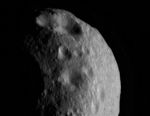
Eros' many craters have a range of ages dating back to the last time the asteroid's surface was "wiped clean" by geologic processes. This NEAR Shoemaker image of the tip of the asteroid, taken March 6, 2000, from a range of 201 kilometers (125 miles), shows craters with a variety of shapes and sizes. When small craters first form, they typically have sharp rims and round floors. As they age, progressively smaller craters are superimposed, rounding the rims and pitting the walls and floors until the original underlying crater becomes almost unrecognizable.
Built and managed by The Johns Hopkins University Applied Physics Laboratory, Laurel, Maryland, NEAR was the first spacecraft launched in NASA's Discovery Program of low-cost, small-scale planetary missions. See the NEAR web page at http://near.jhuapl.edu/ for more details.