












Description
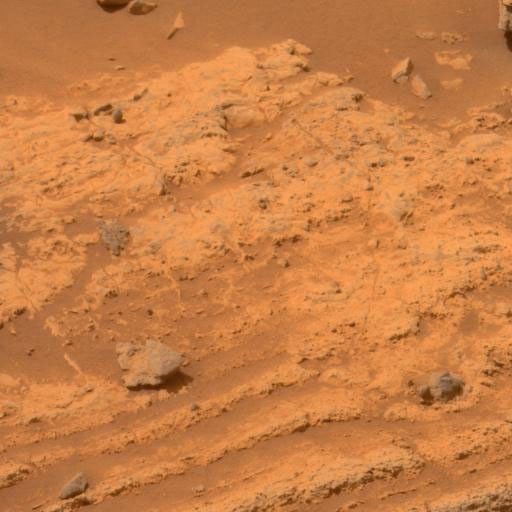
This view of layers around the edge of a low plateau called "Home Plate" inside Mars' Gusev Crater includes a feature that may be what geologists call a "bomb sag" and interpret as evidence of an explosive event, such as a volcanic eruption.
The layers seen here are generally straight and parallel except in the lower right, where they dip around a greyish rock that is about 4 centimeters (about 1.5 inches) in diameter. When layered deposits are struck by a falling rock while the layers are still soft, this type of pattern can be created. The rock might have been lofted by a volcanic burst or as part of the material ejected by the crater-forming impact of a meteorite.
The panoramic camera (Pancam) on NASA's Mars Exploration Rover Spirit acquired the exposures for this image on Spirit's 754th Martian day (Feb. 15, 2006). This view is an approximately true-color rendering mathematically generated from separate images taken through all of the left Pancam's 432-nanometer to 753-nanometer filters.