











Description
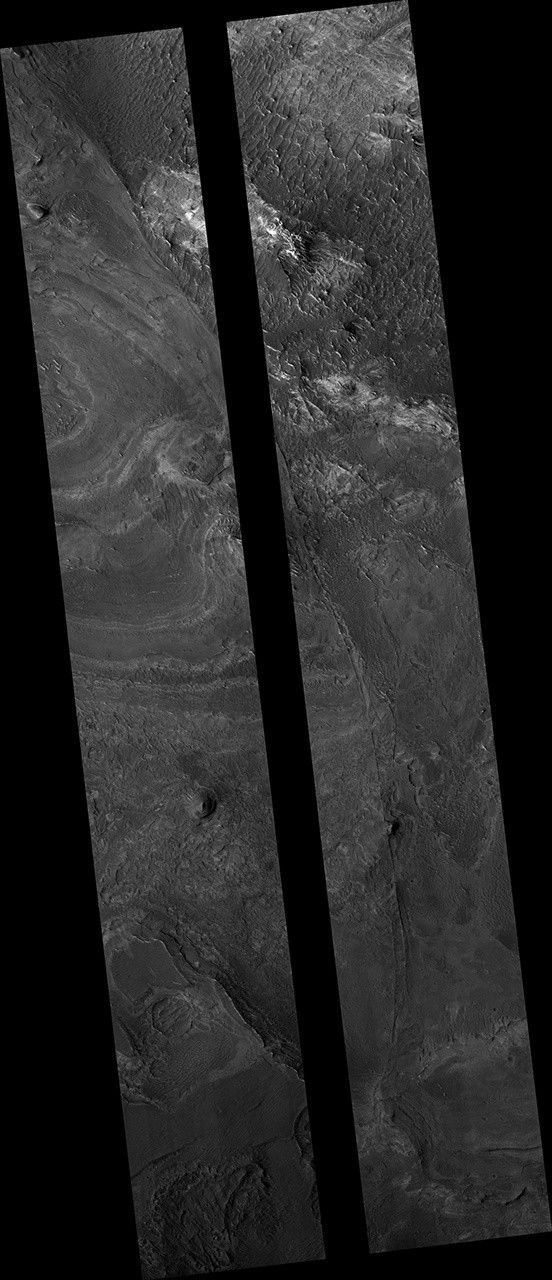
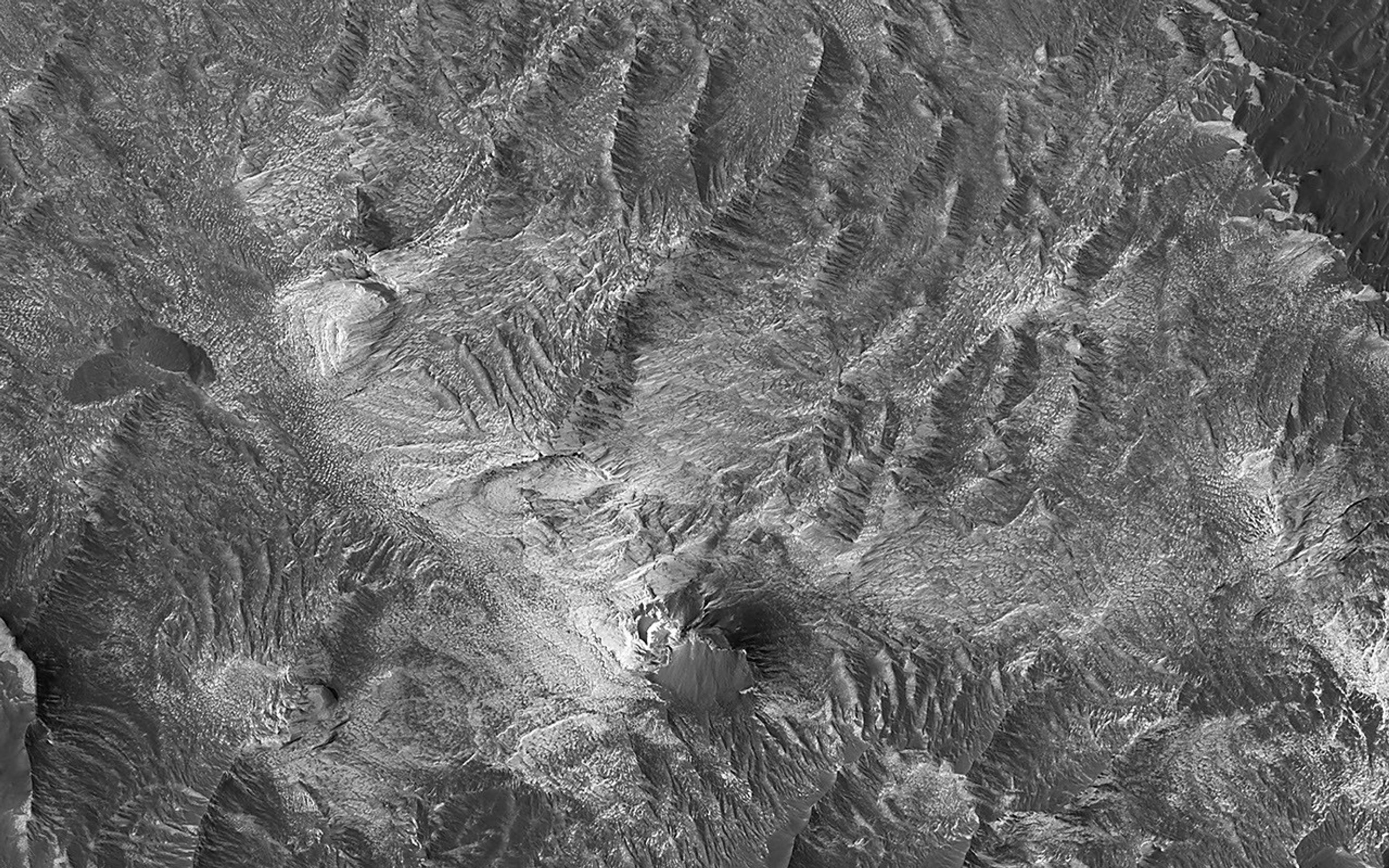
Map Projected Browse Image
Click on image for larger version
This image was acquired to get more information about a site where the CRISM instrument detected hydrated sulfates. The bright materials are likely to be sediments rich in the hydrated sulfates, and this image shows that most of the material is covered by a thin deposit of dark material, perhaps sand.
We also see streamlined patterns that suggest fluvial processes were involved in depositing or eroding the sulfate-rich sediments.
The map is projected here at a scale of 50 centimeters (19.7 inches) per pixel. (The original image scale is 53.2 centimeters [20.9 inches] per pixel [with 2 x 2 binning]; objects on the order of 160 centimeters [63.0 inches] across are resolved.) North is up.
This is a stereo pair with ESP_082990_1670.
The University of Arizona, in Tucson, operates HiRISE, which was built by Ball Aerospace & Technologies Corp., in Boulder, Colorado. NASA's Jet Propulsion Laboratory, a division of Caltech in Pasadena, California, manages the Mars Reconnaissance Orbiter Project for NASA's Science Mission Directorate, Washington.