



















Description
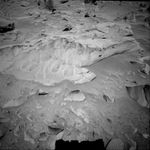
NASA's Spirit took this navigation camera image of the 2-meter-wide (6.6-foot-wide) rock called "Mazatzal" on sol 76, March 21, 2004. Scientists intend to aggressively analyze this target with Spirit's microscopic imager, Moessbauer spectrometer and alpha particle X-ray spectrometer before brushing and "digging in" with the rock abrasion tool on upcoming sols.
Mazatzal stood out to scientists because of its large size, light tone and sugary surface texture. It is the largest rock the team has seen at the rim of the crater informally named "Bonneville." It is lighter-toned than previous rock targets Adirondack and Humphrey. Its scalloped pattern may be a result of wind sculpting, a very slow process in which wind-transported silt and sand abrade the rock's surface, creating depressions. This leads scientists to believe that Mazatzal may have been exposed to the wind in this location for an extremely long time.
The name "Mazatzal" comes from a mountain range and rock formation that was deposited around 1.2 billion years ago in the Four Peaks area of Arizona.