
























Description
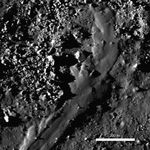
Spectacularly preserved viscous flow on the NE rim of Byrgius A (19 km diameter) crater. This flow has a form similar to lava flows on the Earth -- however it formed as a result of an asteroid or comet slamming into the Moon at hyper-velocity (>16 km/second). So much energy was released in the impact that solid rock was melted and thrown out of the crater where it flowed down the crater flanks (M102573276L, image width 810 m).
NASA's Goddard Space Flight Center built and manages the mission for the Exploration Systems Mission Directorate at NASA Headquarters in Washington. The Lunar Reconnaissance Orbiter Camera was designed to acquire data for landing site certification and to conduct polar illumination studies and global mapping. Operated by Arizona State University, the LROC facility is part of the School of Earth and Space Exploration (SESE). LROC consists of a pair of narrow-angle cameras (NAC) and a single wide-angle camera (WAC). The mission is expected to return over 70 terabytes of image data.