


























Description
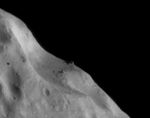
The many craters on Eros' surface attest to its battering by meteors - mostly debris ejected from other asteroids. This picture, taken July 7, 2000, from an orbital altitude of 50 kilometers (31 miles), neatly encapsulates the effects of a long history of impact cratering. Two overlapping craters, probably formed many millions of years apart, form a composite depression nearly 1.6 kilometers (1 mile) long. Large boulders, perhaps broken off Eros during these impacts, are perched on the craters' edge. The largest boulder, on the horizon in the center of the picture, is about 40 meters (130 feet) long. The whole scene is 1.8 kilometers (1.2 miles) across.
Built and managed by The Johns Hopkins University Applied Physics Laboratory, Laurel, Maryland, NEAR was the first spacecraft launched in NASA's Discovery Program of low-cost, small-scale planetary missions. See the NEAR web page at http://near.jhuapl.edu/ for more details.