














Overview
Heliophysics — the study of the Sun and how it influences space — is full of exotic phenomena that shape space from the Sun to the outer edges of the solar system, billions of miles away. Some of them are well understood by scientists, while others remain under study. The Heliopedia is a collection of “living” definitions of some of those phenomena, adapted and expanded upon as we learn more.
Entries are listed alphabetically. Click on a letter below or use the index at left to navigate the Heliopedia.
The term heliophysics was first used in a scientific newsletter in 1910 — that's 48 years before NASA was created!

A, B, C, D
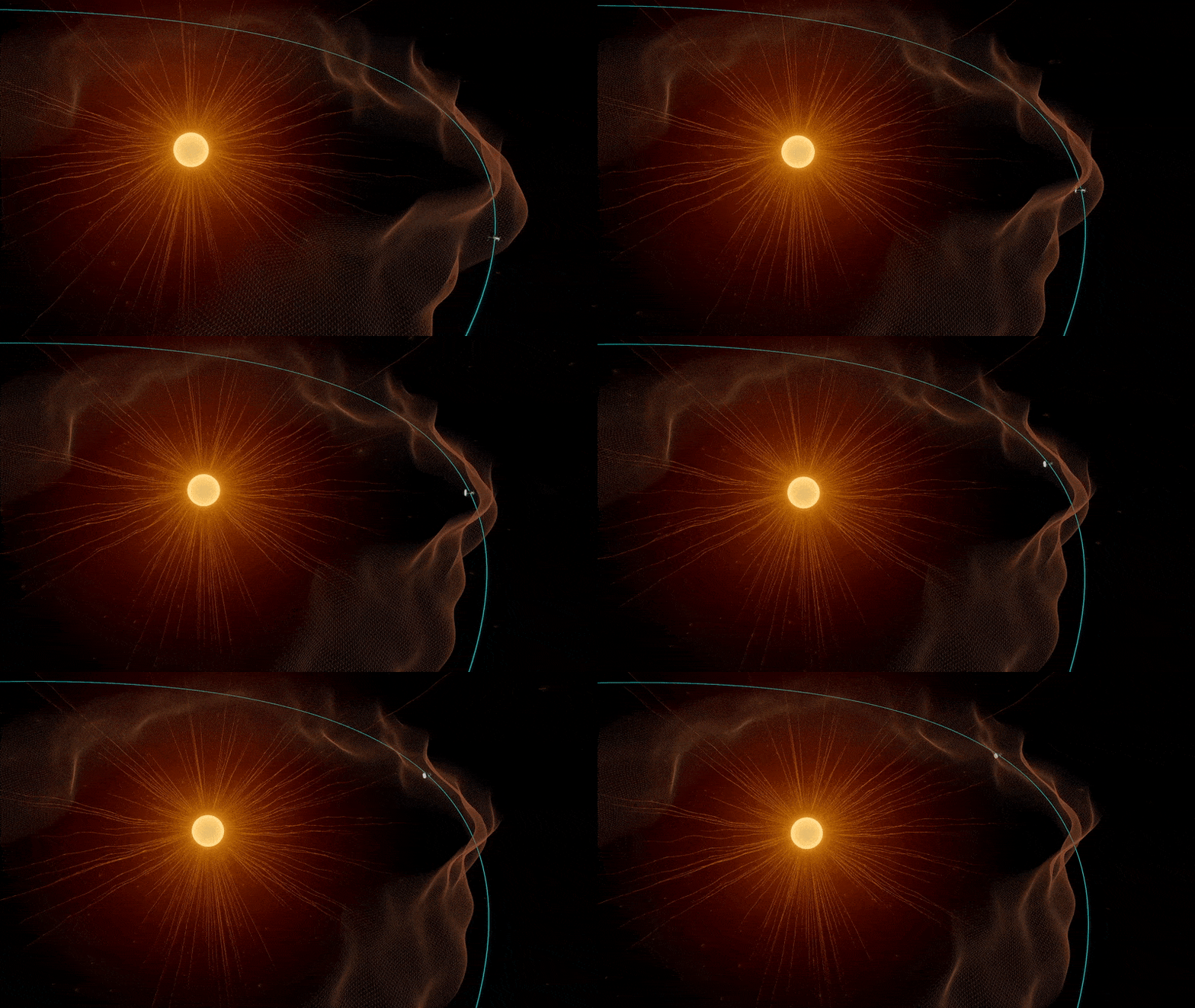
Alfvén surface/Alfvén zone
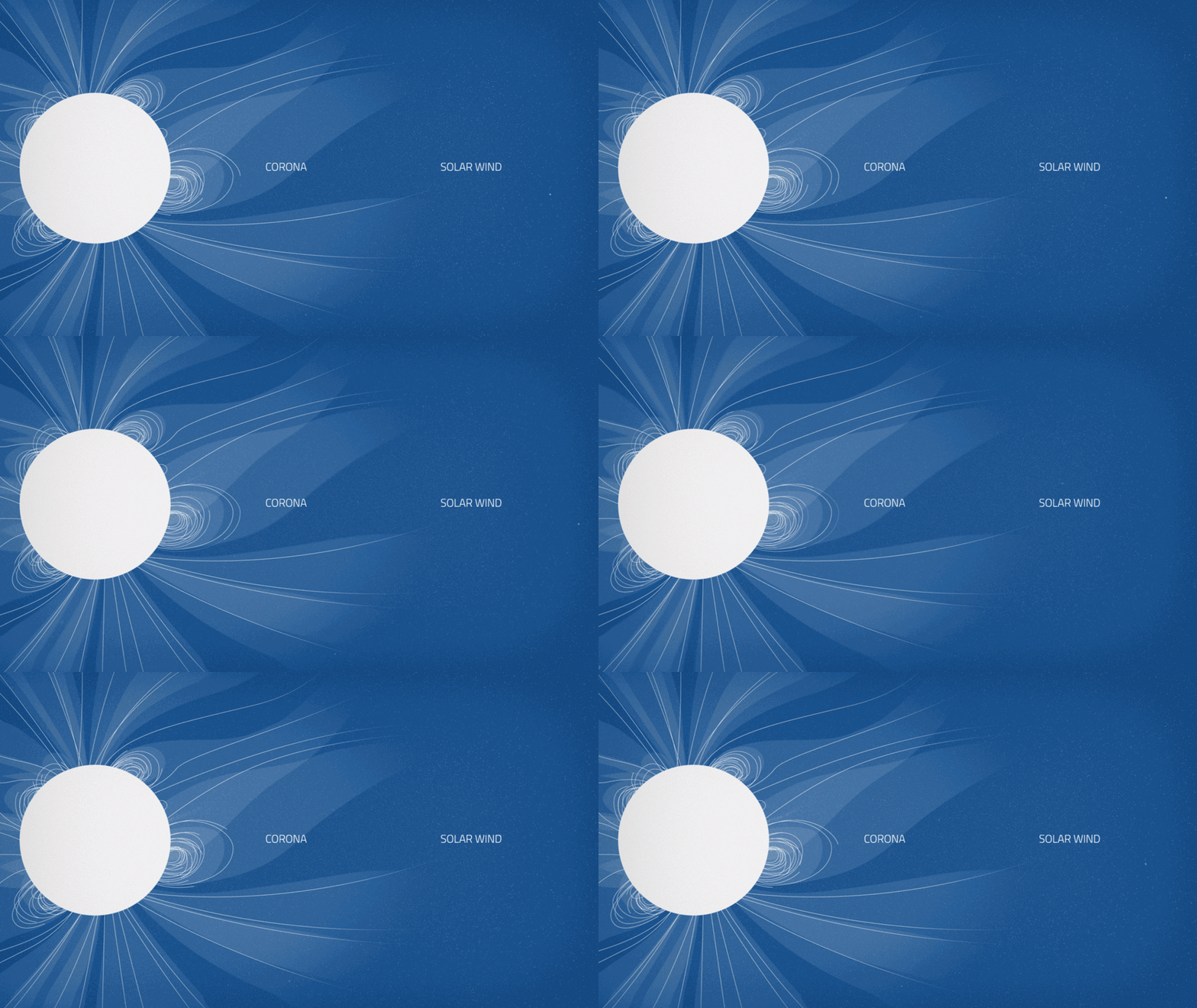
The Alfvén surface (or zone) is the point past which material leaving the Sun is moving too quickly for it to propagate back to the Sun. As material leaves the Sun — in the form of solar wind or explosive clouds called coronal mass ejections — it accelerates, eventually moving too fast to return. The Alfvén surface marks the transition point between the Sun’s outer atmosphere (the corona) and the solar wind.
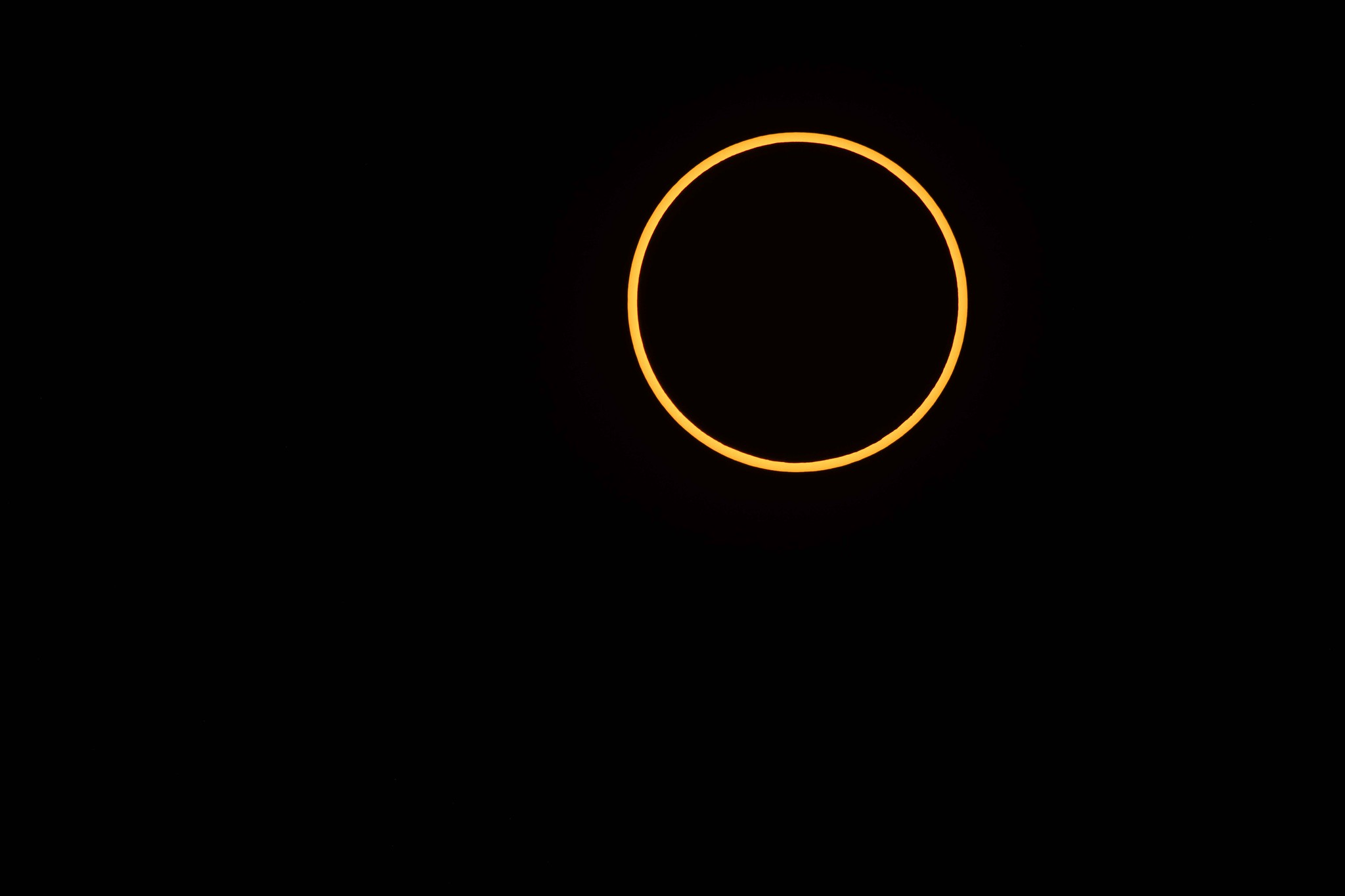
Annular solar eclipse
An annular solar eclipse happens when the Moon passes in front of the Sun but the Moon is near its farthest distance from Earth in its orbit, so its apparent size in the sky is too small to completely block the Sun’s bright disk. As the Moon moves in front of the Sun, its slightly smaller apparent size means that the Moon is completely contained within the solar disk and leaves a bright ring of the Sun visible around the edges. This ring around the edge of the Moon is too bright to look at safely with the unaided eye and is often described as a “ring of fire.” The path of the Moon’s shadow cast during an annular eclipse is called the path of annularity.
Aurora
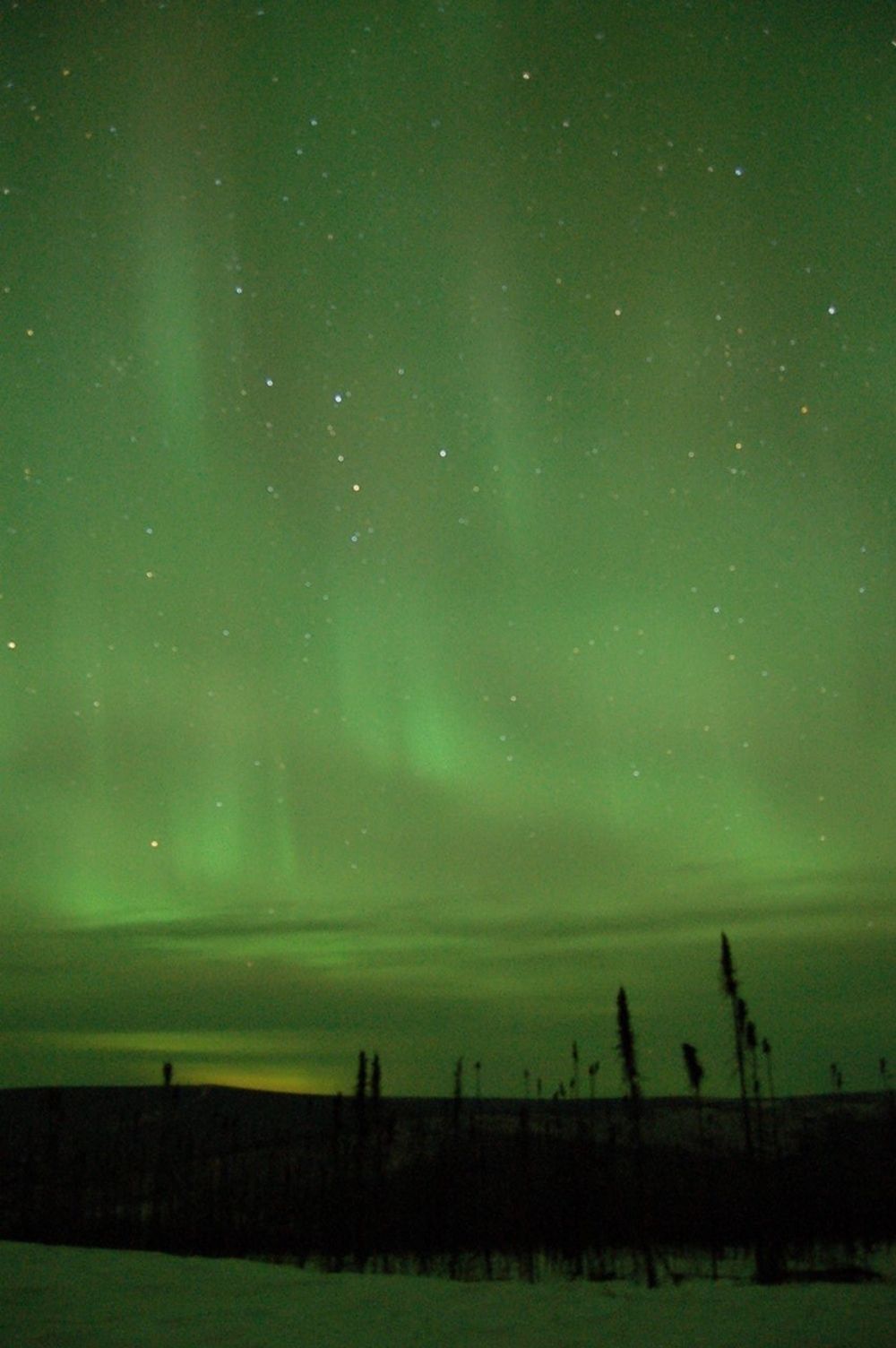
An aurora is a brilliant display of light in the night sky. The aurora borealis and aurora australis — also known as the northern and southern lights — occur mainly near Earth’s poles. When the solar wind reaches Earth’s magnetosphere, it can send charged particles trapped in Earth’s magnetic field raining down toward Earth’s poles, driven by a powerful process called magnetic reconnection.
Along the way, particles can collide with atoms and molecules in Earth’s upper atmosphere, providing the atoms with extra energy that they release as a burst of light. These interactions continue at lower and lower altitudes until all the excess energy is lost. Glowing auroras are the result of millions of individual particle collisions, lighting up Earth’s magnetic field lines. Studying auroras offers insights on how our magnetosphere reacts to near-Earth space weather.
See cusp aurora, diffuse aurora, discrete aurora, pulsating aurora

Baily’s Beads
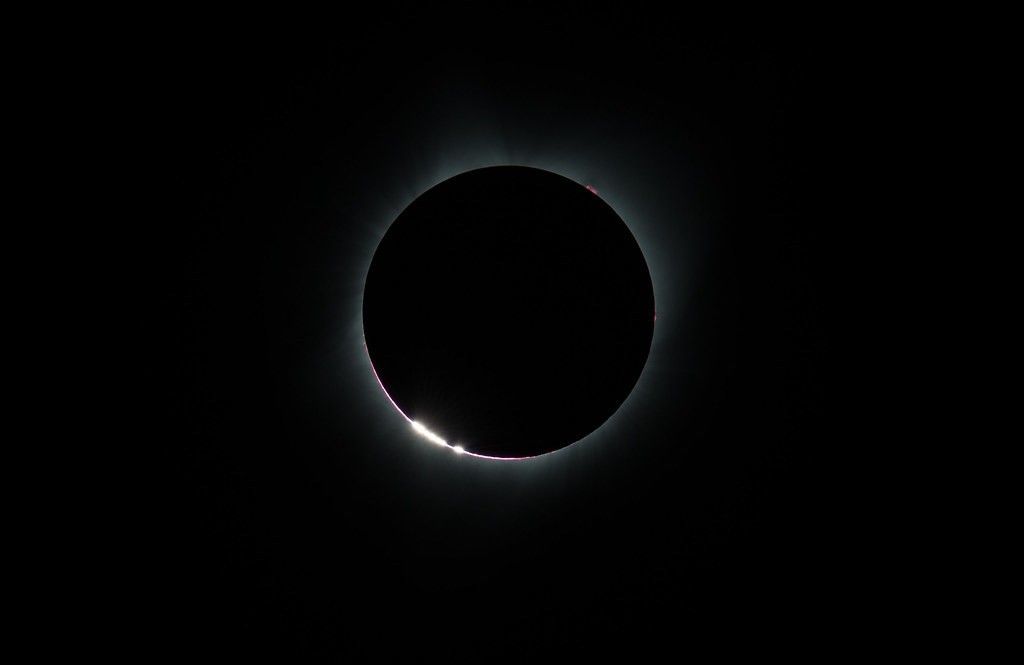
During a total solar eclipse, as the Moon moves across the Sun, the light forming the “diamond” in the “diamond ring” stage may break up into several points of light that shine around the Moon’s edge. Known as Baily’s Beads, these are light rays from the Sun streaming through low-lying valleys along the edge of the Moon. Baily’s Beads are very short-lived and may not last long enough to be noticeable to all observers of the total solar eclipse. Baily’s Beads can also be visible just after totality.
Chromosphere
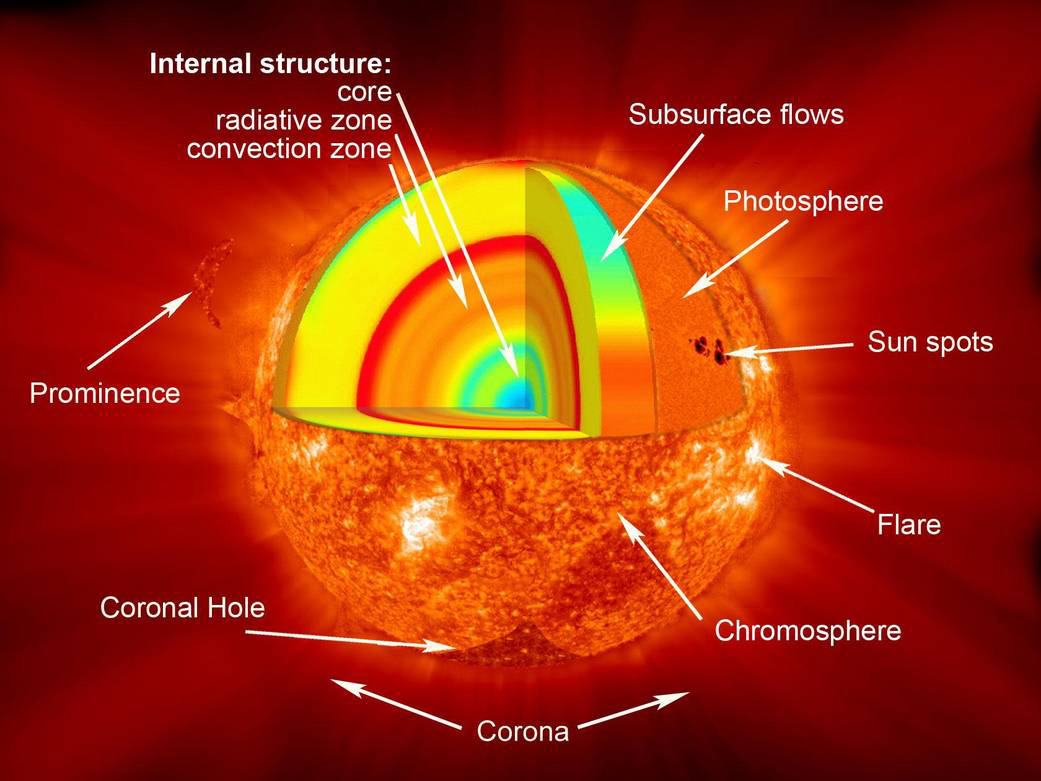
The chromosphere is a layer of the Sun that lies just above the photosphere and is about 1,050 miles thick on average. The temperature in the chromosphere rises from about 10,000 degrees Fahrenheit to about 36,000 degrees Fahrenheit, hotter than the photosphere but nowhere near as hot as the Sun’s multimillion-degree upper atmosphere, known as the corona. Named for the bright reddish color it gives off, the chromosphere is notoriously tricky to study, because it’s where the physical laws affecting the motion of solar material begin to change. In the lower chromosphere, solar material moves as a typical gas or fluid; in the upper chromosphere and above, magnetic forces dominate the motion.

Convection zone
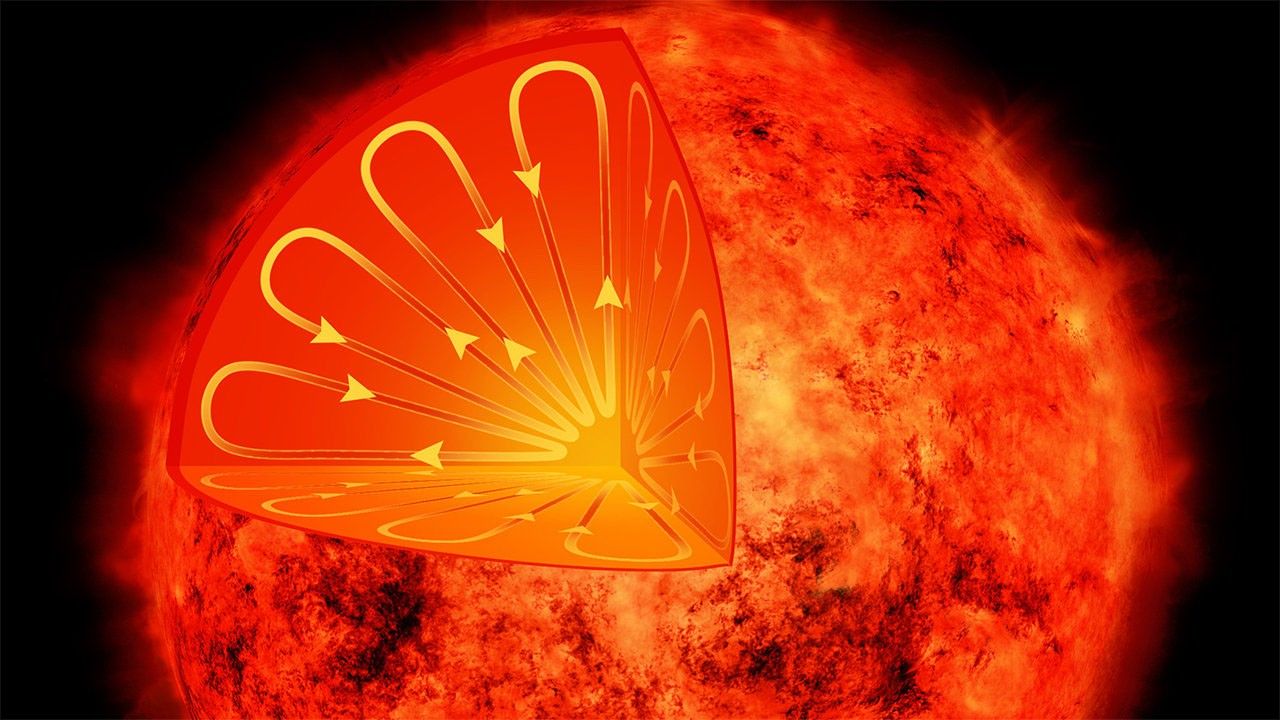
The convection zone is the outermost layer of the solar interior and makes up about two-thirds of the Sun’s volume. At the base of the convection zone, the temperature is about 3.5 million degrees Fahrenheit. The convection zone is much less dense than the radiative zone, with about the same density as the air 50 miles above Earth’s surface. The hot material there rises to the surface of the star, carrying (or convecting) heat with it. Once the material cools by giving off sunlight, it sinks down, where it picks up more heat. The convective motions themselves are visible at the Sun’s surface as features called granules and supergranules.
Core (Sun)
More than 27 million degrees Fahrenheit and 10 times denser than lead, the solar core is the very center of our Sun. Here, the intense pressure from surrounding layers compresses the center to a dense ball — about 172,000 miles across — where hydrogen atoms are squeezed together to form helium, releasing energy and light in the process. This reaction, known as nuclear fusion, has powered our Sun for over 4 billion years and will continue for an estimated 5 billion more.
Corona
The Sun’s dynamic upper atmosphere is called the corona. It is filled with plasma, whose movements are governed by the tangle of magnetic fields surrounding the Sun. Temperatures in the corona can reach millions of degrees. The corona is the source of the solar wind as well as solar flares and coronal mass ejections — the energetic solar eruptions that create the strongest space weather.
Coronal hole
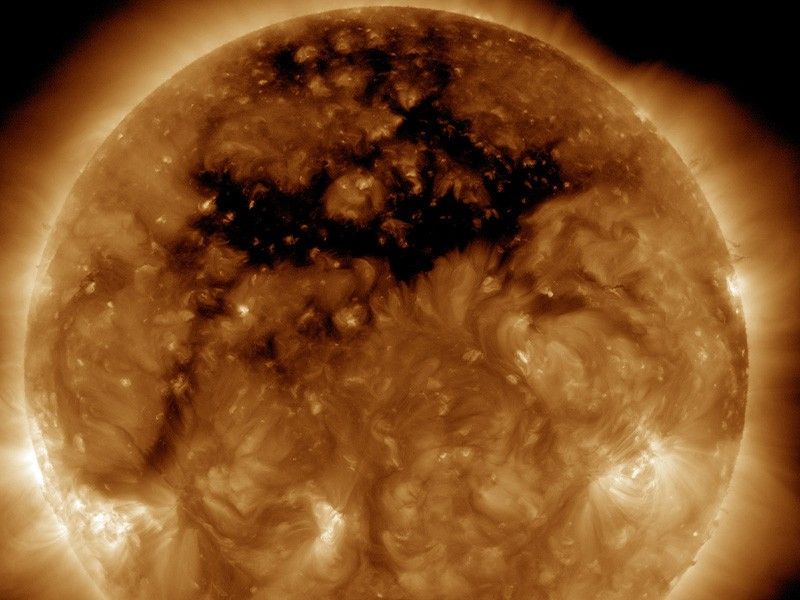
A coronal hole is a patch of the Sun’s atmosphere with much lower density than elsewhere. In ultraviolet views of the Sun, coronal holes appear as dark splotches. These are regions where the Sun’s magnetic field lines are connected directly to interplanetary space, allowing solar material to escape out in a high-speed stream of solar wind, leaving a dark “hole” near the surface of the Sun. Coronal holes appear throughout the solar cycle, but can last for much longer during solar minimums, when the Sun is less active.
Coronal (plasma) rain
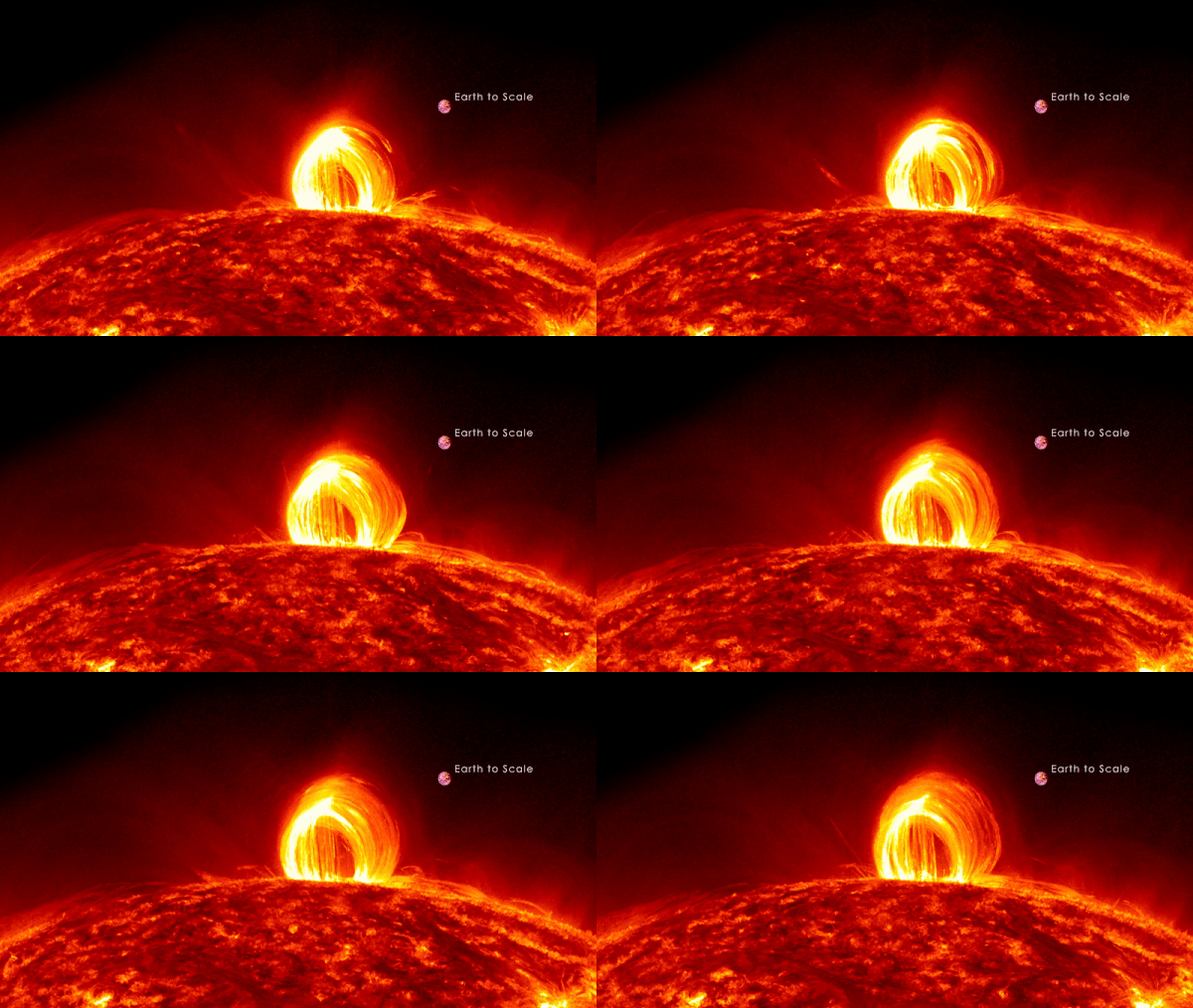
Coronal rain, also known as plasma rain, is made of giant globs of plasma that drip from the Sun’s outer atmosphere back to its surface. It occurs when particular conditions, such as magnetic field line configurations and local heating events in the corona, cause the plasma globs there to become cooler and denser than their surroundings, making them rain down.
Coronal mass ejection (CME)
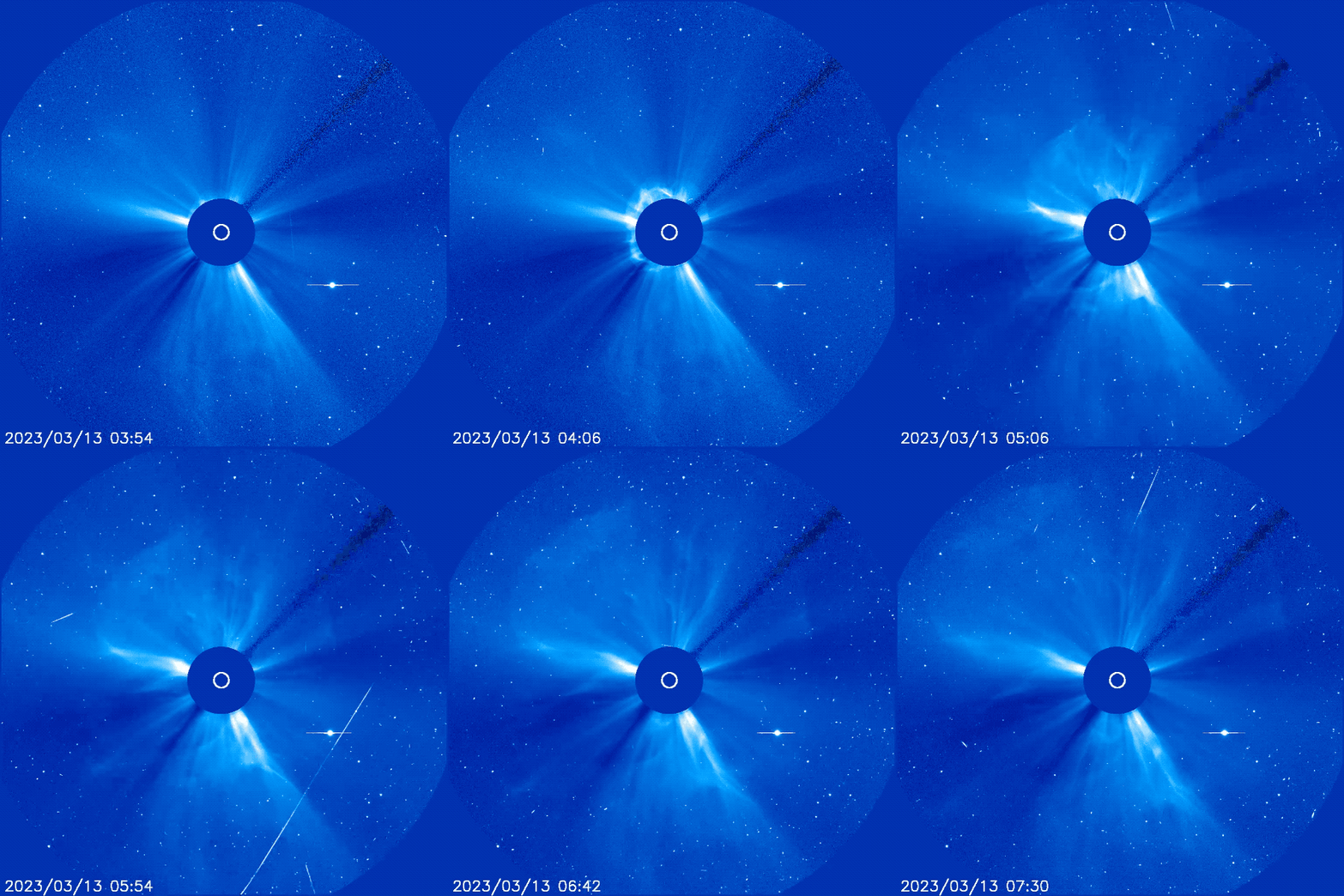
A coronal mass ejection, or CME, is a large cloud of solar plasma and embedded magnetic fields released into space after a solar eruption. A CME expands as it sweeps through space, often measuring millions of miles across, and can collide with the magnetic fields of planets. When directed at Earth, a CME can produce geomagnetic disturbances that ignite bright auroras, short-circuit satellites and power grids on Earth, or endanger astronauts in orbit.
Cosmic rays
Cosmic rays are not a form of light as their name suggests, but instead are high-energy pieces of atoms that move at nearly the speed of light. When produced in or near the Sun, they are known as solar energetic particles, but in high-energy environments across the galaxy, such as supernovae and black holes, they are called galactic cosmic rays. To understand more about high-energy environments where cosmic rays are made, scientists study these particles with special detectors in space.
On Earth, scientists commonly measure cosmic rays indirectly after they run into particles in our atmosphere. The collision of the particles and cosmic rays creates a shower of smaller particles, which are easily picked up by special detectors on the ground.

Cusp aurora
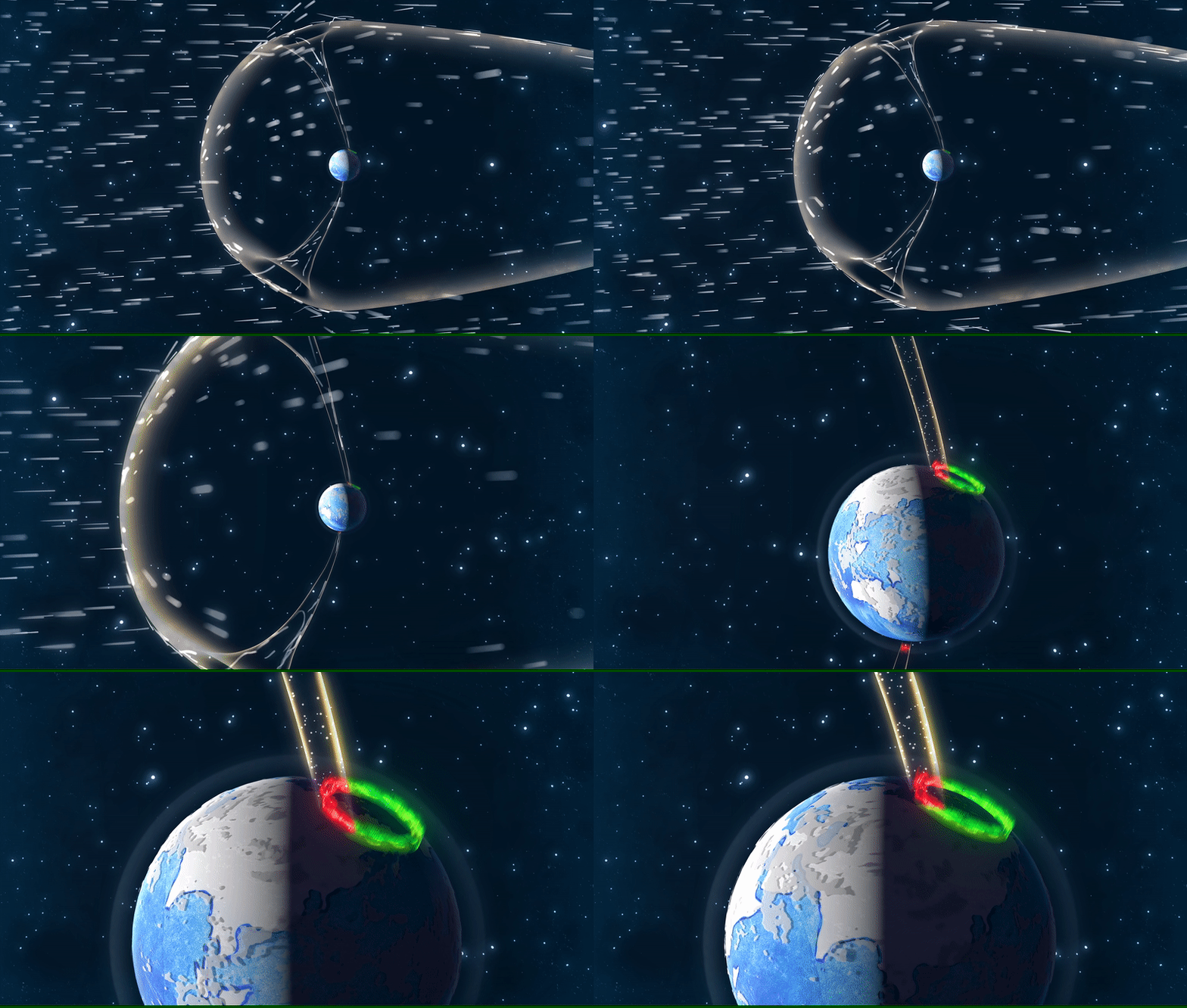
Earth’s magnetosphere has two cusps: regions in the magnetosphere where Earth’s magnetic field lines funnel solar wind directly to the upper atmosphere. A unique kind of aurora occurs at the cusp, marking where auroras can be seen during the daytime. They are unique not only for where they are found, but also how they form. Unlike other auroras, they are sparked directly by solar wind particles.
Diamond ring effect
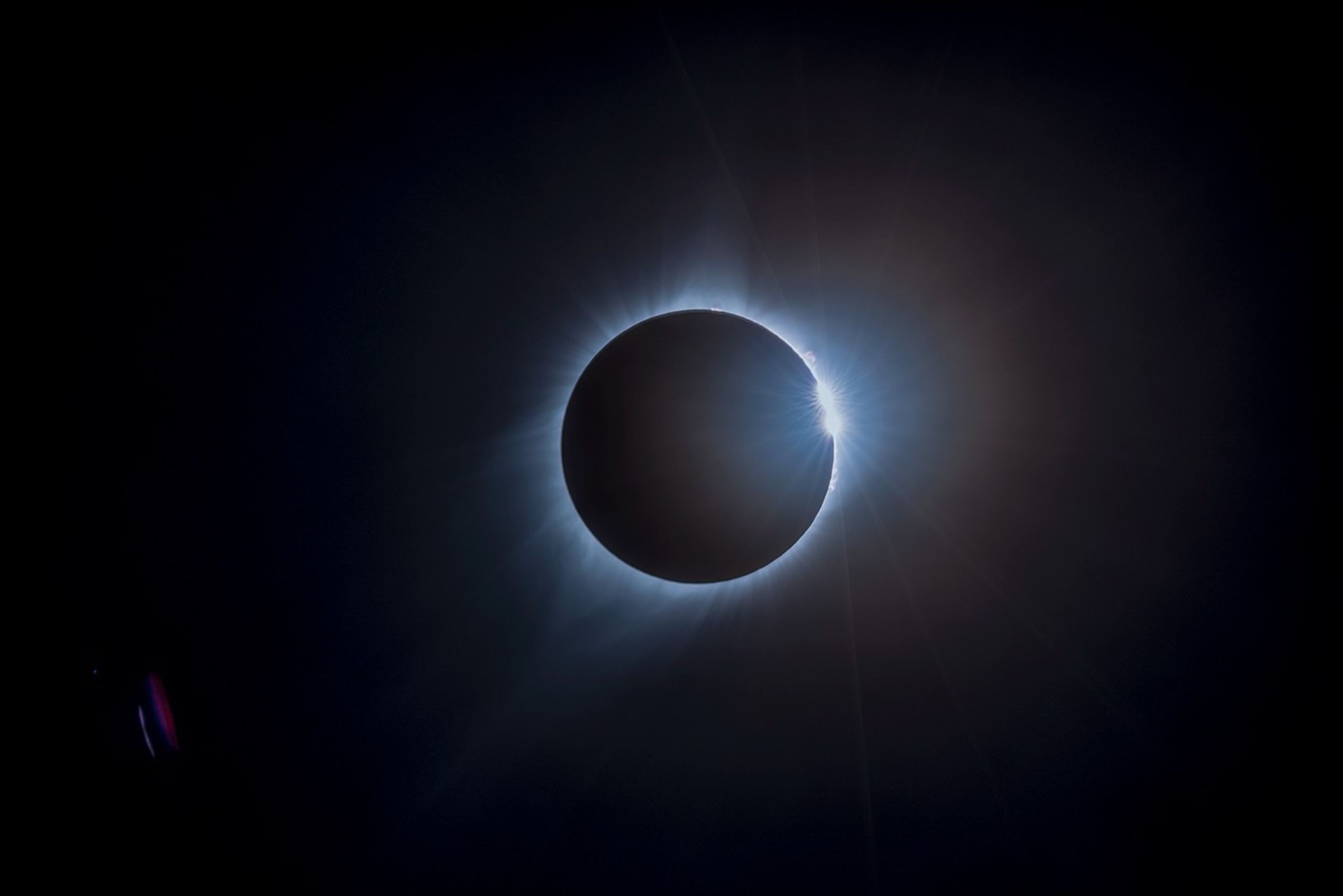
As the Moon moves in front of the Sun during a total solar eclipse, there is a moment when a single bright spot is left — a bright spot that, in combination with the atmosphere of the Sun visible around the Moon, looks like a giant diamond on a ring. This “diamond ring” effect is created by sunlight streaming through valleys on the Moon’s limb — the “diamond” — along with the Sun’s outer atmosphere, the corona, forming a “ring” around the Moon. The diamond ring effect also occurs shortly after totality.
Diffuse aurora
Diffuse auroras are dim, often motionless auroras. They can be green, whitish, or red and occur over a wide area, typically closer to the equator than discrete auroras. They might be confused for clouds.