














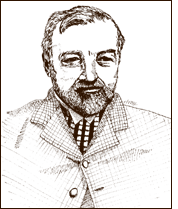
Born in the Boston suburb of Roxbury, Ma., Samuel Langley was one of America's most accomplished scientists. His work as an astronomy, physics, and aeronautics pioneer was highly regarded by the international science community. Ironically though, Langley's formal education ended at the high school level, but he managed to continue his scientific education in Boston's numerous libraries.
Langley began his career as a civil engineer in Chicago, continuing later in St. Louis, before returning to Boston to accept an assistantship at the Harvard Observatory. Heading south once again, Langley later taught mathematics at the U.S. Naval Academy in Annapolis, Md. Then, from 1867-87, he served as professor of physics and astronomy as well as director of the Allegheny Observatory at the Western University of Pennsylvania (now known as the University of Pittsburgh). After 1887, Langley was appointed Secretary of the Smithsonian Institution in Washington D.C.
The Bolometer
Langley's chief scientific interest was the sun and its effect on the weather, and believed that all life and activity on the Earth were made possible by the sun's radiation. In 1878 he invented the bolometer, a radiant-heat detector that is sensitive to differences in temperature of one hundred-thousandth of a degree Celsius (0.00001 C) . Composed of two thin strips of metal, a Wheatstone bridge, a battery, and a galvanometer (an electrical current measuring device), this instrument enabled him to study solar irradiance (light rays from the sun) far into its infrared region and to measure the intensity of solar radiation at various wavelengths.
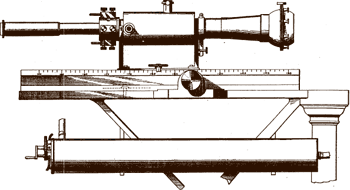
Bolometers have been flown on numerous NASA missions including the Earth's Radiation Budget Experiment (ERBE) and the Clouds and Earth's Radiant Energy System (CERES), which provided accurate regional and global measurements of the components of the Earth's radiation budget. Langley's highly original and innovative research earned him honorary doctorates, awards, and medals from universities and scientific societies around the world.
Aeronautics
In addition to his solar interests, Langley was the only professional scientist of his day who believed that man was destined to fly. While at the Allegheny Observatory, he made important experiments on the lift and drag of an aircraft moving through the air at a measured speed. Backed by these experiments, he was the first to offer a clear explanation of the way birds soar and glide without appreciable wing movement.
In 1886, he undertook a series of experiments on a rotating rig to measure the power needed to propel objects through the air. Encouraged by his findings, Langley set out to build a series of large working models of steam-powered flying machines he called "aerodromes," and, in 1896, became the first to build heavier-than-air machines capable of sustained (although uncontrolled) flight. Langley built two unmanned craft, each of which had two sets of 14-foot (4.3-meter) wings, weighed 26 pounds (11.8 kilograms), and were powered by steam engines.
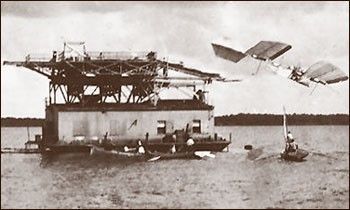
Langley's first manned aircraft, powered by a five-cylinder air-cooled gasoline engine designed by Charles M. Manly did not fair as well as his unmanned craft. Piloted by Manly, the aircraft snagged upon launching from a catapult, and crashed into the Potomac River for the second and last time on Dec. 8, 1903, just nine days before the successful flights of the Wright brothers near Kitty Hawk, N.C. This aircraft had a wingspan of 48 feet (14.6 meters) and a total weight (with pilot) of 850 pounds (386 kilograms). Some authorities believe that if his catapult had not failed, Langley would have been the first to achieve sustained flight in a manned heavier-than-air machine.
Langley's memory lives on in the names of the NASA Langley Research Center, the adjacent Air Force base, and several place names across the country. Our nation's first aircraft carrier, CV-1, built at the Norfolk Navy Yard in the early 1920's, was also named after Langley.
References
- "Langley, Samuel Pierpont," Microsoft © Encarta © Online Encyclopedia 2000
http://encarta.msn.com ©1997-2000 Microsoft Corporation. All rights reserved. - "Langley, Samuel Pierpont," Encyclopedia Britannica Online
http://www.britannica.com 1999-2000 Britannica.com Inc. All rights reserved. - Lansing, David L., 1995: "The Accomplishments of Samuel Pierpont Langley."
Abstract for Colloquium presented at the NASA Langley Research Center on June 6, 1995. (Access restricted to NASA Langley employees and contractors) - Annals of the Astrophysical Observatory of the Smithsonian Institution, Volume I
- CERES Project web site
- Langley's Feat—and Folly (from Smithsonian Magazine)
- Icarus on the Mall
NASA Earth Observatory story by Steve Graham