



















Adding iron to the diet of marine plant life has been shown in shipboardexperiments to boost the amount of carbon-absorbing phytoplankton incertain parts of the world’s oceans. A new study promises to givescientists their first global picture of the extent of these unique“iron-limited” ocean regions, an important step in understanding how theocean’s biology controls the flow of carbon between the atmosphere andthe ocean.
The new study by researchers at NASA’s Goddard Space Flight Center andthe Department of Energy’s Oak Ridge National Laboratory was presentedat the American Geophysical Union’s annual meeting in San Francisco onFriday, Dec. 15, 2000.
Oceanic phytoplankton remove nearly as much carbon from the atmosphereeach year as all land-based plants. Identifying the location and sizeof nutrient-limited areas in the open ocean has challengedoceanographers for nearly a century.
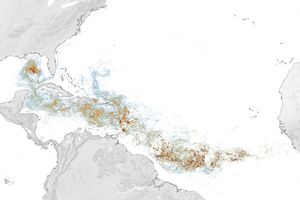
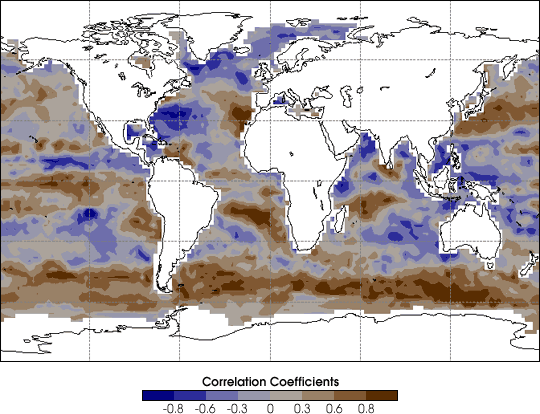
The study pinpointed iron-limited regions by seeing whichphytoplankton-rich areas of the world’s oceans were also areas thatreceived iron from wind-blown dust. In this map, areas with high levelsof chlorophyll from phytoplankton and high levels of dust deposition(high correlation coefficients) are indicated in dark brown. Dust depositionwas calculated by a 3-year modelled climatology for the years 1996–1998.The chlorophyll measurements are from 1998 observations from theSeaWiFS (Sea-viewing Wide Field-of-view Sensor) instrument on theOrbView-2 satellite.
“Global, satellite-based analyses such as this gives us insight intowhere iron deposition may be limiting ocean biological activity,” sayslead author David Erickson of Oak Ridge National Laboratory’s ComputerScience and Mathematics Division. “With this information we will beable to infer how the ocean productivity/iron deposition relationshipmight shift in response to climate change.”
References & Resources
Map Source: David Erickson, Oak Ridge National Laboratory’s Computer Science and Mathematics Division