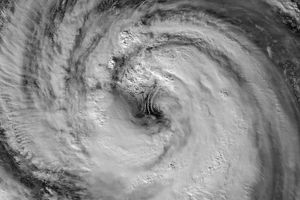





























The Tropical Rainfall Measuring Mission (TRMM) overflew the very core of Typhoon Etau in the western Pacific at 5:30 p.m. (local time) on August 7. This remarkable TRMM image is constructed in three parts: The white background shows the counterclockwise spiral of the storm’s clouds, as imaged by the Visible and Infrared Scanner (VIRS). Superimposed on top of the clouds (wide outer swath) is the rain intensity, as detected by passive microwave energy using the TRMM Microwave Radiometer (TMI). The innermost swath shows the rain intensity as measured by the TRMM Precipitation Radar. Reds indicated the heaviest rain regions, with rain rates on the order of several inches per hour. Typhoon Etau appears as a very symmetric storm—like a giant, slowly spinning pinwheel—with a well defined, nearly closed eye. In one sweep, the TRMM satellite was able to capture the detailed cloud structure, as well as the entire rainfall pattern contained within the clouds.
The Tropical Rainfall Measurement Mission is shared between NASA and the Japanese space agency NASDA. More detailed images of hurricane rain structure can be found on the TRMM website.
References & Resources
Image courtesy of Hal Pierce, NASA Goddard Space Flight Center