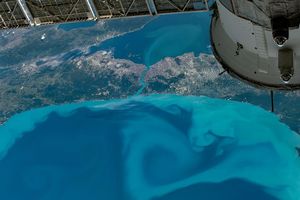





























Turquoise swirls in the cool Barents Sea north of Norway are caused by a bloom of phytoplankton, microscopic plants that turn ocean waters bright blue and green when viewed from space. The bright blue color suggests that this bloom may be caused by coccolithophores, tiny plants coated in white calcium carbonate (chalk). The white plates reflect light, and through the blue reflectance of the water, turn the water the brilliant blue seen here. This image of the bloom was acquired by the Moderate Resolution Imaging Spectroradiometer (MODIS) on NASA’s Terra satellite on August 1, 2004. The image has a resolution of 250 meters per pixel, but is available in additional resolutions.
References & Resources
NASA image courtesy Jacques Descloitres, MODIS Rapid Response Team at NASA GSFC