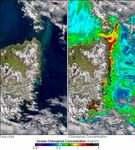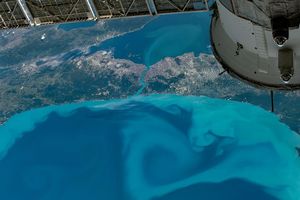



















A streak of bright color down the east coast of Tasmania marks the presence of a large algal bloom. Scientists first measured the extent of this bloom with the Moderate Resolution Imaging Spectroradiometer on NASA’s Aqua and Terra satellites. The above images were acquired by the Sea-viewing Wide Field-of-view Sensor (SeaWiFS) on the OrbView-2 satellite on October 18, 2004. The image on the right shows high concentrations of chlorophyll, red and green, along the coast, confirming the presence of the plant in the water. Ground tests have revealed that the bloom is a species of coccolithophorid, a microscopic plant that is coated in calcium carbonate scales. It is the chalky white scales that give the water the distinctive blue-green tint seen in the true-color image on the left. Light is reflected off the scales, and through the blue ocean water, the bloom looks turquoise.
The scientists monitoring this bloom say it is not harmful to the coastal ecology, but were surprised to see such a large bloom in the Tasmanian Sea, where they are not common.
References & Resources
NASA image courtesy the SeaWiFS Project, NASA/Goddard Space Flight Center, and ORBIMAGE.