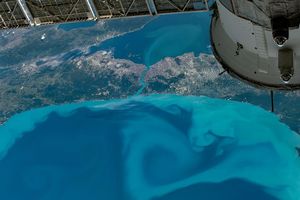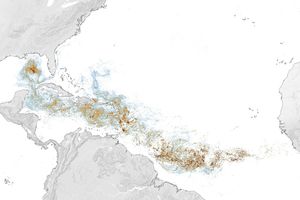















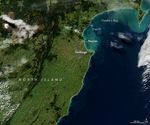

Almost like clockwork, the right conditions develop in different parts of the world and vibrant blooms of phytoplankton color the oceans. Spring and summer, for example, are common times to see blooms in places like the North Sea or off the Alaskan coast. In a bay off the coast of northwest Africa, however, conditions are almost always just right.
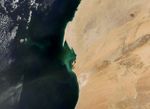
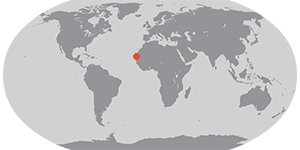
The Moderate Resolution Imaging Spectroradiometer (MODIS) on NASA’s Aqua satellite acquired this image of colorful surface waters off of Mauritania on May 5, 2020. Scrolling through satellite images of the area reveals that there is nothing particularly unique about the May 5 image; the tongue of green water is present constantly throughout the year.
The color is due to a combination of phytoplankton and sediments. Physical samples collected in recent decades off Mauritania have turned up large numbers of diatoms, a type of microscopic algae with silica shells and plenty of chlorophyll. They are one of the most common types of phytoplankton in the ocean.
Diatoms tend to thrive in waters that are rich in nutrients. They often show up after strong storms mix the ocean layers and bring up nutrients from the depths. (In contrast, a type of phytoplankton called coccolithophores can flourish in the more layered, or “stratified” waters common during summer and autumn.)
But the waters off Mauritania don’t need storms to mix. Trade winds constantly displace the surface water—blowing it west and away from the African coast—which is then replaced by cold, nutrient-rich waters from below (a process known as “upwelling”). The sediments here are especially rich with iron from Saharan dust.
While the upwelling off Mauritania is constant, it is strongest in March and October. It is part of the Canary Upwelling System, one of the main upwelling systems that occur along the eastern edges of the planet’s ocean basins. Other such systems show up off of southern Africa (Benguela), Chile and Peru (Humboldt), and the United States (California). These areas are known to be among the most biologically productive regions of the planet’s oceans.
References & Resources
- Fischer, G. et al. (2019) Changes in the Dust?Influenced Biological Carbon Pump in the Canary Current System: Implications From a Coastal and an Offshore Sediment Trap Record Off Cape Blanc, Mauritania. Global Biogeochemical Cycles 33 (8), 1100â1128.
- Fischer, G. et al. (2016) Deep ocean mass fluxes in the coastal upwelling off Mauritania from 1988 to 2012: variability on seasonal to decadal timescales. Biogeosciences, 13, 3071â3090.
- NASA Earth Observatory (2020, April 18) Beautiful Banc d'Arguin National Park.
- NASA Earth Observatory (2017, November 1) Finding Life in the Benguela Current.
- Ocean Color Image Gallery (2018, December 10) Canary Upwelling System. Accessed May 8, 2020.
- Romero, O.E. et al. (2020) Flux variability of phyto- and zooplankton communities in the Mauritanian coastal upwelling between 2003 and 2008. Biogeosciences 17, 187â214.
- Romero, O.E. et al. (2017) Shift in the species composition of the diatom community in the eutrophic Mauritanian coastal upwelling: Results from a multi-year sediment trap experiment (2003â2010). Progress in Oceanography 159, 31â44.
NASA Earth Observatory image by Lauren Dauphin, using MODIS data from NASA EOSDIS/LANCE and GIBS/Worldview. Story by Kathryn Hansen, with image interpretation by Oscar Romero and Gerhard Fischer/University of Bremen, and Violeta Sanjuan Calzado/NASA GSFC.