




























December 18, 2000-December 24, 2019
Deforestation in Argentina’s Gran Chaco
The Gran Chaco is not the most well-known forest in South America. It is second in size and biodiversity to the neighboring Amazon rainforest. Unlike the moist Amazon, the Gran Chaco is located in a semi-arid climate; its vegetation is less colorful. But like the Amazon, the Gran Chaco has been facing rapid deforestation over recent years.
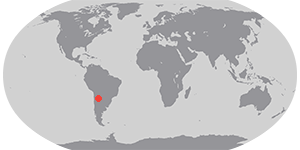
The Gran Chaco spans about 650,000 square kilometers (250,000 square miles) in Argentina, Paraguay, Bolivia, and Brazil—making it the largest dry forest in South America. It largely consists of shrubs and hardwood trees that provide habitat for thousands of plant species and hundreds of animal species. The native Wichí people have hunted and gathered on this land for decades.
But observations by Landsat satellites indicate that roughly 20 percent—142,000 square kilometers (55,000 square miles)—of the forest was converted into farmland or grazing land from 1985-2013. From 2010 to 2018, more than 29,000 square kilometers (11,000 square miles) of the Gran Chaco was cleared for farms and ranches, according to the non-profit Guyra Paraguay. Much of the clearing took place in Argentina.
The images above show deforestation over a span of two decades around the Salta Province of northern Argentina. The image from December 18, 2000, shows a mix of cleared land and greener areas. The image from December 24, 2019, shows much of the forest replaced by large fields. The images were acquired by the Moderate Resolution Imaging Spectroradiometer (MODIS) on NASA’s Terra satellite.
Much of the cleared land has been converted to farmland for growing soybeans and raising livestock. Argentina is the third-largest soybean producer in the world. Research shows that soybean production was a direct driver of deforestation in the forest in the 2000s. As soybean producers felt more pressure to keep up with global demand, they needed to find untapped land and began clearing forests and arid regions. Advances in technology made it easier to grow crops on these marginal lands, which were previously difficult to cultivate.
Controlling deforestation in Gran Chaco has been challenging. In 2007, Argentina enacted a national “forest law” mandating that local governments regulate the expansion of large-scale farming and establish practices to protect native forests. However, research shows that local governments were unable to enforce the law in certain protected zones, some of which actually experienced an increase in deforestation after the law was passed.
References & Resources
- Baumann, M. et al. (2017) Carbon emissions from agricultural expansion and intensification in the Chaco. Global Change Biology, 23, (5), 1902-1916.
- Fehlenberg, V. et al., (2017) The role of soybean production as an underlying driver of deforestation in the South American Chaco. Global Environmental Change, 45, 24â34.
- The Guardian (2018, October 26) Soy destruction in Argentina leads straight to our dinner plates. Accessed May 19, 2020.
- Guyra Paraguay Informe Deforestación. Accessed May 19, 2020.
- Mongabay (2019, September 17) Gran Chaco: South Americaâs second-largest forest at risk of collapsing. Accessed May 19, 2020.
- The New York Times (2012, March 24) Vast Tracts in Paraguay Forest Being Replaced by Ranches. Accessed May 19, 2020.
- University of Maryland Land-Cover/Land-Use Change Program Soy Expansion in the Chaco Forest, Argentina. Accessed May 19, 2020.
- Volante, J. et al., (2018) Canât See the Forest for the Trees: Can Declining Deforestation Trends in the Argentinian Chaco Region be Ascribed to Efficient Law Enforcement? 146, 408â413.
NASA Earth Observatory images by Lauren Dauphin, using MODIS data from NASA EOSDIS/LANCE and GIBS/Worldview. Story by Kasha Patel.