



























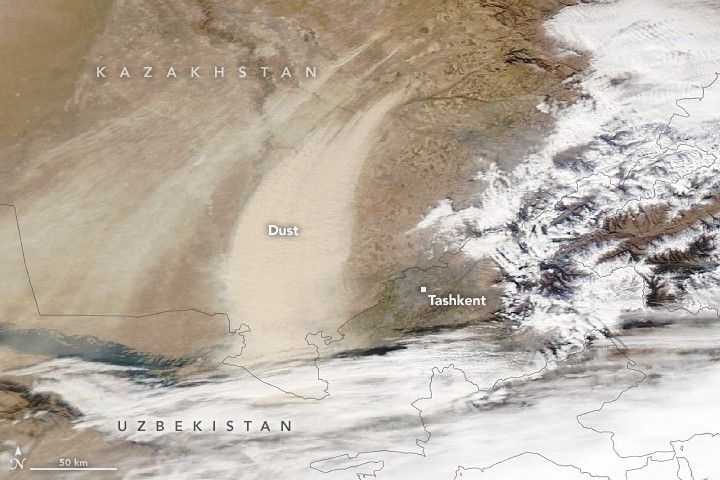
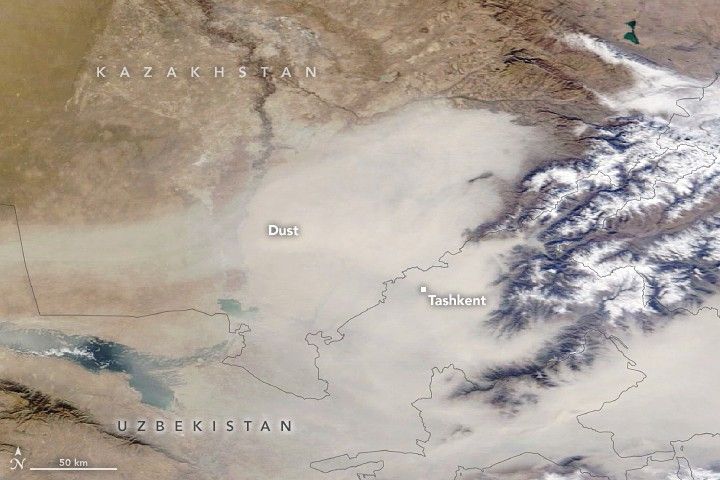
November 4-5, 2021
Dust Blankets Tashkent
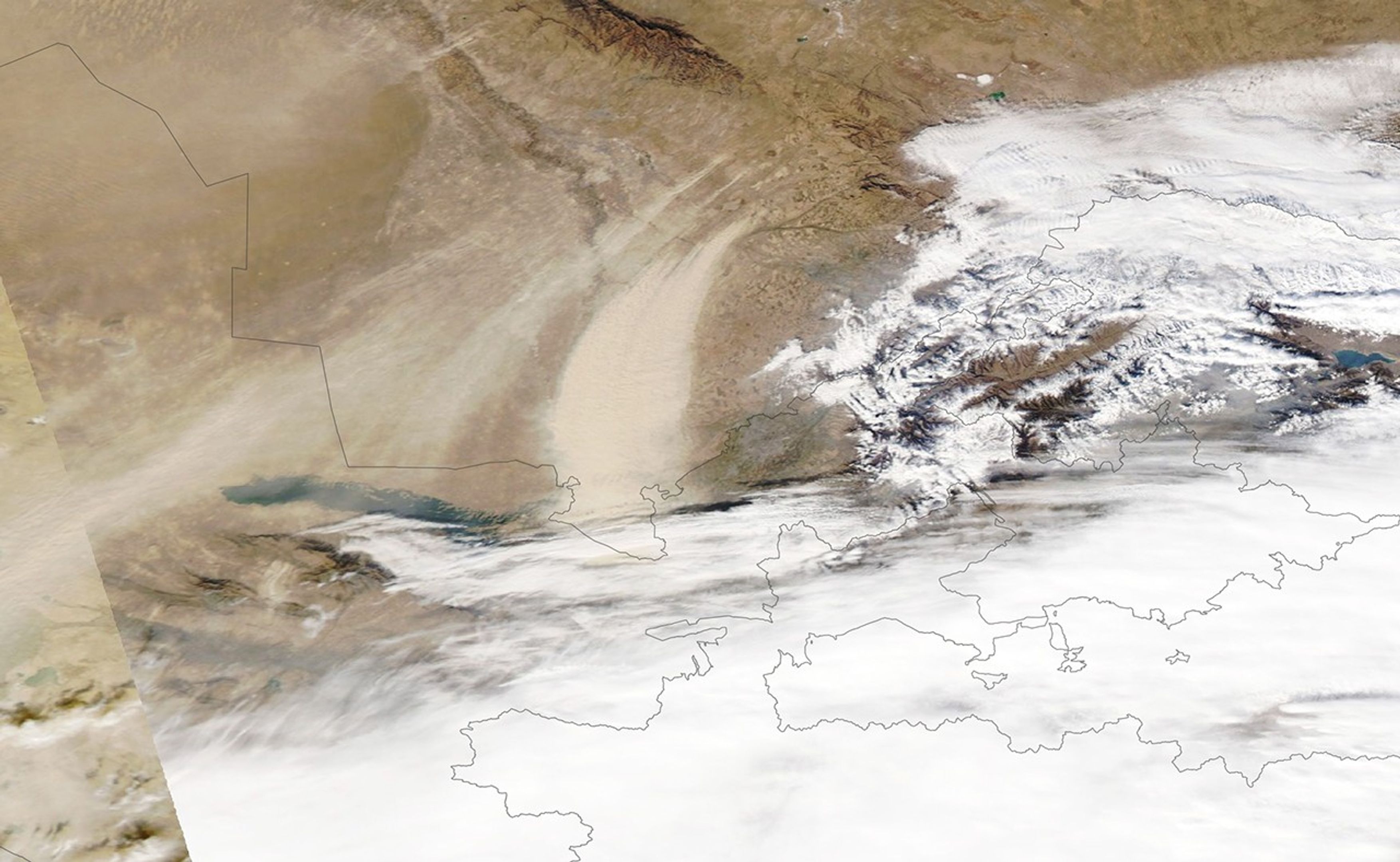
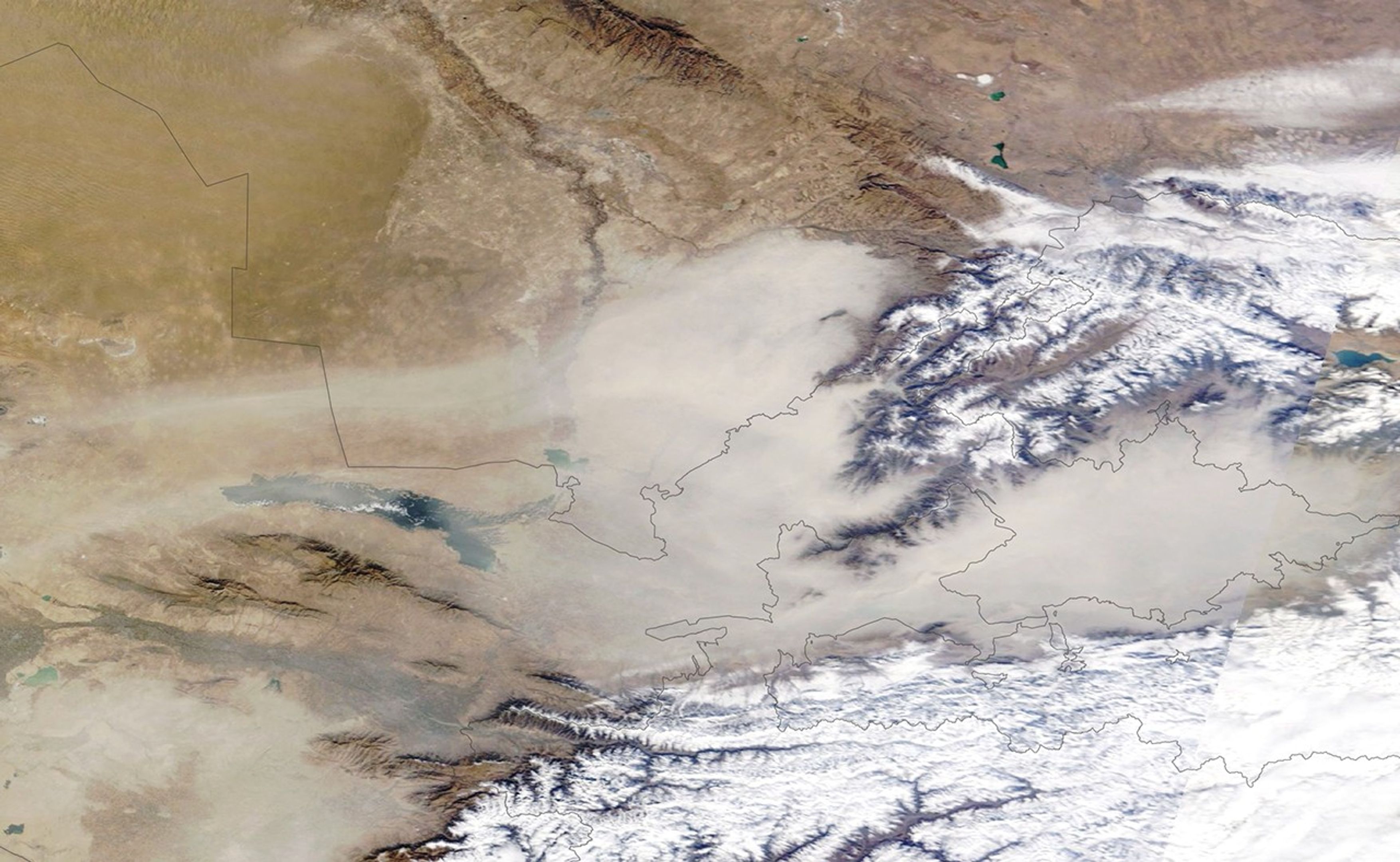
Dust storms are quite common across the dry, windy landscapes of Central Asia. Still, it is unusual for dust to darken the skies of a major city, as one recent storm did in Tashkent, Uzbekistan.
The vast dust pall was triggered by an anticyclonic storm that brought winds as strong as 70-90 kilometers (45-55 miles) per hour to Uzbekistan’s capital. At times, the air in Tashkent grew so thick with dust that visibility dropped to 200 meters. According to Uzbekistan’s weather agency (Uzhydromet), levels of coarse particulate matter (PM10) rose to 18,000 micrograms per cubic meter. At times, the concentration of dust in the air was 30 times what Uzbekistan considers acceptable. Across 150 years of monitoring, such extreme dust conditions have never been observed in Tashkent before, according to Uzhydromet.
The Moderate Resolution Imaging Spectroradiometer (MODIS) on NASA’s Terra satellite captured an image (left) of thick plumes of dust approaching Tashkent on November 4, 2021. Some of the dust appeared to come from parched farmland, pastures, and grasslands to the northeast in the Turkistan region of Kazakhstan. By the next day (right image), the plumes had spread out and a thick haze blanketed much of the region, including several mountain valleys to the east. A layer of unusually cold air near the surface topped by a layer of warmer air—a temperature inversion—concentrated the dust near the surface and contributed to the air quality problems.
“If the measurements are correct, those are truly extreme and extremely hazardous levels of particulate matter for an urban area,” said Thomas Gill, an atmospheric scientist at the University of Texas at El Paso. “The U.S. EPA’s 24-hour average limit is, for example, 150 micrograms per cubic meter for PM10. The highest hourly concentrations I have ever seen recorded in El Paso, Texas—arguably the dustiest city in the U.S.—are about 5000 micrograms per cubic meter for PM10. So these levels in Uzbekistan are about four times worse than I’ve ever seen in El Paso. These may be amongst the largest PM10 values ever measured for ambient air in an urban area.”
Several months of drought primed the region for the extreme dust event. News media have reported record-breaking temperatures and stressed and dying livestock since the beginning of summer. NASA’s Gravity Recovery and Climate Experiment Follow-on GRACE-FO mission observed unusually dry soil moisture conditions in southern Kazakhstan as recently as early November.
References & Resources
- Eurasianet (2021, November 5) Severe dust storm engulfs Uzbekistan. Accessed November 10, 2021.
- Issanova, G. & Abuduwaili, J. (2017) Dust Storms in Central Asia and Kazakhstan: Regional Division, Frequency and Seasonal Distribution. (Singapore: Springer).
- GDACS (2021) Overall Orange alert Drought for Urals â Kazakhstan-2021. Accessed November 10, 2021.
- Reliefweb (2021, October 31) GDO Analytical Report: Drought in southern Urals and Turan Depression â October 2021. Accessed November 10, 2021.
- Reliefweb (2021) Kazakhstan: Drought. Accessed November 10, 2021.
- UNEP (2016) Global Assessment of Sand and Dust Storms. Accessed November 10, 2021.
- The Watchers (2021, November 9) The worst dust storm in Uzbekistanâs recorded history. Accessed November 10, 2021.
- Uzhydromet (2021, November 6) Information on non-seasonal phenomena of dusty haze due to strong winds. Accessed November 10, 2021.
- World Health Organization WHO Air Quality Guidelines. Accessed November 10, 2021.
- Zhang, X. et al. (2020, October 1) Aeolian dust in Central Asia: Spatial distribution and temporal variability. Atmospheric Environment, 238, 117734.
NASA Earth Observatory images by Lauren Dauphin, using MODIS data from NASA EOSDIS LANCE and GIBS/Worldview . Story by Adam Voiland .