
























As it has in most recent summers, Lake Okeechobee has been teeming with blue-green algae in 2022. Fueled by warm summer temperatures and abundant nutrients in Florida’s largest freshwater lake, the algae have been blooming since May but significantly increased in abundance through June.
As of July 14, 2022, the Florida Department of Environmental Protection (DEP) reported that 45 percent of the lake was covered with algae or had conditions very conducive to it. The coverage is comparable to levels in July 2021 and 2020, but not as extreme as in 2018, when cyanobacteria blooms covered about 90 percent of the lake.
Though popularly called blue-green algae, the formal name for the floating, plant-like organisms is cyanobacteria. These single-celled organisms are among the oldest life forms on Earth, and they rely on photosynthesis to turn sunlight into food. Blue-green algae grow swiftly when nutrients like phosphorus and nitrogen are abundant in still water. They produce a toxin known as microcystin that can sicken people and animals, contaminate drinking water, and force closures of boating and swimming sites.
The map above shows estimates of cyanobacteria concentrations on July 13, 2022, as reported by the Cyanobacteria Assessment Network. The CyAN project includes contributions from NASA, the Environmental Protection Agency, the U.S. Geological Survey, and the National Oceanic and Atmospheric Administration. Instruments on the NASA/USGS Landsat satellites, the European Space Agencyâs Sentinel-2 and 3 satellites, as well as several others, can detect some of the spectral signatures of algae, particularly through the fluorescent light the organisms emit in response to sunlight. Compiling and analyzing satellite images of different resolutions and wavelengths, NASA scientists produce weekly reports on the color and other properties of water across Lake Okeechobee and other water bodies in the United States.
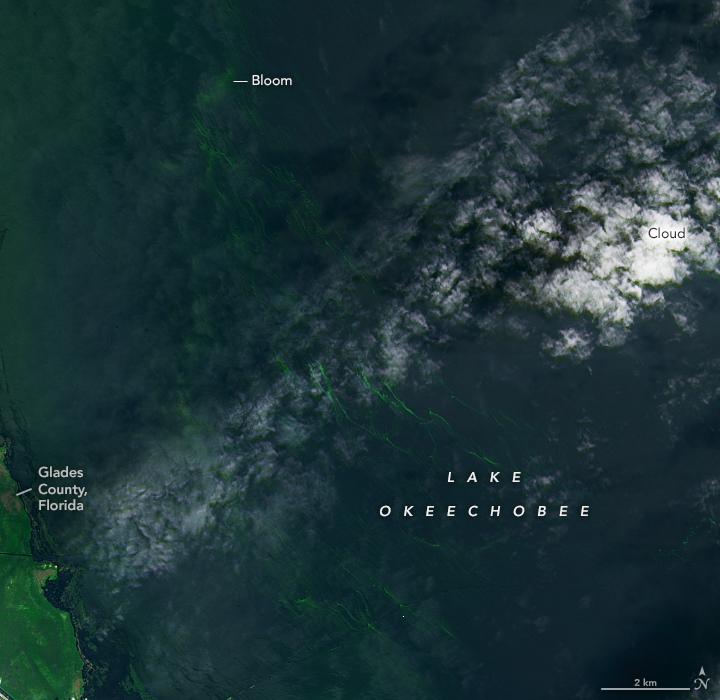
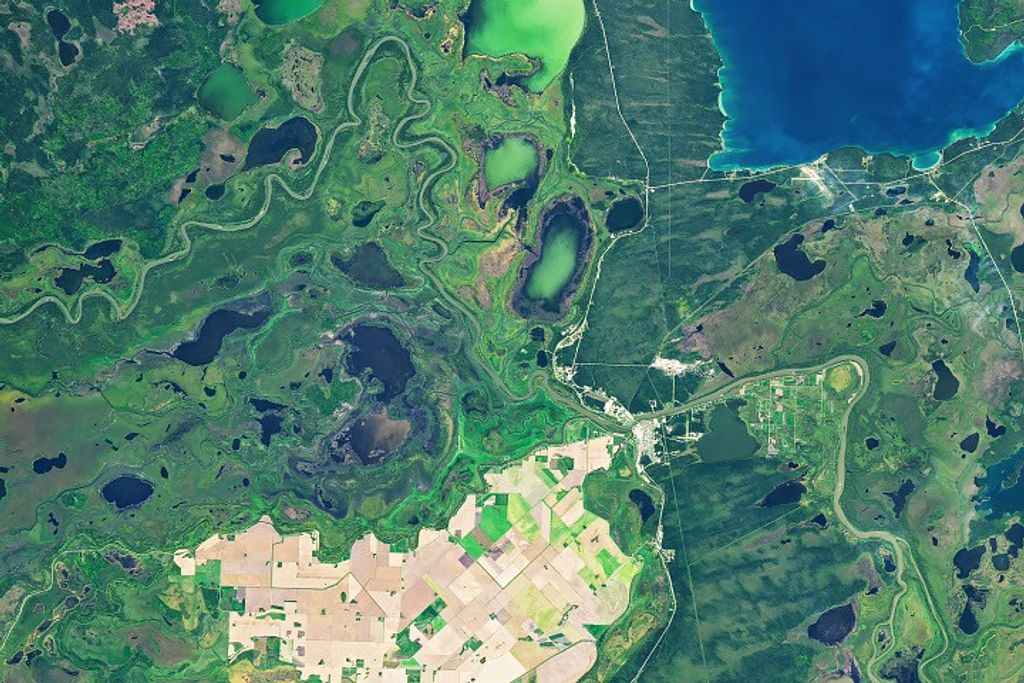
The image above shows green streaks of cyanobacteria and a few clouds along the western shore of Lake Okeechobee, as observed in natural-color by the Operational Land Imager (OLI) on Landsat 8 on July 3, 2022. The NOAA National Centers for Coastal Ocean Science have been tracking the bloom across the summer.
The Florida DEP warned citizens in July 2022: “Different types of blue-green algal bloom species can look different and have different impacts. However, regardless of species, many types of blue-green algae can produce toxins that can make you or your pets sick if swallowed or possibly cause skin and/or eye irritation due to contact. We advise staying out of water where algae is visibly present as specks or mats or where water is discolored pea-green, blue-green or brownish-red.”
In a 2019 study based on Landsat data, environmental scientists examined 71 large lakes on six continents. They found that the intensity of phytoplankton blooms rose considerably in 48 out of the 71 lakes (68 percent). Most of the increases occurred in the 21st century.
References & Resources
- Florida Department of Environmental Protection (2022, July 7) Algal Bloom Weekly Update. Accessed July 14, 2022.
- Florida Health - Palm Beach County (2022, July 12) Health Officials Issue Blue-Green Algae Bloom Alert of Lake Okeechobee Locations. Accessed July 14, 2022.
- Florida Sea Grant (2022) Harmful Algal Blooms in Florida. Accessed July 14, 2022.
- FOX4 News (2022, July 1) Lake Okeechobee sees 240 square miles of blue-green algae. Accessed July 14, 2022.
- NASA Earth Observatory (2020, August 4) Early Detection of Algae Yields Savings.
- NASA Earth Observatory (2020, June 11) The Blooming Blues.
- NASA Earth Observatory (2019, June 22) NASA Helps Warn of Harmful Algae in Lakes and Reservoirs.
- NASA Earth Observatory (2018, July 18) Summer Blooms in North American Lakes.
- NASA Earth Observatory (2016, July 6) Bloom in Lake Okeechobee.
- National Centers for Coastal Ocean Science (2022, July 13) Cyanobacteria Algal Bloom from Satellite in Lake Okeechobee, FL. Accessed July 14, 2022.
- University of Florida (2018, August 2) An algae problem. Accessed July 14, 2022.
- WPTV (2022, July 1) Algae âmore than 20 times too toxic for human contactâ prompts new concerns. Accessed July 14, 2022.
NASA Earth Observatory images by Lauren Dauphin, using Landsat data from the U.S. Geological Survey and cyanobacteria data from the Cyanobacteria Assessment Network (CyAN). Story by Michael Carlowicz .