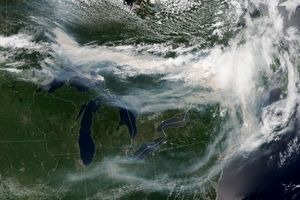





















In July 2023, a combination of unusual heat, dry lightning, and drought fueled major outbreaks of fire in Canada. According to the Canadian Interagency Forest Fire Center (CIFFC), nearly 600 out-of-control fires burned throughout the country on July 13, with about half of these raging in British Columbia or Alberta.
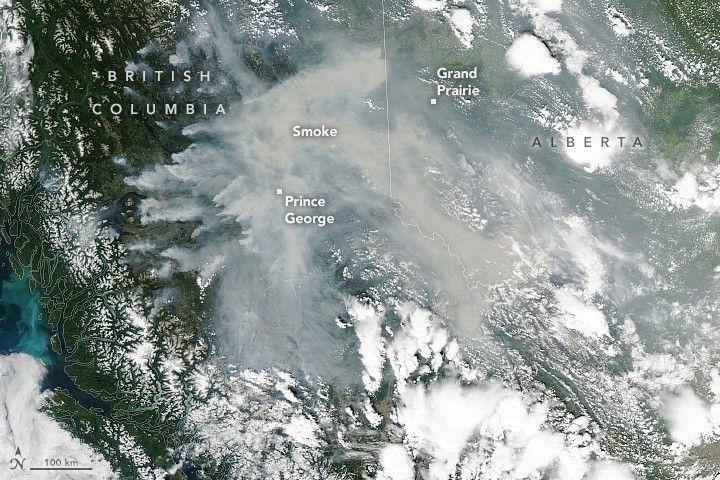
The Moderate Resolution Imaging Spectroradiometer (MODIS) on NASA’s Aqua satellite captured the image above on July 12, 2023. Dense plumes of smoke billowing from several of the largest fires streamed east, prompting Environment Canada to issue air quality warnings for several communities in British Columbia, Alberta, and the Northwest Territories.
Several blazes in British Columbia have produced smoke-infused storm clouds known as pyrocumulonimbus (pyroCb) in recent weeks, though the features are not apparent in this image. Scientists track these towering, heat-generated storms closely because they loft smoke high in the atmosphere where fast-moving upper-level winds spread the smoke widely.
“We observed 14 pyroCbs with satellites on July 9-10 alone—several in British Columbia and some in Quebec,” said David Peterson, an atmospheric scientist with the U.S. Naval Research Laboratory. “This surge in activity has made 2023 the most active year for pyroCbs both in Canada and worldwide since we began tracking their numbers closely about a decade ago.” As of July 13, with about six weeks left in the Canadian fire season, Peterson and colleagues had observed 90 pyroCbs in Canada and 104 worldwide in 2023. The previous records, both set in 2021, were 50 for Canada and 100 worldwide.
That is not the only remarkable aspect of the fires in Canada. More than 1.2 million hectares (3 million acres) had burned in British Columbia as of July 12 , 2023, roughly 30 times the average for that point in the year.
The large amount of burned area in British Columbia contributed to record-breaking burned area totals at a national scale. Across Canada, fires had charred 9.4 million hectares as of July 12, an area about the size of the state of Indiana. That is well ahead of the 7.1 million hectares burned in 1995, the second-highest year on the CIFFC record. A major outbreak of fire in eastern Canada in June also contributed to the high numbers.
This story was updated on July 22, 2024, to reflect the correct year that 7.1 million hectares burned in Canada.
References & Resources
- Associated Press (2023, July 6) Wildfires in Canada have broken records for area burned, evacuations and cost, official says. Accessed July 13, 2023.
- Canadian Interagency Forest Fire Center (2023, July 12) National Fire Situation Report.Accessed July 13, 2023.
- NASA Earth Data (2023) Air Quality Data Pathfinder (FIRMS). Accessed July 13, 2023.
- NASA Earth Data (2023) Fire Information for Resource Management System (FIRMS). Accessed July 13, 2023.
- NASA Earth Observatory (2022) Lightning is Sparking More Boreal Forest Fires in Far North America. Accessed July 13, 2023.
- North American Drought Monitor Canada. Accessed July 13, 2023.
- Peterson, D. via Twitter (2023) Expert on wildfire-generated thunderstorms (pyrocumulonimbus). Accessed July 13, 2023.
- Province of British Columbia (2023) Current Wildfire Situation. Accessed July 13, 2023.
- Reuters (2023, June 27) Canadian wildfire emissions hit record high as smoke reaches Europe. Accessed July 13, 2023.
- Vancouver Sun (2023, July 10) B.C. announces total campfire ban after huge surge in wildfires, worsening drought. Accessed July 13, 2023.
- Vancouver Sun (2023, July 5) More hot and dry weather, lightning strikes concern B.C. wildfire officials. Accessed July 13, 2023.
- The Washington Post (2023, July 10) Canada sees its farthest-north 100-degree temperature as wildfires rage. Accessed July 13, 2023.
NASA Earth Observatory image by Lauren Dauphin, using MODIS data from NASA EOSDIS LANCE and GIBS/Worldview . Story by Adam Voiland .